Yes, crypto is illegal in a small number of countries, and legal (though not legal tender) in most. As of 14 October 2026, the countries with the strictest bans include mainland China (all crypto business activity is illegal under a 2021 central bank notice, reaffirmed by eight agencies on 6 February 2026), Algeria (Law No. 25-10 of 24 July 2025 criminalises owning, trading and mining crypto), Nepal and Morocco. The Library of Congress counted 9 countries with an absolute ban and 42 with an implicit ban in its November 2021 survey; several of those have since legalised and licensed crypto, including Bolivia (June 2024), Turkey (July 2024), Pakistan (2025) and Vietnam (pilot market from September 2025). The Atlantic Council’s tracker (updated September 2026) counts 45 of 75 countries as legal, 20 with a partial ban and 10 with a general ban. The tables below give each country’s status, what the rule covers, the key law, the date checked and the source, and mark which rows were independently re-verified for this update.
“Is crypto illegal?” has a different answer depending on where you stand, and most lists that try to answer it for the whole world are undated, unsourced or a few years stale. Some still call Bolivia and Turkey “banned” years after both changed their laws, and some repeat a 2025 social media claim that China banned personal ownership, which was never backed by any official act. This guide starts from the most complete government survey of crypto bans, the Law Library of Congress report, then re-checks the banned and restricted countries against newer laws and regulator notices, with every row dated as of 14 October 2026.
Is crypto illegal anywhere?
Yes. A handful of countries ban crypto outright, a larger group restricts it (usually by barring banks from touching it or banning its use as payment), and most of the world allows it, with or without a licensing regime. In no country checked for this article is crypto illegal simply because it is not legal tender: “not legal tender” means no one has to accept it as money, not that owning it is a crime.
Two datasets give the big picture:
- Law Library of Congress, Regulation of Cryptocurrency Around the World: November 2021 Update. Its table covers about 140 jurisdictions. It found 9 jurisdictions with an absolute ban (Algeria, Bangladesh, China, Egypt, Iraq, Morocco, Nepal, Qatar, Tunisia), 42 with an implicit ban, and 103 applying tax or anti-money laundering (AML) laws to crypto. The report says its findings reflect research as of November 2021 and have not been updated.
- Atlantic Council, Cryptocurrency Regulation Tracker. It covers 75 countries, including the G20, and was last updated in September 2026. It counts 45 countries as legal (all activities permitted), 20 with a partial ban (one or more activities not permitted) and 10 with a general ban (all activity limited).
The numbers differ because the two use different country samples and definitions. Neither covers all of the world’s roughly 195 countries one by one, and no public dataset checked for this article does.
How this table was built (and what “every country” means here)
To be precise about what this page does and does not cover:
- Base dataset: every jurisdiction the Library of Congress flagged in November 2021 as having an absolute or implicit ban, with the law or notice it cited.
- Re-verification: the outright-ban countries and every country with a known change since 2021 were re-checked against newer laws, regulator notices and dated reporting. Rows marked Re-verified were checked against a 2024 to 2026 source on 14 October 2026. Rows marked Dataset only repeat the November 2021 finding and were not independently re-checked.
- Additions: Afghanistan, which is not in the 2021 dataset, plus the main legal-and-regulated markets readers ask about.
- Everything else: a country not named in these tables was not flagged as banning or restricting crypto in the 2021 survey. That usually means crypto is legal there, either regulated or unregulated, but check the current national rule before relying on it.
Status labels used: Banned (holding, trading or dealing in crypto is prohibited for everyone), Restricted (specific activities are prohibited, usually banks dealing in crypto or crypto used as payment, while individuals are not explicitly barred), Legal, regulated (a licensing regime for crypto firms exists), Legal, unregulated (legal, taxed or covered by AML rules, but with no dedicated licensing law), and Unclear.
Countries where crypto is banned outright
| Country | Status (14 Oct 2026) | What is covered | Key law or notice | Date checked | Source |
|---|---|---|---|---|---|
| China (mainland) | Banned | Trading, exchange services, issuance and all “virtual currency-related business activities”; RMB-pegged stablecoins issued abroad and domestic RWA tokenisation added in 2026 | PBoC Circular on Further Preventing and Disposing of Speculative Risks in Virtual Currency Trading (15 Sept 2021); joint notice of eight agencies (6 Feb 2026) | 14 Oct 2026 | LoC 2021; CoinGeek, 13 Feb 2026. Re-verified |
| Algeria | Banned (criminal) | Owning, issuing, trading, mining and promoting crypto | Law No. 25-10 (24 July 2025), strengthening Finance Law 11-17, art. 117 (27 Dec 2017) | 14 Oct 2026 | LoC 2021; ICIJ, 17 Nov 2025. Re-verified |
| Nepal | Banned | All transactions, trading and mining, per Nepal Rastra Bank | Nepal Rastra Bank notices (including 9 Sept 2021) | 14 Oct 2026 | LoC 2021; NRB Financial Information Unit report via Clickmandu, 1 Jan 2026. Re-verified |
| Morocco | Banned (reform bill pending) | Transactions in virtual currencies treated as exchange-control violations | Office des Changes notice (20 Nov 2017); draft Bill 42.25 published Nov 2025, not shown as adopted in any source checked | 14 Oct 2026 | LoC 2021; Cryptopolitan, 5 May 2026. Re-verified |
| Egypt | Banned | Individuals, banks and financial institutions dealing in crypto | Central Bank of Egypt warning (10 Jan 2018); Law No. 194 of 2020, art. 206 | Dataset Nov 2021 | LoC 2021. Dataset only |
| Bangladesh | Banned | Crypto transactions, treated as possible money laundering offences | Bangladesh Bank cautionary notice (24 Dec 2017); 2021 clarification “Cryptocurrency Trading Not Allowed at All” | Dataset Nov 2021 | LoC 2021. Dataset only |
| Iraq | Banned | Dealing in crypto, with AML penalties | Central Bank of Iraq statement (3 Dec 2017) | Dataset Nov 2021 | LoC 2021. Dataset only |
| Qatar | Banned (banking) | All banks barred from dealing in crypto, with penalties | Qatar Central Bank Circular No. 6/2018 (2 Feb 2018) | Dataset Nov 2021 | LoC 2021. Dataset only |
| Tunisia | Banned (as payment) | Central bank does not recognise or deal in crypto as payment | Central Bank of Tunisia press release (undated in LoC) | Dataset Nov 2021 | LoC 2021. Dataset only |
| Afghanistan | Reported ban | Reported ban on crypto trading by the Taliban authorities, August 2022 | No official text located | Not verified | Not in LoC 2021. Unclear |
LoC 2021 = Law Library of Congress, Regulation of Cryptocurrency Around the World: November 2021 Update. “Dataset only” rows repeat that report’s finding and were not re-checked against a newer source for this update.
Algeria is now the clearest example of a full criminal ban. According to ICIJ’s global crypto regulation explainer (17 November 2025), Law No. 25-10 of 24 July 2025 criminalises owning, issuing, trading, mining and promoting crypto, with up to one year in prison and fines of 200,000 to 1,000,000 dinars, and harsher penalties where money laundering or terrorist financing is involved.
Nepal’s ban is being enforced, not just declared. The Nepal Rastra Bank’s Financial Information Unit recorded 658 crypto-related suspicious transaction reports between 2021 and mid-July 2025, about 91% of them filed by commercial banks, as reported on 1 January 2026.
Morocco is moving the other way. Its ban dates from late 2017, but the Ministry of Economy and Finance published draft Bill 42.25 in November 2025 to license crypto service providers, and the central bank governor has called the total ban ineffective. As of the latest source checked (5 May 2026), the bill was still a draft, so the ban still applies.
Is crypto banned in China?
Yes, in mainland China. The People’s Bank of China’s circular of 15 September 2021 declared virtual currency business activities illegal financial activities, and on 6 February 2026 eight authorities, led by the PBoC and including the China Securities Regulatory Commission and the State Administration of Foreign Exchange, issued a joint notice reaffirming that ban. According to CoinGeek’s report on the notice (13 February 2026), it also bans issuing renminbi-pegged stablecoins overseas and says domestic real-world asset (RWA) tokenisation should be prohibited.
What China has not done, on the evidence checked, is ban personal ownership. Posts in May 2025 claimed a new nationwide ban on owning bitcoin. Forbes traced those claims to a user post on Binance Square and found no official statement from any relevant Chinese authority (4 June 2025). The 2026 notice, as reported, does not address personal holding either. Several pages ranking for this topic still repeat the May 2025 claim as fact.
Hong Kong is a separate legal system with its own licensing regime for crypto trading platforms; see the Hong Kong VATP guide.
Countries that lifted or loosened a ban since 2021
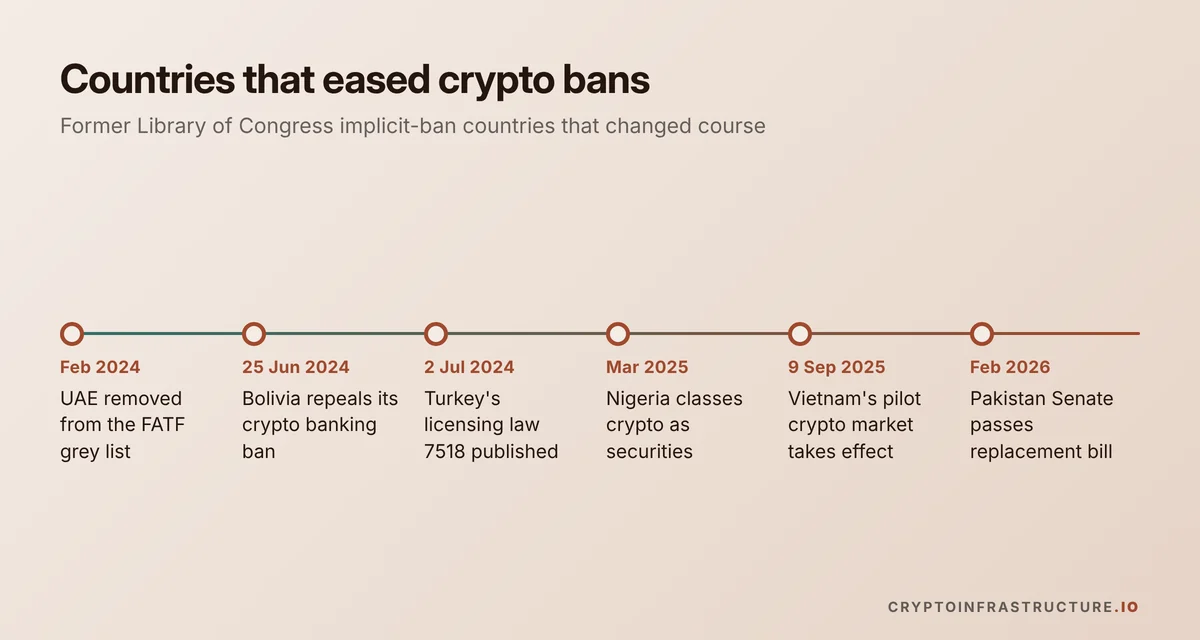
This is where most country lists go wrong. Each of these appeared in the Library of Congress’s 2021 ban counts, and each has changed.
| Country | 2021 dataset | Status (14 Oct 2026) | What changed | Key law | Source |
|---|---|---|---|---|---|
| Bolivia | Implicit ban | Legal, unregulated (not legal tender) | Central bank allowed electronic payment channels to be used to buy and sell crypto; banking ban repealed | BCB Resolution 082/2024 (25 June 2024), repealing Resolution 144/2020 | Erbol, 26 June 2024. Re-verified |
| Turkey | Implicit ban | Legal, regulated | Crypto asset service providers must be licensed by the Capital Markets Board; unlicensed foreign platforms targeting Turkish residents had to stop by 2 Oct 2024; operating without a licence carries 3 to 5 years’ imprisonment | Law No. 7518 (Official Gazette 32590, 2 July 2024) | Legal500 (Gün + Partners), 29 Oct 2024. Re-verified |
| Vietnam | Implicit ban | Restricted, pilot licensing | Five-year pilot crypto asset market; at most 5 exchanges to be licensed; minimum capital VND10 trillion | Government Resolution 05/2025/NQ-CP (effective 9 Sept 2025) | State Securities Commission notice; VnEconomy, 6 Oct 2025. Re-verified |
| Pakistan | Implicit ban | Legal, regulated (framework being set up) | Pakistan Virtual Assets Regulatory Authority (PVARA) created to license virtual asset service providers | Virtual Assets Ordinance 2025; Senate passed a replacement bill (reported 28 Feb 2026) | National Assembly of Pakistan, Ordinance No. VII of 2025; Dawn, 28 Feb 2026. Re-verified (partly) |
| Nigeria | Implicit ban | Legal, regulated | Bank restrictions eased in late 2023; crypto classified as securities under the SEC | Investments and Securities Act (March 2025) | ICIJ, 17 Nov 2025. Re-verified |
| United Arab Emirates | Implicit ban | Legal, regulated | Licensing by the Securities and Commodities Authority, Central Bank, Dubai’s VARA and Abu Dhabi’s FSRA; removed from the FATF grey list in February 2024 | Federal and emirate virtual asset rules | ICIJ, 17 Nov 2025. Re-verified |
All rows checked 14 October 2026 against the dated sources shown. Pakistan: reports from March 2026 describe a Virtual Assets Act 2026 approved by parliament; the final enacted text was not located, so the row is marked as partly re-verified.
Turkey and Vietnam show why “legal” and “unrestricted” are different things. Both now let licensed firms operate, but both limit who can serve their residents, and Vietnam’s pilot is capped at five exchanges.
Countries with restrictions in the 2021 dataset (not re-verified)
The Library of Congress marked these jurisdictions as having an implicit ban in November 2021, typically a rule stopping banks and other financial institutions from dealing in crypto, or a ban on crypto exchanges. For individuals, owning crypto was not explicitly prohibited in most of them. None of these rows was re-checked for this update unless noted.
| Country | Status in dataset | What is covered (where the dataset says) | Date checked |
|---|---|---|---|
| Saudi Arabia | Restricted | Financial institutions banned from dealing in crypto (SAMA statement, 4 July 2017) | Dataset Nov 2021 |
| Kuwait | Restricted | Financial institutions barred from dealing in crypto (Central Bank of Kuwait, 18 Jan 2018). Several 2025 lists now call Kuwait banned; not verified here | Dataset Nov 2021 |
| Indonesia | Restricted | Crypto cannot be used as payment but may be traded as a commodity | Dataset Nov 2021 |
| Bahrain, Jordan, Lebanon, Oman | Restricted | Implicit ban (banking or exchange restrictions) | Dataset Nov 2021 |
| Kazakhstan, Tajikistan, Turkmenistan, Georgia, Moldova | Restricted | Implicit ban (banking or exchange restrictions) | Dataset Nov 2021 |
| Macao, Maldives, Palau | Restricted | Implicit ban (banking or exchange restrictions) | Dataset Nov 2021 |
| Ecuador, Guyana | Restricted | Implicit ban (banking or exchange restrictions) | Dataset Nov 2021 |
| Benin, Burkina Faso, Côte d’Ivoire, Mali, Niger, Senegal, Togo | Restricted | Implicit ban (banking or exchange restrictions) | Dataset Nov 2021 |
| Cameroon, Central African Republic, Chad, Gabon, Republic of the Congo, Democratic Republic of the Congo | Restricted | Implicit ban (banking or exchange restrictions) | Dataset Nov 2021 |
| Burundi, Lesotho, Libya, Namibia, Tanzania, Zimbabwe | Restricted | Implicit ban (banking or exchange restrictions) | Dataset Nov 2021 |
Source: Law Library of Congress, November 2021 Update. With Bolivia, Turkey, Vietnam, Pakistan, Nigeria and the UAE (moved to the table above), these make up the report’s 42 implicit-ban jurisdictions. Statuses may have changed since November 2021.
Where crypto is legal: the main regulated markets
| Jurisdiction | Status (14 Oct 2026) | What is covered | Key law | Source |
|---|---|---|---|---|
| European Union (27 states) | Legal, regulated | Licensing for crypto firms, reserve rules for stablecoin issuers, white papers for token launches | MiCA, fully applicable from 30 Dec 2024 | ICIJ, 17 Nov 2025 |
| United Kingdom | Legal, regulated | AML registration with the FCA since 10 Jan 2020; financial promotions regime since 8 Oct 2023; full authorisation regime for firms from 25 Oct 2027 | Money Laundering Regulations; FCA final rules of 30 June 2026 | FCA, page updated 30 June 2026 |
| United States | Legal, regulated (federal and state) | Stablecoin issuers under the GENIUS Act; market-structure bill (CLARITY Act) passed the House and was pending in the Senate at the source date | GENIUS Act (signed July 2025) | ICIJ, 17 Nov 2025 |
| Japan | Legal, regulated | Exchange registration, KYC and AML with the FSA; stablecoin issuance limited to licensed banks, trust companies and registered payment providers | Payment Services Act; Financial Instruments and Exchange Act | ICIJ, 17 Nov 2025 |
| El Salvador | Legal; bitcoin legal tender status rolled back | 2021 Bitcoin Law made bitcoin legal tender; 2025 changes ended the requirement for businesses to accept it | Bitcoin Law (2021), amended 2025 | ICIJ, 17 Nov 2025 |
| India | Legal, unregulated (AML-registered) | Crypto firms register with the Financial Intelligence Unit; gains taxed at 30%; no comprehensive crypto law | PMLA reporting; Income-tax rules | ICIJ, 17 Nov 2025 |
All rows checked 14 October 2026 against the dated sources shown. Laws in these markets change often; the US row reflects the source date, and later developments are covered in this site’s regulation news.
For country-level detail, the site’s regional guides go further: Is Binance legal in India? covers FIU-IND registration and Indian tax, Is Binance legal in the UK? covers FCA authorisation, and Is Binance legal in Canada? covers registration with Canadian securities regulators.
Is crypto legal in the US?
Yes. Owning, buying and selling crypto is legal in the United States. Firms that serve US customers face federal rules (anti-money laundering registration, and since July 2025 the GENIUS Act for stablecoin issuers) plus state licensing. The open question in the US is not legality but which regulator covers which token, which is what the market-structure bill known as the CLARITY Act is meant to settle; see the site’s CLARITY Act explainer for where it stands.
What “banned” actually means
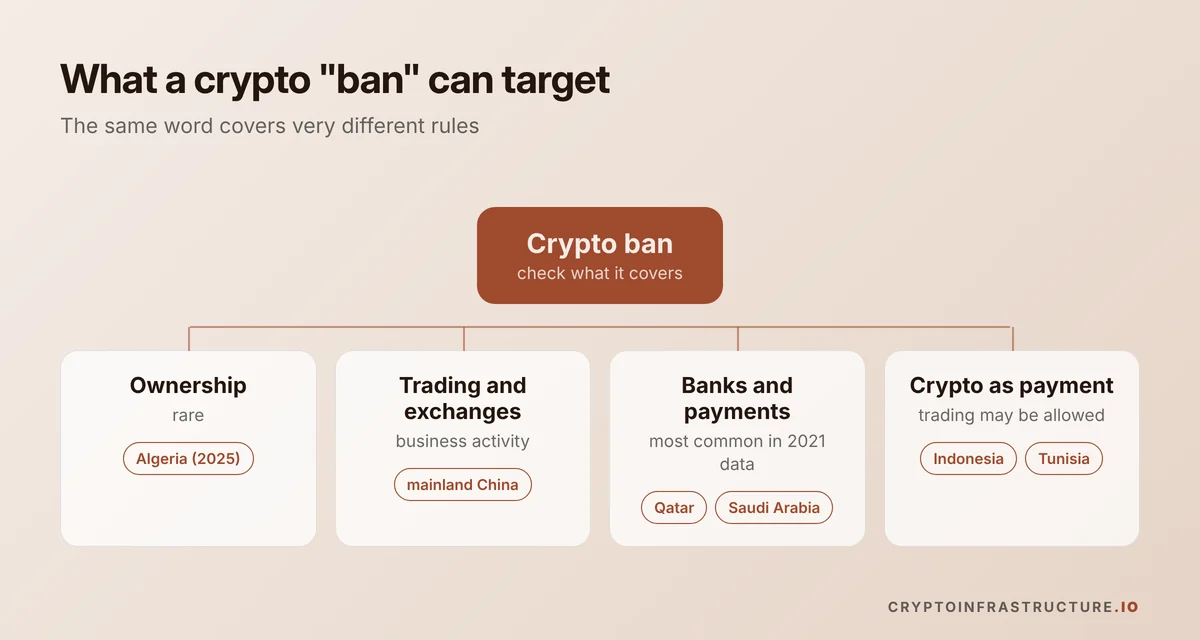
A “ban” can target very different things, and lists that use one word for all of them mislead you. Before you assume a country is off limits, check which of these the rule actually covers:
- Ownership. Rare. Algeria’s 2025 law is one of the few that reaches ownership itself.
- Trading and exchanges. China bans crypto business activity, including exchange services. Turkey and Vietnam allow trading only through licensed platforms.
- Banks and payment firms. The most common restriction in the 2021 dataset: banks may not deal in crypto, which makes buying it with local currency hard even though owning it is not a crime.
- Payments. Some countries allow trading but bar using crypto to pay for goods, as the 2021 dataset records for Indonesia and Tunisia.
- Mining. Covered by China’s and Algeria’s rules, and by Nepal’s central bank warnings.
Penalties also vary, from exchange-control fines (Morocco) to prison (Algeria, and Turkey for unlicensed platforms).
Is cryptocurrency recognised by any government as money?
Barely. El Salvador made bitcoin legal tender in 2021 but rolled that back in 2025, ending the requirement for businesses to accept it, as part of a $1.4 billion IMF programme (ICIJ, 17 November 2025). Bolivia, which reopened crypto trading in 2024, said at the time that the boliviano remains its only legal tender and that no one is obliged to accept crypto as payment. Some ranking pages still describe El Salvador’s 2021 rules as current.
Which countries are “crypto friendly”?
There is no official ranking, and “friendly” usually means one of two things: a clear licensing route for firms, or low tax for individuals. On the first, the EU (MiCA), the UAE (SCA, VARA, FSRA), the UK (FCA) and Japan (FSA) all have defined regimes, which is not the same as being easy or cheap to enter. On tax, ICIJ notes that the UAE does not tax personal income or crypto trading gains (17 November 2025). If you are a business choosing where to get licensed, compare the regimes in the VASP licence guide.
What other lists get wrong
Errors found in pages ranking for this keyword, checked 14 October 2026:
- Bolivia listed as banned. Its central bank lifted the restriction on 25 June 2024 (Resolution 082/2024).
- Turkey and Pakistan listed as banned or “partial”. Turkey has had a licensing law since 2 July 2024; Pakistan created a regulator in 2025.
- “China banned owning bitcoin in May 2025”. No official act was found; the claim traced back to a user post on a forum (Forbes, 4 June 2025).
- Algeria described as having “limited information”. Law No. 25-10 of 24 July 2025 is specific and criminal.
- Undated lists. Most country lists reviewed give no law name, no date and no source for each country, so you cannot tell a 2017 rule from a 2026 one.
What this means for you
As of 14 October 2026, crypto is legal in most countries, banned outright in a small group led by mainland China, Algeria, Nepal and Morocco, and restricted in a larger group where banks or payments are the target rather than ownership. Several countries that older lists still call “banned”, including Bolivia, Turkey, Vietnam, Pakistan and Nigeria, now license or permit crypto. If you are a business entering a market, read the current law, not a list (this one included), and check the regulator’s licence register. If you are an individual, the questions that matter are whether owning is an offence where you live, whether your bank will process the transfer, and how gains are taxed (see how crypto is taxed). For new rules as they land, follow the site’s regulation news and read how this site checks its sources in its methodology.