A whale in crypto is a person, company, fund or other entity that holds or trades enough of a coin to move its price or its liquidity with a single decision. For Bitcoin, the most common cut-off is 1,000 BTC or more: Glassnode’s “Number of Whales” metric counts entities holding at least 1,000 coins. Whales include exchanges, ETFs, corporate treasuries, early miners and private holders. They move markets mostly through order-book mechanics: a large order eats through available liquidity and shifts the price, which is why big holders often trade through OTC desks. Whale-alert feeds show that coins moved, not why, and following them is not a strategy.
A post goes viral: “Whale moves 10,000 BTC to an exchange.” Prices wobble, commentators call it a sell signal, and an hour later nothing has happened. If you want to know what a crypto whale actually is, how much it takes to be one, who the biggest holders really are and how a large trade changes a price, most explainers give you a 1,000 BTC rule of thumb and stop there. This guide adds the cohort definitions analysts use, a dated look at how Bitcoin is distributed across address sizes, a worked slippage example, documented manipulation cases and an honest account of what whale trackers can and cannot tell you.
What is a whale in crypto?
A crypto whale is any holder whose position is large enough, relative to a coin’s supply or its trading liquidity, that buying, selling or moving it can affect the market. The word is borrowed from casino slang for high rollers. It describes size, not identity: a whale can be one person, a fund, a public company, an exchange or a government.
There is no official threshold. What makes someone a whale depends on the asset. In a coin with deep markets, it takes a very large holding. In a thinly traded token, a few hundred thousand dollars can be enough to push the price.
How much crypto makes you a whale?
For Bitcoin, the convention most analysts use is 1,000 BTC or more. The clearest written definition comes from the on-chain data firm Glassnode: its “Number of Whales” metric counts “unique entities holding at least 1,000 coins” (Glassnode entities documentation, checked 14 October 2026).
Two details in that definition matter more than the number:
- Entities, not addresses. Glassnode defines entities as “clusters of addresses estimated to be controlled by the same actor”, built with its own clustering heuristics, and says the series can be revised as the clustering improves. One whale can control hundreds of addresses, and one exchange address can hold coins for millions of customers.
- Exchanges and miners are carved out. Glassnode says exchange-labelled and miner-labelled entities are excluded from its balance band totals and treated as separate clusters. A whale count from Glassnode is therefore not the same as a count of large addresses.
Glassnode publishes its supply bands in tenfold steps, from under 0.001 coins up to 1,000 to 10,000, 10,000 to 100,000 and at least 100,000 coins. Nicknames such as “shrimp”, “dolphin”, “shark” or “humpback” that you see on social media and dashboards are informal labels for these bands, not part of Glassnode’s metric definitions.
For other coins, including XRP or Ether, there is no single agreed whale threshold. Analysts usually pick a balance band from the coin’s own rich list (the top holders by balance on a block explorer) or define whales as a share of supply. When you read “XRP whales are buying”, check which threshold the source used, and whether it separated exchange wallets from everyone else.
How Bitcoin is distributed across address sizes (14 October 2026)
To see where whale-sized balances sit, here is BitInfoCharts’ Bitcoin distribution by address balance, captured 14 October 2026 at 00:36 UTC.
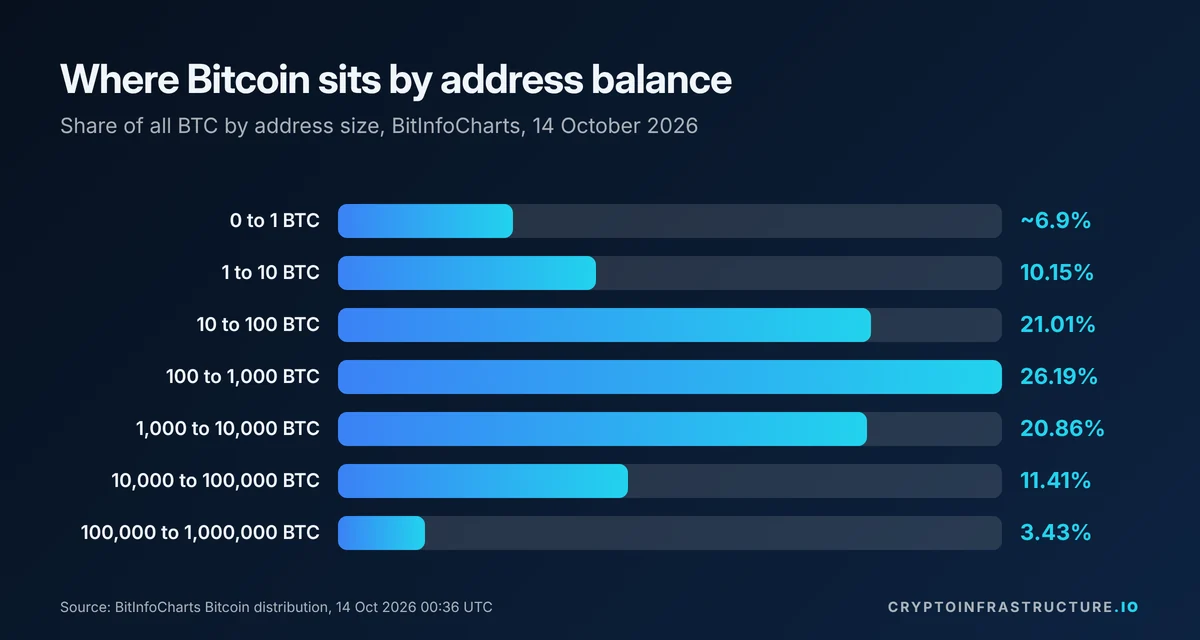
| Balance per address (BTC) | Addresses | BTC held | Share of all BTC |
|---|---|---|---|
| 0 to 1 | 58,689,816 | 1,395,703 | about 6.9% |
| 1 to 10 | 820,437 | 2,038,704 | 10.15% |
| 10 to 100 | 129,672 | 4,221,896 | 21.01% |
| 100 to 1,000 | 18,367 | 5,263,548 | 26.19% |
| 1,000 to 10,000 | 1,939 | 4,192,456 | 20.86% |
| 10,000 to 100,000 | 84 | 2,292,735 | 11.41% |
| 100,000 to 1,000,000 | 4 | 690,088 | 3.43% |
Source: BitInfoCharts Bitcoin distribution, page timestamp 2026-10-14 00:36:29 UTC. The first row sums the site’s six smallest bands; the share is rounded.
Read at face value, 2,027 addresses holding 1,000 BTC or more controlled about 7.18 million BTC, roughly 35.7% of the supply counted by the site. But this is an address count, not a whale count. On the same page, the four largest addresses were labelled as Binance cold wallets (two of them, 248,598 and 170,630 BTC), a Robinhood cold wallet (140,850 BTC) and a Bitfinex cold wallet (130,010 BTC). The fifth was labelled Tether (96,932 BTC). The biggest “whale addresses” on Bitcoin are mostly custodians holding coins for their customers, which is exactly why Glassnode strips exchanges out before counting whales.
Who are the crypto whales?
When you ask “who is the biggest crypto whale”, the honest answer depends on whether you mean a single owner or a single wallet. The main groups:
- Exchanges and custodians. They hold the largest single addresses, as the table above shows, but the coins belong to many customers. Movements between their own wallets are usually housekeeping, not trades.
- ETFs. US spot bitcoin ETFs such as iShares Bitcoin Trust hold actual bitcoin through custodians and create or redeem shares in baskets of BTC (the fund’s page listed a basket bitcoin amount of 22.64 BTC as of 12 October 2026). An ETF is a whale on behalf of its shareholders, and its flows follow investor demand, not one person’s view.
- Corporate treasuries. The largest public example is Strategy (formerly MicroStrategy). Its purchase ledger showed 848,250 BTC held after a purchase dated 12 October 2026 (checked 14 October 2026). That makes it a single entity whale under any definition.
- Early miners and early adopters. Coins mined or bought in Bitcoin’s first years sit in some of the oldest wallets. The best-known holding is the early-mined BTC widely attributed to Satoshi Nakamoto, commonly estimated at around 1.1 million BTC. That figure is a researchers’ estimate based on early mining patterns, not something Satoshi ever confirmed, and those coins have never moved. Founder and early-holder concentration is a theme in other networks too: see who owns Ethereum and who owns Dogecoin.
- Governments. States can become whales through seizures in criminal cases. Their holdings and sales are often disclosed in court records and official statements rather than announced in advance.
- Funds and private individuals. Trading firms, venture funds and wealthy individuals, most of whom are not publicly identified on-chain.
How whales move markets: the mechanics
Whales do not move prices by being rich. They move prices because markets have limited depth. Every exchange runs an order book: a list of buy orders (bids) and sell orders (asks) at different prices. A large market order fills against the best prices first, then keeps working through worse ones until it is complete. The gap between the price you expected and the average price you got is called slippage.
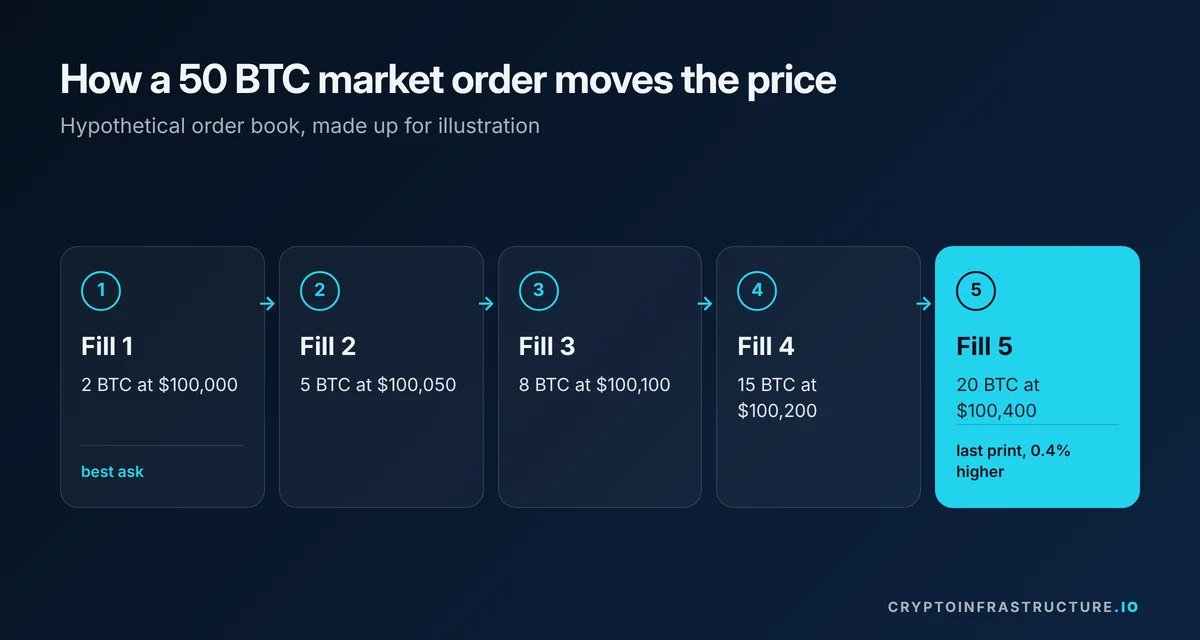
A worked slippage example (hypothetical numbers)
The order book below is made up for illustration. It is not a snapshot of any real exchange.
| Ask price (USD) | BTC available |
|---|---|
| 100,000 | 2 |
| 100,050 | 5 |
| 100,100 | 8 |
| 100,200 | 15 |
| 100,400 | 30 |
| 100,800 | 40 |
A buyer sends a market order for 50 BTC. It fills like this:
- 2 BTC at $100,000 = $200,000
- 5 BTC at $100,050 = $500,250
- 8 BTC at $100,100 = $800,800
- 15 BTC at $100,200 = $1,503,000
- 20 BTC at $100,400 = $2,008,000
Total cost: $5,012,050 for 50 BTC, an average of $100,241. That is about 0.24% above the best ask. The last trade printed at $100,400, so the visible price jumped 0.4% in one order, and the next buyer faces only 10 BTC left at that level.
Now apply the same logic to a small token where the whole book within 2% of the price holds, say, $200,000. A $1 million market order would clear that and keep going, moving the price far more than 2%. This is why the same dollar amount is a non-event in Bitcoin and a price spike in a thin altcoin. The site’s guide to market cap vs FDV explains why a big market cap does not mean deep liquidity.
Why most big trades go through OTC desks
Because of slippage, large holders rarely dump coins on a public order book. They use over-the-counter (OTC) desks: brokers or dealers who match the trade privately with other large parties, or work the order gradually across venues. The trade still happens, but it does not hit the public book all at once.
The best-documented recent example: in July 2025, an address that had been dormant since April 2011 moved its entire 80,000 BTC to trading desks, with the final 40,191 BTC sent to Galaxy Digital on 18 July 2025 (CoinDesk, 18 July 2025). CoinDesk noted at the time that moving coins to a desk does not by itself confirm a sale. About a week later Galaxy said it had sold more than 80,000 BTC, valued at around $9 billion, on behalf of a “Satoshi-era investor” as part of estate planning, as reported by CoinGape on 25 July 2025. CoinGape also reported that bitcoin fell about 3% that day, with an intraday low of $114,759, before recovering above $117,000. Even with an OTC desk, a sale that size had a visible footprint, but a far smaller one than an open-market dump would have had.
Other ways whales affect prices
- Derivatives and liquidations. A large leveraged position can, when it is liquidated, force selling or buying into the market. On venues where a shared vault takes over liquidated positions, that vault can end up holding the whale’s risk. The leverage mechanics are covered in the site’s guide to leverage and perpetual futures.
- Signalling. Visible transfers to exchanges can make other traders act first, so the market moves on the expectation rather than on the trade itself.
- Governance. In proof-of-stake networks and DAOs, large token holders also carry large voting power, so whales can shape protocol decisions as well as prices.
Can whales manipulate crypto prices? Documented cases
Large trades that move prices are not manipulation in themselves. Manipulation is trading designed to create a false price or false picture of activity. Some cases with public records:
| Date | Case | What happened | Status and source |
|---|---|---|---|
| 9 October 2024 | SEC and DOJ market-maker cases (US) | The SEC charged promoters and three market makers, ZM Quant, Gotbit and CLS Global, and named employees, alleging “market-manipulation-as-a-service”: wash trading and other non-economic trades by bots to fake an active market and lure retail buyers. One token in the probe was created at the FBI’s direction. | Allegations at filing; parallel criminal actions by the US Attorney’s Office for Massachusetts. SEC press release 2024-166 |
| 12 March 2025 (reported) | Hyperliquid 50x ETH whale | A trader built a roughly 175,000 ETH long (about $340 million), withdrew margin after profits, and the remaining position was liquidated into Hyperliquid’s HLP vault, which lost over $4 million in 24 hours. Hyperliquid said it was not an exploit but high leverage and margin mechanics, then cut maximum leverage to 40x for BTC and 25x for ETH and raised margin requirements for large positions. | Reported by AMBCrypto, 12 March 2025. Intent is analysts’ view, not a finding. |
| 26 March 2025 | Hyperliquid JELLYJELLY squeeze | A trader opened an $8 million short on the low-cap JELLY token, removed margin so the HLP vault inherited it, and allegedly bought JELLY elsewhere to push the price up. HLP showed about $12 million in unrealised losses. Hyperliquid’s validators voted to delist JELLY perps citing “evidence of suspicious market activity”, settled at $0.0095, and said non-flagged users would be made whole. | Reported by Crypto Briefing, 26 March 2025, quoting Hyperliquid’s statement. No enforcement action identified. |
The pattern across these cases: manipulation works best where liquidity is thin (small tokens, new perpetual markets) or where platform rules let one trader push losses onto a shared pool. Bitcoin’s spot market is far harder to move this way than a low-cap token.
What does whale activity mean, and what can whale trackers tell you?
Whale-alert bots and dashboards watch public blockchains for large transfers and post them in real time, often with a label such as “unknown wallet to Coinbase”.
What they can tell you:
- That a given amount moved between two addresses at a given time.
- Whether either address carries a label from the tracker’s database, such as a known exchange wallet.
- Long-run shifts in how supply is spread across balance bands, if you use an entity-adjusted source.
What they cannot tell you:
- Why coins moved. An exchange deposit can be a sale, collateral for a loan, a custody change or an internal transfer. CoinDesk’s own coverage of the 80,000 BTC move said a transfer to a desk does not confirm a sale.
- Who owns the address. Labels are estimates. Glassnode itself says its entity clustering is heuristic and revised over time.
- Off-chain activity. OTC fills, trades inside an exchange’s books, ETF creations settled with custodians and derivatives positions on centralised venues do not appear as individual on-chain whale transfers.
- What happens next. People often ask what a “whale pattern” indicates in trading. There is no reliable rule: a big inflow can precede a fall, a rise or nothing. Treating alerts as buy or sell signals means reacting to partial information that other traders also see.
Common mistakes when reading whale news
- Counting exchange wallets as whales. The largest Bitcoin addresses are custodians, as the 14 October 2026 BitInfoCharts list shows.
- Using one threshold for every coin. 1,000 BTC is a Bitcoin convention. It means nothing for a token with a different supply and liquidity.
- Assuming every transfer is a trade. Many large moves are custody changes or internal transfers.
- Calling any big trade manipulation. Manipulation needs deceptive intent or fake activity; a large honest sale is just a large sale.
What this means for you
A whale is defined by its size relative to a market, not by a fixed number, and the 1,000 BTC convention only makes sense once exchanges and custodians are separated out. Whales move prices through ordinary order-book mechanics, which is why the same trade can be invisible in Bitcoin and decisive in a thin token, and why the biggest holders route trades through OTC desks. Documented manipulation cases cluster in illiquid markets and in platforms whose rules let a trader shift risk onto others.
If you follow whale alerts, read them as data about movements, not as instructions. For how this site sources and dates figures like these, see the methodology, and find more explainers in Guides.