Yes. As of 14 October 2026, Bybit can legally serve users in India. Its operator, Bybit Fintech Limited, is registered with the Financial Intelligence Unit-India (FIU-IND) as a reporting entity under the Prevention of Money Laundering Act, 2002 (PMLA). It registered in early 2025, after FIU-IND fined it Rs 9.27 crore (about $1 million) on 31 January 2025 and had its websites blocked. That registration is an anti-money-laundering registration, not a licence and not investor protection. Your gains are still taxed at 30%, and the February 2025 hack of about $1.5 billion is part of the record you should weigh.
If you are in India and use Bybit, or are thinking about it, you have probably seen three different answers: banned, back, and “fully licensed”. None of them is quite right. Bybit stopped serving Indian users in January 2025, paid an FIU-IND penalty, registered, and returned in stages through September 2025. This guide sets out what the law requires, what the FIU-IND order actually says, what has changed since, how your trades are taxed in brief, and what risk registration does not remove.
Is Bybit legal in India?
Yes. As of 14 October 2026, Bybit operates in India as a virtual digital asset service provider (VDA SP) registered with FIU-IND. Using it as an Indian resident is legal, and the income you make on it is taxable.
The legal basis is narrow. India has no crypto licensing law for exchanges. What it has is an anti-money-laundering rule: since March 2023, VDA SPs have been brought under the PMLA, and any VDA SP serving users in India must register with FIU-IND as a reporting entity. The Ministry of Finance restated in a PIB release of 9 September 2026 that VDA SPs were brought under the PMLA framework in March 2023, and used that framework to issue non-compliance and takedown notices to 15 more unregistered platforms. Bybit is not on that list.
So “legal” means one specific thing here: Bybit is registered with the authority the law requires it to register with. It does not mean the Reserve Bank of India (RBI) or SEBI supervises Bybit, and it does not mean your balances are protected the way a bank deposit is.
Is Bybit FIU registered in India?
Yes. Bybit announced its FIU-IND registration on 6 February 2025, saying it had applied as a VDA SP on 26 June 2024 and had settled the monetary fine. The government’s own record goes further. A list of registered VDA SPs as on 9 March 2026, given to the Lok Sabha in answer to Unstarred Question 5805 on 30 March 2026, includes Bybit Fintech Limited as one of seven offshore-incorporated registrants out of 54, with Seychelles shown as its country (as summarised by Infinilex, checked 14 October 2026). FIU-IND does not publish a public register, so that parliamentary answer is the most recent official entity-level list.
Older claims that Bybit registered in 2024, or that it “is not registered with FIU-IND”, conflict with the FIU-IND order, Bybit’s announcement and the Lok Sabha list.
Was Bybit banned in India?
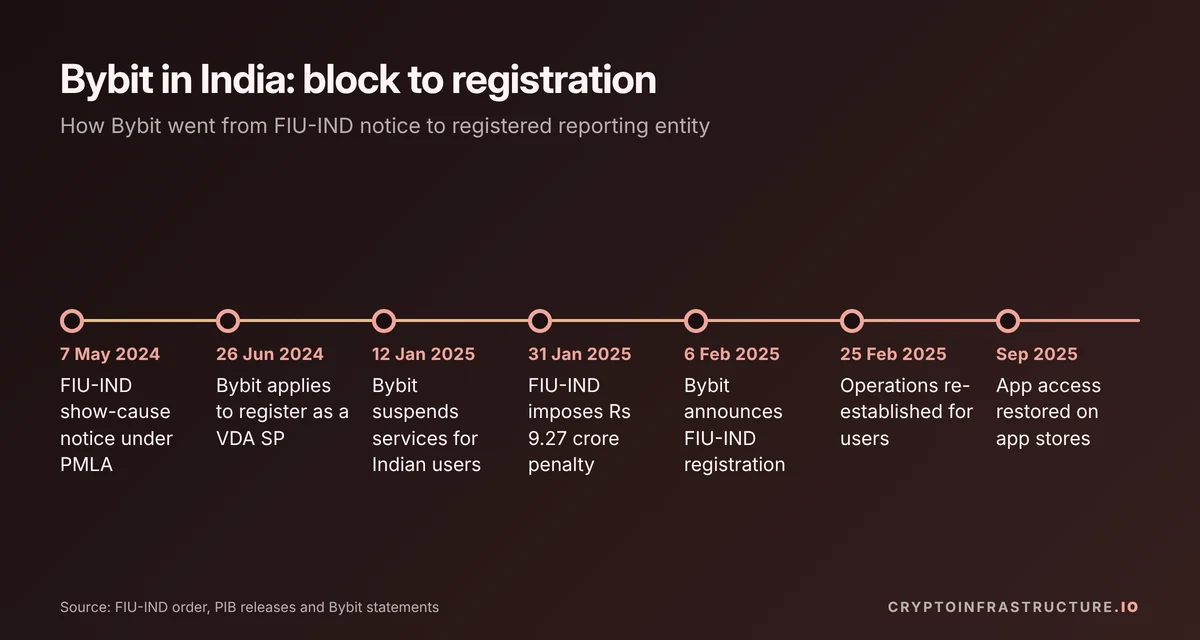
Not banned outright, but blocked and then suspended. Bybit expanded in India without the registration the PMLA requires, FIU-IND had its websites blocked, and Bybit itself suspended services to Indian users from 12 January 2025 until it registered. Here is the sequence, with sources.
| Date | What happened | Source |
|---|---|---|
| 10 March 2023 | FIU-IND issues AML/CFT guidelines for VDA reporting entities | PIB release, 31 January 2025 |
| 17 October 2023 | FIU-IND circular on registering VDA SPs as reporting entities | PIB release, 31 January 2025 |
| Before January 2025 (date not given) | FIU-IND has Bybit’s websites blocked through the IT ministry (MeitY) under the Information Technology Act, 2000, for continued non-compliance | PIB release, 31 January 2025 |
| 7 May 2024 | FIU-IND issues a show-cause notice to Bybit under Section 13 of the PMLA | FIU-IND order No. 15/DIR/FIU-IND/2024 |
| 26 June 2024 | Bybit applies for registration as a VDA SP | Bybit press release, 6 February 2025 |
| 12 January 2025 | Bybit suspends services for Indian users; withdrawals remain open | Bybit statement reported by Cointelegraph via Yahoo Finance, 10 January 2025 |
| 31 January 2025 | FIU-IND imposes a penalty of Rs 9,27,00,000 (Rs 9.27 crore) on Bybit Fintech Limited | FIU-IND order; PIB release, 31 January 2025 |
| 6 February 2025 | Bybit announces FIU-IND registration and settlement of the fine | Bybit press release |
| 25 February 2025 | Operations re-established for authorised users | Bybit statement reported by FF News, 7 September 2025 |
| September 2025 | App access restored on the App Store and Google Play; website access restored in phases | Bybit statement reported by FF News, 7 September 2025, and CCN, 8 September 2025 |
| 9 March 2026 | Bybit Fintech Limited listed among 54 registered VDA SPs | Lok Sabha answer, 30 March 2026 (via Infinilex) |
| 9 September 2026 | FIU-IND names 15 more unregistered VDA SPs; Bybit is not among them | PIB release |
All entries checked 14 October 2026. FIU-IND’s compliance orders page lists the Bybit order under 31 January 2024; the order itself and the PIB release both date it 31 January 2025.
What did the FIU-IND order find?
The FIU-IND order against Bybit Fintech Limited, dated 31 January 2025 and issued by the Director of FIU-IND under Section 13 of the PMLA, imposes a total penalty of Rs 9.27 crore. It treats Bybit as a reporting entity under Section 2(1)(wa) of the PMLA and finds contraventions of Section 12(1) of the Act read with several record-keeping and reporting rules (Rules 3(1)(D), 7 and 8 of the PML (Maintenance of Records) Rules, 2005). The order does not break the penalty down by contravention.
The PIB release on the order puts it plainly: Bybit expanded in India “without the mandatory registration” and, because of continued non-compliance, FIU-IND had its websites blocked. The penalty is often given as “about $1 million”. That conversion is fine (CoinDesk used it), but the legal figure is the rupee amount in the order.
What FIU-IND registration means, and what it does not
| FIU-IND registration means | It does not mean |
|---|---|
| Bybit is a reporting entity under the PMLA and must follow its KYC, record-keeping and reporting duties | A licence from RBI or SEBI, or supervision of Bybit’s trading, custody or solvency |
| FIU-IND can penalise it and order its apps and URLs taken down if it stops complying, as it did with Bybit’s websites before registration | Deposit insurance or an Indian compensation scheme if the exchange fails or is hacked |
| Bybit must verify who you are; its India account guide asks for your PAN card and income details | That every product on the global platform is available to Indian users |
That last point is concrete. Bybit’s own card availability page lists India as “Not currently available” for the Bybit Card (information last verified June 2026, checked 14 October 2026). Bybit’s February 2025 announcement said it was committed to offering spot, derivatives, options and Bybit Earn to Indian users, but registration under the PMLA says nothing about whether any of those products suit you.
What is Bybit’s status in 2026?
As of 14 October 2026, nothing in the official record points to a change in Bybit’s India status this year:
- It is on the government’s March 2026 list of registered VDA SPs.
- It is not among the 15 platforms named in FIU-IND’s 9 September 2026 non-compliance and takedown notices, issued under Section 13 of the PMLA and Section 79(3)(b) of the Information Technology Act, 2000.
- No new FIU-IND order against Bybit appears on the compliance orders page.
One detail to watch: Infinilex’s summary of the Lok Sabha answer says Bybit also appears in Annexure II, the takedown list, which matches its 2024 to 2025 website block. The summary does not say when that entry dates from, and Bybit reported its app and website access restored from September 2025.
The wider pressure on offshore platforms has not eased. The September 2026 notices named Weex, Blofin, Bitunix, DigiFinex, Toobit, XT.com, LATOKEN, WOO X, Pionex, ChangeNow, SimpleSwap, FixedFloat, WhiteBIT, Guardarian and RezorEx. If you use any of those from India, expect access to be cut off. The Binance India guide covers the earlier rounds of notices, including Binance’s own 2024 block.
Which country owns Bybit?
Bybit describes itself as a Dubai-based exchange: it was founded in Singapore in 2018 and has been headquartered in Dubai since 2022, and its press releases are datelined Dubai. The entity on India’s registration list, Bybit Fintech Limited, is shown as incorporated in Seychelles. Either way, your Indian account sits with an offshore company, which matters if you ever need to pursue a dispute or a claim.
The February 2025 hack
Legal status and security are separate questions, but you should not answer the first without knowing about the second. On or about 21 February 2025, four days before Bybit re-established operations for Indian users, about $1.5 billion in virtual assets was stolen from Bybit, in an attack on how its cold wallet transfers were signed. The FBI said on 26 February 2025 that North Korea was responsible, naming the activity “TraderTraitor”. FIU-IND registration does not cover or compensate for losses like this.
How Bybit trades are taxed in India (in brief)
Using an offshore exchange does not change how your crypto income is taxed. The Income Tax Department’s VDA page says income from transferring a virtual digital asset is “taxed at a flat rate of 30% plus surcharge and cess”, computed “without any deduction except for the cost of acquisition” (checked 14 October 2026).
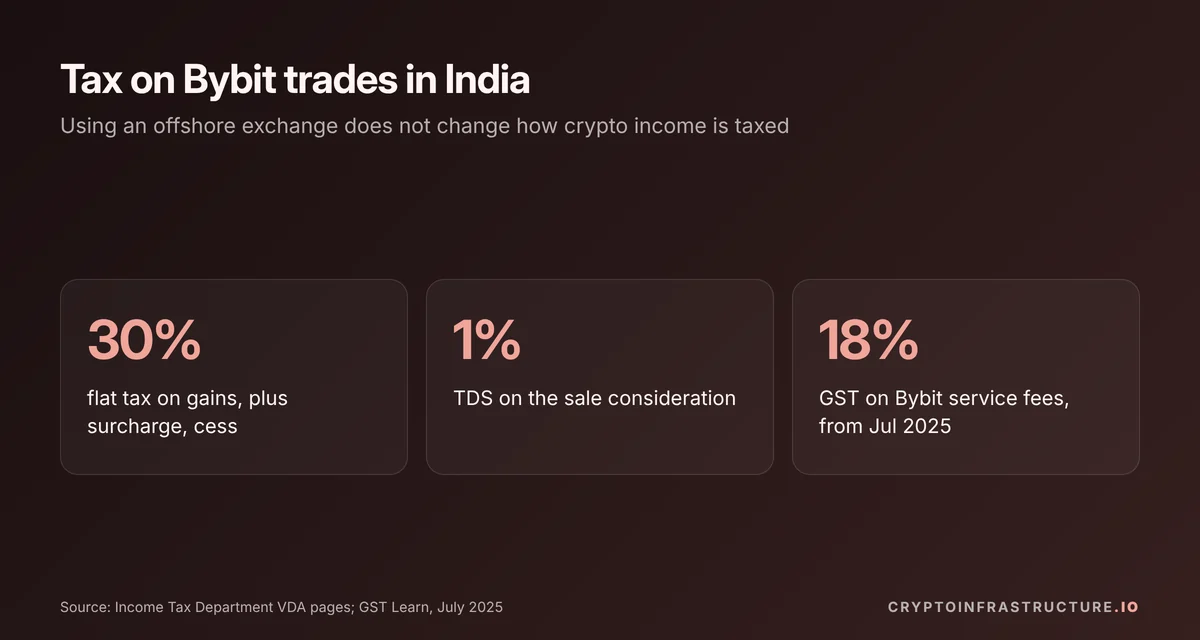
- 30% on gains plus surcharge and cess, whatever your slab or holding period.
- Losses on one VDA cannot be set off against gains on another or carried forward.
- 1% TDS on the sale consideration, with thresholds of Rs 50,000 a year for specified persons and Rs 10,000 for others, according to the department’s TDS on VDA page. No Bybit statement on whether it deducts TDS for Indian users was found for this article, so check your account statements; if TDS is not deducted on your trades, your tax liability does not disappear.
- GST on fees: GST Learn reported in July 2025 that Bybit began charging 18% GST on its service fees for Indian users from 7 July 2025. That applies to the fee, not the trade value. No primary Bybit notice was reachable when this article was checked.
The Income-tax Act, 2025 replaced the 1961 Act from 1 April 2026 and renumbered the VDA sections. The full rules, worked examples and filing steps are in the crypto tax in India guide.
Can you trade crypto in India legally?
Yes. Buying, holding and selling crypto is legal in India as of 14 October 2026, on three conditions that apply to you and the platform: the platform must be registered with FIU-IND, you complete KYC with your PAN, and you report and pay tax on your gains. There is still no dedicated crypto law; the PMLA and income tax rules are the framework.
To check any exchange, including Indian ones such as CoinDCX or offshore ones such as Coinbase (Coinbase India Private Limited is on the March 2026 list):
- Look for the platform’s operating company, not its brand, on the latest official list of registered VDA SPs. Indian exchanges usually register under a company name that differs from the app’s name.
- Search the brand against FIU-IND press releases and the compliance orders page. Being named in a non-compliance notice is a red flag.
- Be wary of any app that has just disappeared from the Indian Play Store or App Store. That is what an FIU-IND takedown looks like from your side.
If you run a crypto business serving India
Bybit’s case is the second clear precedent after Binance: an offshore exchange served Indian users without registering, had its websites blocked, paid a penalty and then registered. FIU-IND’s 9 September 2026 notices show it is still issuing non-compliance and takedown directions to unregistered VDA SPs. If your exchange, wallet, swap service or OTC desk serves Indian users, plan for FIU-IND registration, KYC, record-keeping and reporting before launch, not after a notice (see the crypto compliance guide). The KYC/AML & Compliance section covers providers that handle this work.
What this means for you
As of 14 October 2026, you can use Bybit in India legally. It is a registered FIU-IND reporting entity, it paid a Rs 9.27 crore penalty for operating without registration, and it has been back in full since September 2025. Treat that registration as the minimum: it is not RBI or SEBI supervision, it does not protect your balance, and it did not prevent a $1.5 billion hack. Keep your own transaction records for tax, watch FIU-IND releases for changes, and judge Bybit on the same points this site uses for every provider: track record, transparency, security practices, pricing clarity and jurisdiction coverage, as set out in the methodology.
For other platforms, browse the Exchanges section.
This guide is general information, not tax advice. Rules and thresholds change; confirm your position with a qualified tax adviser before filing. See the site’s disclaimer.