Is Bybit legal in the US? Bybit does not serve you if you live in the US. Its BVAPO platform terms list the United States first among its “excluded jurisdictions”. Its Service Restricted Countries page says the same. No US licence or US Bybit company serving customers has been found. No CFTC, SEC, Justice Department, FinCEN or New York DFS enforcement action against Bybit has been found; other state regulators were not searched one by one. Giving false information about where you live lets Bybit close your account immediately and liquidate open positions. Bybit’s chief executive has said the company is considering US entry through a licensed partner, but nothing has launched.
Search “is Bybit legal in the US” and you get a confusing mix: Bybit’s own help page saying it does not serve the US, YouTube videos and blogs walking you through VPN setups plus 2026 headlines about Coinbase talks and Bybit “eyeing” America. This guide sets out what Bybit’s own terms say, what US regulators have and have not done, what Bybit has said about coming to the US plus what is actually at stake if you use it from there.
Is Bybit legal in the US? The short answer
No, not as a service for US residents. Section 3.4 of the BVAPO Platform Terms and Conditions says Bybit does not offer services or products to users in excluded jurisdictions “including the United States”. Bybit’s Service Restricted Countries page, updated the same day, repeats it and cites section 11.3 of the Bybit Platform Terms as well.
That is a restriction Bybit applies to itself. It is not a US court order or a regulator’s ban, and no federal or New York enforcement action against Bybit has been found. The practical effect for you is the same: there is no licensed Bybit company in the US to open an account with.
| Question | What the evidence shows |
|---|---|
| Does Bybit accept US residents? | No. The US is listed first in section 3.4 of the BVAPO terms and on the restricted countries page |
| Does Bybit hold a US licence? | No US entity or US licence appears in its terms. The operator named in the terms is Bybit Virtual Asset Platform Operator L.L.C. S.P.C., which describes itself as regulated by the UAE’s Capital Markets Authority |
| Is there a “Bybit US” like Gate US? | No separate US Bybit company serving customers has been found |
| Any US regulator action against Bybit? | None found at the CFTC, SEC, Justice Department, FinCEN or New York DFS; other states not searched individually |
| US plans? | Company statements and press reports about a possible entry through a licensed partner; nothing launched |
| Where do disputes go? | Terms governed by the laws of England and Wales, with arbitration under SIAC rules seated in Singapore (clauses 46.1 and 46.4) |
Based on Bybit’s BVAPO terms and its Service Restricted Countries page.
Why is Bybit banned in the US?
Strictly, Bybit is not banned by a US authority. It has chosen not to serve the US. Section 3.4 of its terms gives the general reason: Bybit does not serve anyone in a place where providing its services “would be contrary to” applicable law or where it is “not authorized” to provide them. No US registration or state licence for Bybit appears in its terms or in the sources reviewed. The US sits first on its excluded list.
The US is not alone. The same section 3.4 lists the Chinese mainland, Hong Kong, Singapore, Canada, France, the United Kingdom, Dubai, North Korea, Cuba, Iran, Uzbekistan, Russian-controlled regions of Ukraine, Sudan and Syria. It lets Bybit add others “at our sole discretion”. The help page version leaves out France and the United Kingdom and says Dubai is excluded only for the BVAPO company, so the two lists do not match exactly. For the United States they agree.
Has Bybit been fined or sued in the US?
No federal or New York enforcement action against Bybit has been found. That covers a Google search of Bybit across the CFTC, SEC, New York DFS, Justice Department and FinCEN websites, which returned no Bybit case, plus news searches for US action. Other state regulators were not searched one by one. “None found” is not the same as “none exists”, and it is not a licence. Bybit’s stated position is simply that it does not serve US customers.
Bybit’s main contact with US authorities was as a victim. On 26 February 2025, the FBI published a public service announcement titled “North Korea Responsible for $1.5 Billion Bybit Hack”. It attributed the theft of about $1.5 billion in virtual assets on or about 21 February 2025 to North Korean activity it calls “TraderTraitor”. How Bybit covered the loss is set out in the Bybit safety review.
Can you use Bybit in the USA?
Not without breaking its terms. The terms spell out what Bybit can do when that happens. Under the BVAPO terms of 13 October 2026:
- Clause 3.4 excludes the United States from Bybit’s services.
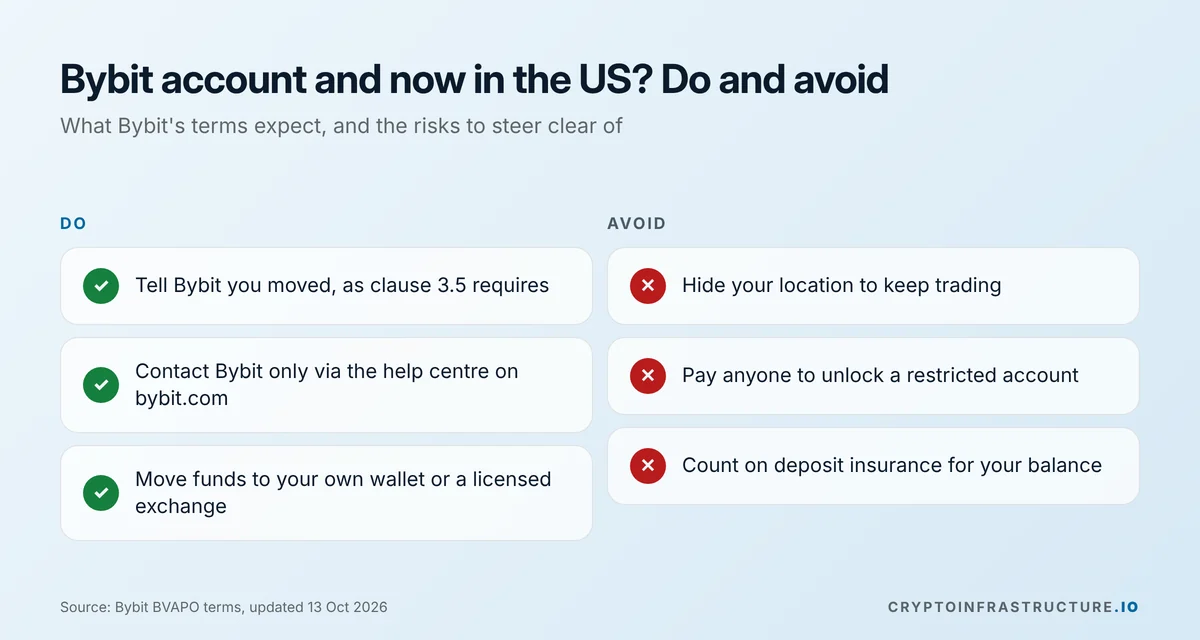
- Clause 3.5 requires you to tell Bybit immediately if you become resident in an excluded jurisdiction. If Bybit finds you gave “false representations” about your location or residence, it can terminate your account “immediately” and liquidate any open positions.
- Clause 41.1 says virtual assets and fiat “are not protected by any form of deposit protection or deposit insurance scheme in the UAE or any other jurisdiction”.
- Clauses 46.1 and 46.4 put the contract under English law, with disputes decided by three arbitrators under SIAC rules in Singapore.
Put together: a US resident who signs up by hiding their location is in breach from day one. They have no US-licensed company on the other side, no deposit protection, no US regulator to complain to plus a leveraged position that can be closed at whatever price the market gives when Bybit acts. This guide does not explain how to get around the block.
Is it illegal for you to use Bybit from the US?
The clearest rule that applies to you is Bybit’s contract, not a criminal law aimed at users. No US case against an individual for simply holding a Bybit account has been found. The real risks are the ones above: a closed account, liquidated positions and funds held up while Bybit reviews them, with disputes in Singapore. Tax is a separate question, covered in how crypto is taxed.
What if you already have a Bybit account and moved to the US?
Clause 3.5 expects you to tell Bybit straight away. If you still hold a balance, contact Bybit through the help centre on bybit.com only. Plan to move funds to a wallet you control or an exchange licensed where you live. Ignore anyone offering to “unlock” or “recover” a restricted Bybit account for a fee: that is a common scam aimed at people cut off from an exchange.
Is Bybit coming to the US?
Bybit has talked about it, but nothing has launched. Everything in this table is either a company statement or a press report, labelled as such.
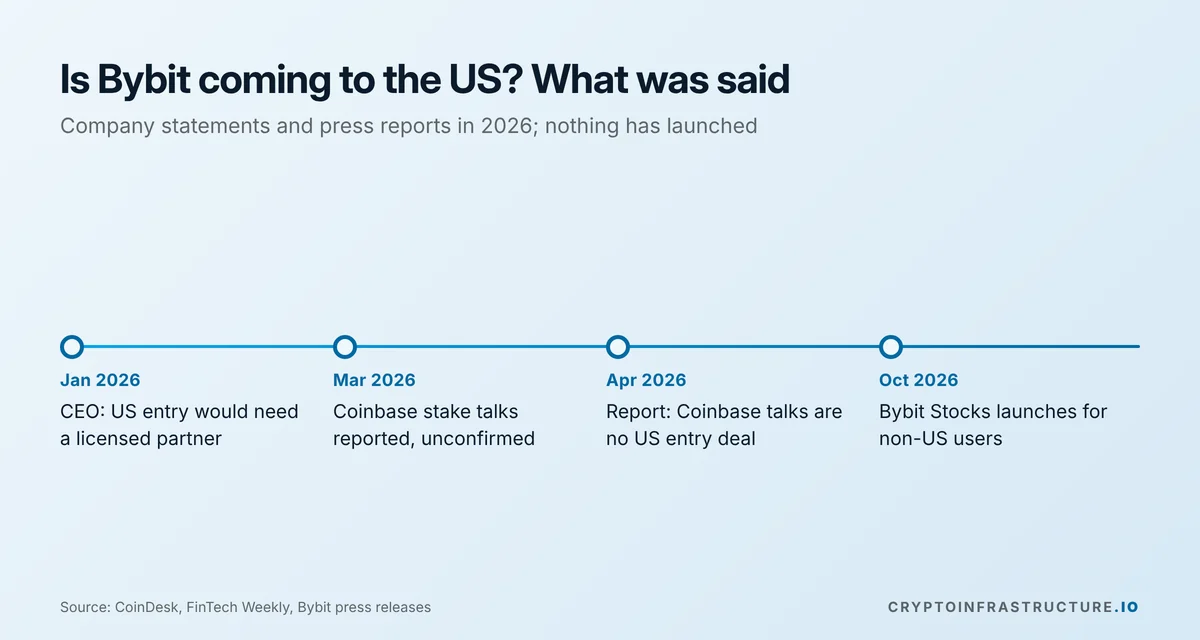
| Date | What was said or reported | Type and source |
|---|---|---|
| 29 January 2026 | Bybit is “considering U.S. market entry, but would need a licensed partner to proceed”; a US public listing is described as a long-term goal | Chief executive Ben Zhou, as reported by Bloomberg and summarised by CoinDesk. Bybit did not respond to CoinDesk |
| 7 March 2026 | Co-CEO Helen Liu to leave the company on 30 April 2026 | Bybit press release (PR Newswire). It does not mention the US |
| 14 March 2026 | Coinbase said to be in talks with Bybit about a strategic investment | Wu Blockchain report citing three sources, carried by FinTech Weekly. Neither company confirmed it |
| 20 April 2026 | Coinbase and Bybit said to be working on tokenizing, holding and distributing US stocks. The talks “do not involve any sort of stake acquisition or similar deal for Bybit to enter the U.S.” A separate US entry plan is described as involving an unnamed local partner that would handle licensing, with a new entity led by Helen Liu | One unnamed source, reported by CoinDesk. Both companies declined to comment |
| 14 August 2026 | ABFinance, a US finance startup founded by Helen Liu after she left Bybit, said its “planned launch will not move forward” and that it was winding down | Cryptopolitan report. Whether ABFinance was the US entity described in the April 2026 report has not been confirmed by Bybit or by Liu |
| 12 October 2026 | Bybit Stocks: US stocks and ETFs for “eligible users in permitted jurisdictions”, via Infra Capital Limited (regulated by Mauritius’s Financial Services Commission) with execution and custody through Alpaca | Bybit press release. This is US securities offered to non-US users, not a US launch |
Statements about plans are claims by the company or anonymous sources, not commitments.
Two points follow. First, “Bybit adds US stocks” headlines do not mean Bybit now serves Americans; the US is still on its excluded list. Second, on the April 2026 report a US launch would run through a local partner that handles licensing, not through Bybit’s global platform, much as Gate set up a separate company, Gate US (see the Gate.io US guide). Until such a company exists and lists its state licences, there is nothing to sign up for.
Which country is Bybit from, and which countries can use it?
The global platform is run under the BVAPO terms by Bybit Virtual Asset Platform Operator L.L.C. S.P.C. The terms describe it as a virtual asset service provider regulated by the Capital Markets Authority of the United Arab Emirates, with business days counted in Abu Dhabi. Its March 2026 press release on Helen Liu was datelined Dubai. Its contract, though, is governed by English law with arbitration in Singapore. Who runs and owns the group is covered in who owns Bybit. Its licences by region are in the Bybit safety review.
Bybit does not publish a list of allowed countries. It publishes a list of excluded ones, so any country not on section 3.4 or the help page list is not excluded by Bybit, subject to local law and to whichever Bybit company serves that country. For the US the answer does not depend on which list you read.
Some answers online are wrong or out of date
- “Using a VPN is legal, so using Bybit is fine.” Two of the ranking pages reviewed make this jump. Whether a VPN is lawful is a different question from whether Bybit will let a US resident trade. Its terms say it will not. Clause 3.5 lets it close the account and liquidate positions.
- “Bybit doesn’t require KYC.” One 2025 guide says this in its FAQ while saying the opposite higher up the same page. Do not plan around it.
- “Bybit was blocked in the US in 2021.” A tax software blog says this. No primary source for a 2021 US action has been found; what can be confirmed is that Bybit’s current terms exclude the US.
- “Coinbase is buying into Bybit to bring it to the US.” Neither company confirmed the March 2026 report. CoinDesk’s April 2026 source said the talks did not involve a stake or a US entry deal.
- “Apex Omni is Bybit under another name.” One affiliate guide says this without a source. Nothing in Bybit’s terms or announcements supports it.
What this means for you
If you live in the US, Bybit is off limits under its own terms. That is Bybit’s choice rather than a US ban, and no federal or New York enforcement action against it has been found. It still leaves you with no licensed Bybit company, no deposit protection and disputes heard in Singapore if you use it anyway. Bybit has said it is considering a US entry through a licensed partner. Treat that as a company plan until a US entity appears with state licences you can confirm on a regulator’s register.
US-licensed platforms are compared in the best crypto exchanges in the US and, head to head, in Coinbase vs Gemini. For how Bybit stacks up against other offshore exchanges on licences, reserves and hacks, see the offshore exchange comparison, or browse the Exchanges section.
This guide is general information, not legal or financial advice. Nothing here is a recommendation to use any platform. See the site’s disclaimer.