KuCoin is a real exchange with a real operator, but “legit” and “safe” are different questions. The evidence is mixed. KuCoin publishes Merkle tree proof of reserves (snapshot 30 September 2026, BTC 109%, ETH 117%, USDT 110%, USDC 127%), but no auditor is named on the page. Its operator, Peken Global Limited, pleaded guilty in the US on 27 January 2025 and paid more than $297 million and a CFTC consent order announced on 30 March 2026 permanently bars it from letting US participants trade unless it registers. Its Austrian company holds a MiCA authorisation from November 2025, but Austria’s regulator still prohibits it from starting business. In October 2026 South Korea’s financial intelligence unit ordered KuCoin’s website blocked as an unregistered foreign exchange and on 29 October 2026 KuCoin ended services for users in Russia and Belarus. KuCoin lost about $281 million to $285 million in a September 2020 hack and says users were covered. Is KuCoin legal in the US? No: it closed US accounts on 23 January 2025 and the US is on its restricted list.
“Is KuCoin safe?” usually comes from someone who has an old KuCoin account, has been sent a referral link, or has just read about the US guilty plea. Most answers either call KuCoin “trusted” because it has security certificates, or quote a $300 million fine with no context. Neither tells you what actually protects your money, or whether you are even allowed to use it. This guide checks KuCoin against the same six points this site uses for every exchange: licences by region, proof of reserves, custody claims, insurance, incident and enforcement history and the risk that stays with you. It also answers the US question with dates.
Is KuCoin safe and legit? The short answer
KuCoin is legit in the sense that it is a real company group that has paid its US penalties and holds registrations in some countries. No exchange can be called safe outright and KuCoin’s record has clear weak points. It publishes regular proof of reserves and says it covered all user losses after its 2020 hack. Against that, its main operator has a US criminal conviction, a permanent US court order against it and a European licence its regulator has not yet let it use. Its terms of use are governed by the laws of the Turks and Caicos Islands and say nothing about insurance. Whether that is acceptable depends on where you live, how much you keep there and for how long.
The six checks this site uses for every exchange review:
- Licences by region, from regulator registers where available
- Proof of reserves: method, who checked it and the snapshot date
- Custody and cold storage, labelled as company claims
- Insurance and what it actually covers
- Incident and enforcement history, dated and sourced
- The risk that remains for you
They follow the site’s methodology criteria of track record, transparency, security practices and jurisdiction coverage. The same checks for other platforms are in the OKX review and the Binance review.
Who runs KuCoin?
KuCoin was founded in September 2017 and says it has more than 30 million customers, according to the US Department of Justice release on its guilty plea (27 January 2025). The global platform is operated by Peken Global Limited. The DOJ described Peken as Seychelles-based in January 2025. By the CFTC case in March 2026, it was described as incorporated in the Turks and Caicos Islands (Crowdfund Insider, 31 March 2026). KuCoin’s own terms of use say they are governed by Turks and Caicos law, with disputes sent to the Singapore International Arbitration Centre.
The DOJ said co-founders Chun Gan and Ke Tang, indicted in March 2024, each agreed to forfeit about $2.7 million under two-year deferred prosecution agreements and “will no longer have any role in KuCoin’s management or operations”.
Separate local companies serve some markets: KuCoin EU Exchange GmbH in Austria and KuCoin Thailand, run by ERX Company Limited. Which one you deal with decides which regulator, if any, can act on your complaint.
Is KuCoin legal in the US?
No. KuCoin does not serve US residents and three separate actions stand behind that:
- 27 January 2025, DOJ guilty plea. Peken Global pleaded guilty in the Southern District of New York to one count of operating an unlicensed money transmitting business. It agreed to pay more than $297 million ($184.5 million forfeiture and about $112.9 million fine) and to “exit the U.S. market for at least the next two years”.
- 23 January 2025, US accounts closed. KuCoin’s announcement of 16 January 2025 said it would close all accounts of US users at 9:00 PM EST on 23 January 2025 and restrict US IP addresses.
- 30 March 2026, CFTC consent order. The US District Court for the Southern District of New York permanently barred Peken Global from letting US participants trade on its platform unless it first registers with the CFTC as a foreign board of trade and imposed a $500,000 civil penalty (Crowdfund Insider and Yahoo Finance, 31 March 2026). This replaces the “two years” framing: there is no automatic return date.
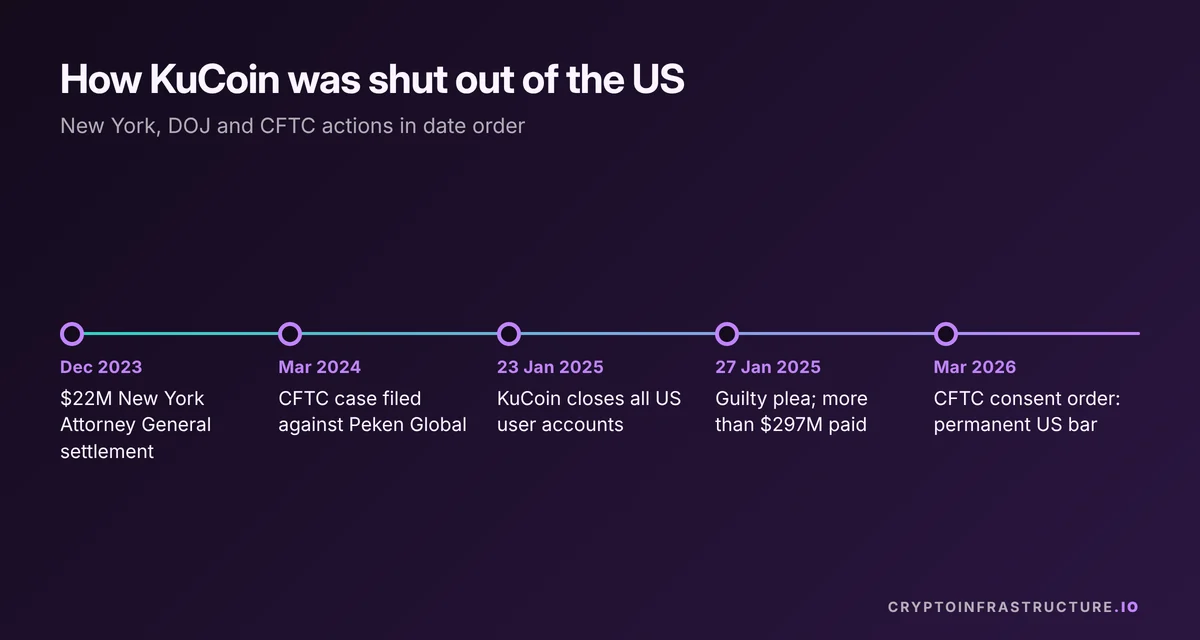
Before all this, New York had already acted. KuCoin agreed in December 2023 to pay $22 million to settle the New York Attorney General’s lawsuit: $16.77 million in refunds to New York customers and $5.3 million to the state and to close New York accounts within 120 days (CoinDesk, 12 December 2023).
Is KuCoin still banned in the USA and can you use it with a VPN?
Yes, it is still closed to US users and a VPN does not change that. KuCoin’s terms list “the United States and its territories” as a restricted location and require you to confirm you are not a resident of one. Article 19 lets KuCoin suspend an account and refuse access to your assets for breaching those undertakings. Using a VPN to get around the block puts your balance at risk of exactly that. If you are in the US and want a licensed option, see the best crypto exchanges in the US.
Can US users still withdraw from KuCoin?
KuCoin’s January 2025 announcement says US users with assets left after the 23 January 2025 deadline must withdraw through customer service, with a one-time fee of 30 USDT or the equivalent. Check your account and contact support through the official site only; this is exactly where fake “recovery” services target people.
Is KuCoin regulated? Licences by region
In some places, but there is no single “KuCoin licence” and the global platform you sign up to at kucoin.com does not name one. This is what the record shows.
| Region | KuCoin entity | Status | Source |
|---|---|---|---|
| European Union (EEA, except Malta) | KuCoin EU Exchange GmbH (FN 641084x, Vienna) | MiCA crypto-asset service provider authorisation granted 27 November 2025 (custody, exchange crypto-fiat and crypto-crypto, placing, transfers). New-business ban ordered 19 February 2026 and lifted 18 May 2026, but the FMA says “commencement of business operations remains prohibited” because governance conditions are not yet met. | FMA authorisation notice; FMA release, 18 May 2026 |
| Thailand | KuCoin Thailand (ERX Company Limited) | Exchange supervised by Thailand’s Securities and Exchange Commission, opened to all eligible Thai users in June 2025 at kucoin.th | KuCoin announcement, 13 June 2025; not confirmed on the Thai SEC register |
| Australia | Not named in the release | AUSTRAC digital currency exchange registration, announced November 2025 | KuCoin EU press release, 28 November 2025 (company claim) |
| India | Not confirmed | Reported as registered with FIU-IND as a virtual asset service provider | Datawallet, 4 August 2026; not confirmed on the FIU-IND register |
| South Korea | None | Not registered. The Financial Intelligence Unit ordered access to KuCoin’s website blocked in October 2026 as one of 27 unregistered foreign exchanges. | CryptoTicker; ForkLog |
| Global platform (kucoin.com) | Peken Global Limited | No licence named in the terms of use. Terms governed by Turks and Caicos law. | KuCoin terms of use, 29 September 2026 |
| Restricted by KuCoin | None | United States and its territories, Singapore, mainland China, Hong Kong, Malaysia, Kazakhstan, Uzbekistan, Ontario and British Columbia (Canada), France, the Netherlands and the occupied Crimea, Donetsk, Luhansk, Zaporizhzhia and Kherson regions of Ukraine. Russia and Belarus added: KuCoin ended services there with immediate effect on 29 October 2026, giving users individual withdrawal deadlines. | KuCoin terms of use, Article 17(5), 29 September 2026; KuCoin notice on Russia and Belarus; CoinDesk, 29 October 2026 |
The Austrian entries come from the FMA website. Thailand, Australia and India are as reported by KuCoin or third parties; confirm them on the Thai SEC, AUSTRAC and FIU-IND registers before relying on them.
Which countries have banned KuCoin?
Two formal national blocks stand out. The US is the clearest legal block, through the DOJ plea and the CFTC court order. South Korea is the second: in October 2026 its Financial Intelligence Unit ordered access to KuCoin’s website blocked, alongside 26 other unregistered foreign exchanges, after the Korea Communications Standards Commission approved the request (CryptoTicker). Most of the rest of the list is KuCoin restricting itself to comply with local rules, not a formal ban. The newest addition is Russia and Belarus, where KuCoin ended services on 29 October 2026 (The Moscow Times). Note the European twist: France and the Netherlands are on KuCoin’s own restricted list and the Austrian entity that would serve the EU under MiCA was still not allowed to start business according to the FMA’s latest notice of 18 May 2026. If you are in the EU, check which company you are signing up with.
What a licence does not mean
A licence means a regulator can supervise and fine the company. It does not guarantee your balance. And a licence held by one KuCoin company does not cover your account if you are actually signed up with another, such as the global platform.
Does KuCoin have proof of reserves?
Yes. KuCoin publishes it on its proof of reserves page. This is what it showed:
| Item | What KuCoin publishes |
|---|---|
| Method | Merkle tree. User balances are hashed into a single root so you can check your own balance is included and compare total user assets with on-chain wallet totals. |
| Who checked it | The page says backing is verified “by an independent third party” but does not name the firm or link a report. Some reviews call it Hacken-audited; that is not stated on the page. |
| Snapshot | 30 September 2026. The page shows two times for the same day (15:59:59 and 23:59:59 UTC+8) without explaining the difference. |
| Reserve ratios shown | BTC 109%, ETH 117%, USDT 110%, USDC 127% |
| Scope | Four assets only. No total reserves, total liabilities or figure for other tokens. |
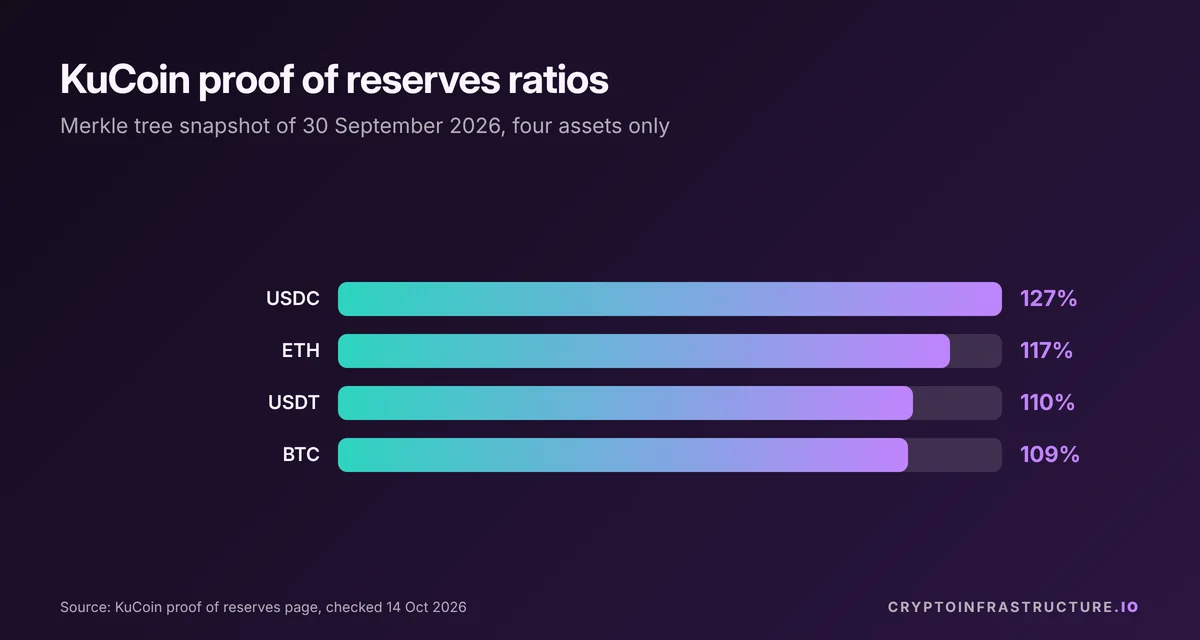
The limits matter as much as the ratios. A Merkle tree proof shows that on 30 September 2026 KuCoin’s tracked wallets held more of those four coins than its records said users were owed. It does not show KuCoin’s other debts, the hundreds of other tokens it lists, or anything after the snapshot. Several ranking pages quote “114% reserves” or “over 104%” with no date. Use the snapshot date, not a headline percentage, and check KuCoin’s page for newer snapshots.
Custody and cold storage: what KuCoin claims
Everything in this section comes from KuCoin, not an independent check.
- Certifications: KuCoin’s November 2025 press release cites SOC 2 Type II, ISO 27001:2022, ISO 27701 and CCSS. These cover security and privacy processes at audit time. They are not a guarantee against theft or insolvency.
- Cold storage: KuCoin’s security page gives no cold storage percentage. Reviews say most funds are in cold storage, but KuCoin’s own pages give no figure.
- Security spending: KuCoin’s own review blog (9 March 2026) says it committed $2 billion to security and compliance upgrades for 2026 to 2028. No breakdown is given.
Do you own your crypto on KuCoin?
KuCoin’s terms do not say clearly. Unlike some exchanges, they contain no statement that you are the legal owner of assets in your account and nothing on pooling or segregation of customer assets. They describe the platform as an “information intermediary service Platform” and cap KuCoin’s liability for a breach at “the total amount of service fees charged” for the transaction in question. Holding the keys yourself is the only way to remove that question. That means a self-custody wallet and a properly stored seed phrase.
Is KuCoin insured?
Not in any way you can claim on. The terms of use (29 September 2026) do not address insurance at all. KuCoin did use its own insurance fund after the 2020 hack (below), but that was its choice, the fund’s current size is not published and fiat balances carry no deposit insurance. Treat it as goodwill, not cover.
Has KuCoin ever been hacked?
Yes, once at scale. Ranking pages give the loss as anything from $275 million to $285 million; the figures below are the ones KuCoin itself published.
| Date | What happened | Client funds | Source |
|---|---|---|---|
| 26 September 2020 | Private keys for KuCoin hot wallets were exposed and about $281 million in Bitcoin, ERC-20 and other tokens was first reported taken. KuCoin’s later breakdown (below) adds up to $285 million. The North Korean Lazarus Group was blamed. | KuCoin said it recovered $222 million (78%) with exchange and project partners and $17.45 million (6%) with law enforcement and its insurance fund covered the remaining $45.55 million (16%). Together that is $285 million | CEO Johnny Lyu’s February 2021 update, as reported by Decrypt; 84% recovery figure reported by The Block, 11 November 2020 |
No later exchange-wide theft of client funds at KuCoin has been reported.
The recovery is a real point in KuCoin’s favour: users were made whole. But most of it depended on token projects and other exchanges freezing or reissuing stolen tokens, which is not something you can count on in another incident.
KuCoin’s enforcement history
| Date | Authority | What it was about | Outcome |
|---|---|---|---|
| 9 March 2023 (filed); 12 December 2023 (settled) | New York Attorney General | Offering tokens New York treated as securities, including ether, without registering | $22 million: $16.77 million refunds to New York users and $5.3 million to the state; New York accounts closed within 120 days |
| 27 January 2025 | US Department of Justice (Southern District of New York) | Operating an unlicensed money transmitting business. The DOJ said that “until at least July 2023, KuCoin did not require customers to provide any identifying information”, never registered with FinCEN, never filed suspicious activity reports and served about 1.5 million registered US users from September 2017 to March 2024 | Guilty plea; more than $297 million ($184.5 million forfeiture, about $112.9 million fine); US exit for at least two years; founders’ deferred prosecution agreements |
| 30 March 2026 (announced) | CFTC (US District Court, Southern District of New York) | Letting US participants trade without registering as a foreign board of trade; case filed 26 March 2024 | Consent order: permanent injunction and $500,000 civil penalty. Peken neither admitted nor denied the allegations. Claims against Mek Global, PhoenixFin and Flashdot were dismissed. |
| 19 February 2026 | Financial Market Authority (FMA), Austria | AML Officer and Sanctions Compliance Officer roles at KuCoin EU no longer filled as required | Ban on new business, lifted 18 May 2026. A separate decision of 18 February 2026 still prohibits starting business operations. |
| October 2026 | Financial Intelligence Unit, South Korea | Serving Korean users without registering as a virtual asset service provider | Website access block ordered for KuCoin and 26 other unregistered foreign exchanges |
DOJ figures are from the DOJ press release (27 January 2025). CFTC details from Crowdfund Insider and Yahoo Finance (31 March 2026); New York from CoinDesk (12 December 2023); Austria from the FMA; South Korea from CryptoTicker and ForkLog. Some ranking pages give the DOJ total as $300.5 million or say it was paid to the SEC; the DOJ figure is just over $297 million.
None of these actions found that customer money was missing. They are about licensing and anti-money-laundering controls. They matter to you because a weak compliance record raises the chance of sudden account freezes, product withdrawals or regional exits, which is exactly what happened to US and New York users and in October 2026 to users in Russia and Belarus. For how no-KYC access and enforcement connect, see the guide to no-KYC exchanges.
Can you lose your crypto on KuCoin?
Yes, in several ways that none of the above removes:
- Exchange failure: no insurance, no stated ownership or segregation of your assets and liability capped at fees.
- Frozen access: the terms let KuCoin suspend accounts without notice for security reasons and exclude liability for freezes imposed by regulators.
- Region changes: US users were given one week’s notice in January 2025 and users in Russia and Belarus lost service with immediate effect in October 2026. If your country is added to the restricted list, you may only be able to withdraw.
- Account takeover and scams: phishing sites, fake support agents and “account recovery” offers target exchange users, especially those cut off from a platform.
- Trading losses: futures and leverage can lose more than you expect and none of the protections above cover them.
Is KuCoin safer than Binance?
Don’t trust a one-word ranking. Both have US criminal pleas on record, both publish Merkle tree proof of reserves and both serve users through different companies in different regions. Compare the same six points for each: which company serves your country, the latest proof of reserves and who checked it, custody terms, insurance, incident history and enforcement history. Binance’s record is set out in the Binance safety review and OKX’s in the OKX review. For a side-by-side of Binance against a US-licensed exchange, see Kraken vs Binance. The full series is in the Exchanges section.
How to reduce the risk you control
- Check you are allowed to use it. Read the restricted list in the terms before you deposit and don’t use a VPN to get around it.
- Type the address yourself rather than following ads, referral links or messages.
- Use an authenticator app or passkey rather than SMS. Set an anti-phishing code and a withdrawal address whitelist.
- Treat any “KuCoin support” contact as suspect, especially if it asks you to move funds or pay a fee to unlock them.
- Keep only what you are actively trading on the exchange. Move long-term holdings to a wallet you control.
What this means for you
KuCoin is a real exchange that publishes proof of reserves and made users whole after its 2020 hack. It is also an exchange whose operator pleaded guilty in the US in January 2025, is permanently barred from US users by a March 2026 court order, has been blocked in South Korea and whose MiCA-licensed EU company is still not allowed to start operating. Its terms offer no insurance, no clear ownership statement and a liability cap at fees. If you are in the US, the answer is simple: you can’t use it. Elsewhere, the risk that remains is counterparty risk: you are trusting KuCoin’s solvency and its rebuilt compliance with whatever you leave on it. Hold an amount that matches that trust and check which KuCoin company you are actually dealing with.
For the same evidence check on other platforms, see the Exchanges section.
This review is general information, not financial advice. Cryptoassets are volatile and uninsured; nothing here is a recommendation to use any platform or hold any asset. See the site’s disclaimer.