In the US, NFTs are digital assets and are taxed as property: buying an NFT with crypto, selling it or swapping it for another NFT is a taxable disposal and the gain is a capital gain for collectors or ordinary income for creators selling in a business. Some NFTs can be taxed as collectibles at up to 28% on long-term gains instead of the usual 0%, 15% or 20%: under IRS Notice 2023-27 the IRS looks through to the asset or right the NFT represents. Brokers report NFT sales on Form 1099-DA and under an optional aggregate method they can skip reporting if your NFT proceeds for the year are $600 or less, but you still have to report every sale. The crypto wash-sale bill H.R. 10357 is written for fungible assets, so it would not appear to reach NFTs. In the UK each NFT is its own asset for capital gains tax and in India NFTs are virtual digital assets taxed at 30%.
NFT taxes trip people up because the asset does not behave like a coin. Each token is unique, you often pay for it in ether rather than dollars, gas is charged on every step and some NFTs fall under the higher US tax rate for art and collectibles while others do not. Many of the pages ranking for this topic are written by crypto tax software firms and repeat the same capital gains outline; several leave out the collectibles test, the Form 1099-DA rules for NFTs or the wash-sale bill moving through Congress. This guide explains how NFT taxes work for collectors and creators, using IRS, HMRC and Indian Income Tax Department sources, with hypothetical worked examples and notes for the UK and India.
How are NFTs taxed in the US?
The IRS treats NFTs as digital assets and digital assets as property. The IRS Digital assets page defines a digital asset as “any digital representation of value recorded on a cryptographically secured, distributed ledger” and lists non-fungible tokens as an example next to cryptocurrencies and stablecoins. Digital assets are “considered property, not currency.”
That gives you two kinds of NFT tax:
- Capital gains tax when you dispose of an NFT (or the crypto you paid with) for more or less than its cost basis. This is the collector or investor side.
- Income tax on money you earn from NFTs: sales of NFTs you create as a business, royalties and NFTs or tokens received as payment or rewards. This is the creator side.
Every return also carries the digital asset question on Form 1040, which asks whether during the year you received a digital asset as a reward, award or payment, or sold, exchanged or otherwise disposed of one. If you bought, sold or minted NFTs, the answer is usually yes.
Which NFT transactions are taxable?
| What you do | Taxable? | How (US federal) |
|---|---|---|
| Buy an NFT with dollars | No | Your cost, including fees, becomes the NFT’s basis |
| Buy an NFT with ETH, SOL or another crypto | Yes | You dispose of the crypto: gain or loss on the coins spent. IRS virtual currency FAQ 16 says exchanging virtual currency for “other property” produces a capital gain or loss |
| Sell an NFT for dollars or crypto | Yes | Capital gain or loss for a collector; ordinary income for a creator selling in a business |
| Swap one NFT for another | Yes | A disposal of the NFT you give up, at the value of what you receive |
| Mint an NFT and pay gas in crypto | Yes, the gas payment is taxable | Spending crypto on gas is a disposal of that crypto; the cost goes into the NFT’s basis (see below) |
| Receive royalties on secondary sales | Yes | Income when received, at fair market value |
| Receive an NFT as payment or reward | Yes | Ordinary income at fair market value (FAQ 9) |
| Hold an NFT, or move it between your own wallets | No | No disposal; gas paid for the transfer in crypto is itself a small disposal of that crypto |
Do you have to report NFTs if you don’t sell?
If you only bought an NFT with dollars and held it, there is no gain or loss to report, though you still answer the Form 1040 digital asset question. But many collectors who “never sold” did dispose of something: buying an NFT with ETH, paying gas in ETH or swapping NFTs are all disposals of property. Those belong on your return even if no dollars reached your bank.
Are NFTs collectibles? The 28% question
This is where NFTs differ from ordinary crypto. Under IRS Topic 409, long-term capital gains on most assets are taxed at 0%, 15% or 20%, but “net capital gains from selling collectibles (such as coins or art) are taxed at a maximum 28% rate.” Short-term gains on anything held one year or less are taxed as ordinary income either way.
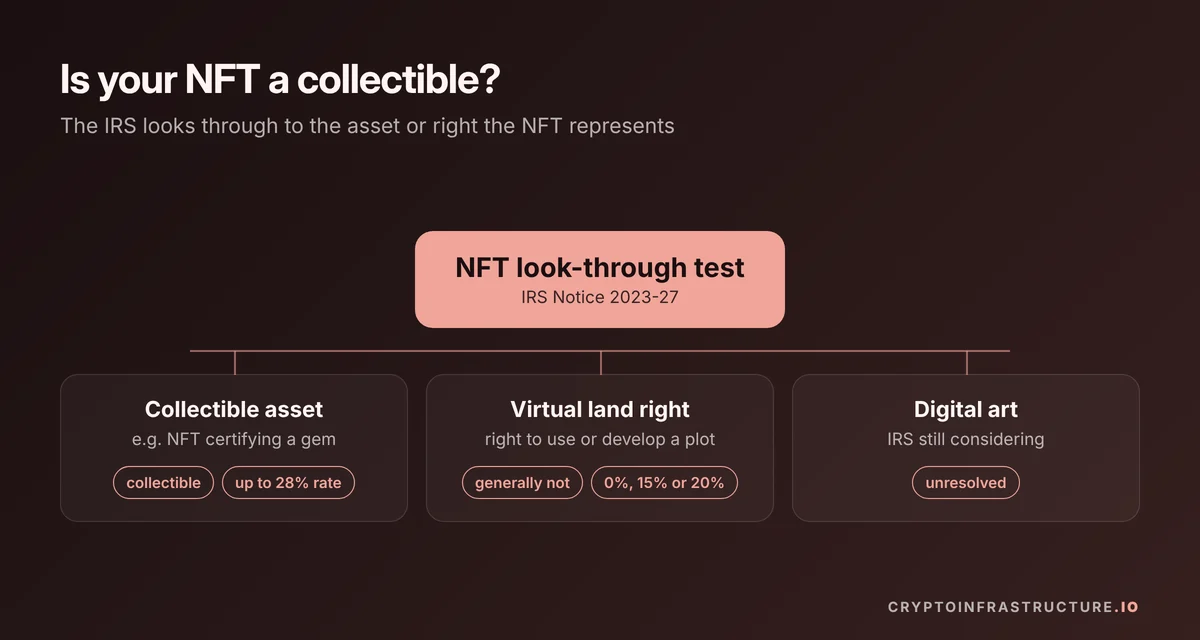
IRS Notice 2023-27 sets out how the IRS decides whether an NFT is a collectible under section 408(m). Until it issues further guidance, the IRS “intends to determine whether an NFT constitutes a section 408(m) collectible by analyzing whether the NFT’s associated right or asset is a section 408(m) collectible.” This is called the look-through analysis.
- The notice’s collectible example: an NFT that certifies ownership of a gem. A gem is a collectible, so the NFT is too.
- The notice’s non-collectible example: an NFT that gives a right to use or develop a plot of land in a virtual environment. That right “generally is not” a collectible.
- The open question: digital art. Treasury and the IRS said they are “considering the extent to which a digital file may constitute a ‘work of art.'” Many profile-picture and generative art NFTs sit in this unresolved area.
The notice asked for comments by 19 June 2023 and described its approach as interim. The IRS Digital assets page still points to Notice 2023-27 for NFTs as collectibles and no final collectibles rule for NFTs is listed there. Some ranking pages skip the collectibles question entirely and others present the 28% rate with more certainty than the IRS does. Neither helps you: it depends on what the NFT represents and for art-like NFTs the IRS has not decided.
Two details matter when you work out the cost. The 28% is a ceiling, not a flat rate: it only raises your tax if your ordinary bracket is above the long-term rate you would otherwise pay. And it only affects long-term gains (held more than one year), because short-term gains are already taxed at ordinary rates.
Cost basis: minting costs, gas and marketplace fees
Your basis is what you paid to acquire the NFT. IRS virtual currency FAQ 8 says basis is the amount spent “including fees, commissions and other acquisition costs in U.S. dollars.” For NFTs, that means:
- Buying: the purchase price plus the gas and marketplace fees you paid to acquire it.
- Minting: the mint price and gas. If you mint by paying 0.1 ETH, you have disposed of 0.1 ETH at its value that day and that value becomes part of the NFT’s basis.
- Selling: marketplace fees, creator royalties deducted from the sale and gas reduce the amount realised.
Because each NFT is unique, basis tracking is per token, which is easier than for coins bought in many lots. For the crypto you spend, FAQ 39 to 41 let you choose which units you are disposing of if you can identify them and prove their basis; otherwise first in, first out applies.
Worked example: a collector
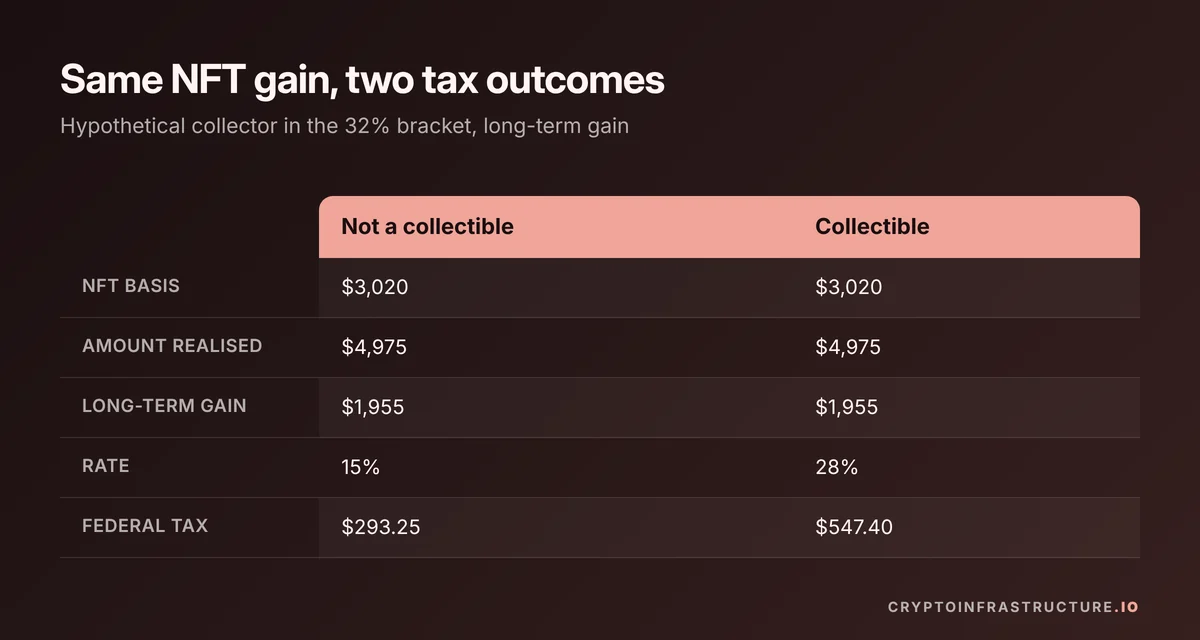
All figures are hypothetical. Assumptions: you are a US single filer whose ordinary income puts you in the 32% bracket and the 15% long-term capital gains bracket, there is no state tax and the net investment income tax is ignored.
- In January 2024 you bought 1 ETH for $2,000.
- In March 2025 you spent that 1 ETH, worth $3,000 at the time, on an NFT and paid $20 of gas from ETH that had cost you $12. You have disposed of crypto: a $1,000 gain on the 1 ETH and an $8 gain on the gas ETH, both long-term.
- Your basis in the NFT is $3,020: the $3,000 of ETH plus $20 of gas.
- In June 2026 you sell the NFT for ETH worth $5,000 and pay $25 of gas. Your amount realised is $4,975 and your gain is $1,955. You held it more than one year, so it is long-term.
| Item | If the NFT is not a collectible | If the NFT is a collectible |
|---|---|---|
| Long-term gain on the NFT | $1,955 | $1,955 |
| Rate | 15% | 28% (your 32% bracket is higher, so the 28% cap applies) |
| Federal tax on the NFT gain | $293.25 | $547.40 |
The collectibles question is worth $254.15 here. The ETH you received from the sale now has a $5,000 basis, so selling or spending it later is another taxable event. Had you sold within a year of buying, the $1,955 would be short-term and taxed at 32% in both columns.
NFT taxes for creators
If you create and sell NFTs, the first sale of your own work is generally not a capital gain. The IRS Digital assets page says sales to customers in a business go on Schedule C. Royalties work the same way: the IRS has no NFT-specific royalty guidance and the tax guides from Awaken, CoinTracking and Holland & Knight (via Simmons & Simmons) all treat royalties as ordinary income, reported when you receive them at their fair market value.
If your NFT work is a business, self-employment tax applies too. IRS Topic 554 says you usually owe it if your net earnings from self-employment are $400 or more, at a rate made up of 12.4% for Social Security and 2.9% for Medicare, calculated on Schedule SE. In return, you can deduct business costs such as gas, minting fees and marketplace fees.
If it is a hobby, the income is still taxable, but you lose the business deductions. The Holland & Knight guide on Simmons & Simmons notes that hobbyists cannot deduct gas fees and one of the top-ranking vendor pages tells hobby creators to report net proceeds after costs, which conflicts with that. Whether you are running a business depends on facts such as profit motive and regularity, which is a question for a tax professional.
Worked example: a creator
Hypothetical and treated as a business. In 2026 you mint 10 NFTs and pay $150 of gas. You sell all 10 on first sale for a total of $1,500 (value of the ETH received) and the marketplace keeps $37.50 in fees. Secondary sales later in the year pay you $400 of royalties.
| Item | Amount |
|---|---|
| First-sale proceeds | $1,500.00 |
| Royalties received | $400.00 |
| Less gas and marketplace fees | ($187.50) |
| Net profit on Schedule C | $1,712.50 |
That $1,712.50 is taxed at your ordinary income rate and because it is above $400, self-employment tax applies on Schedule SE (15.3% before the Schedule SE adjustments). The ETH you received has a basis equal to its value on receipt, so when you later sell it, any change in value is a separate capital gain or loss.
Form 1099-DA and the $600 NFT rule
Brokers, including marketplaces and platforms that qualify as brokers, report digital asset sales on Form 1099-DA. The IRS Digital assets page says gross proceeds reporting applies to transactions from 1 January 2025 and basis reporting to certain transactions from 1 January 2026.
NFTs get their own rules. The 2026 Instructions for Form 1099-DA (last updated 30 April 2026) define a “specified NFT” as a digital asset that is “indivisible, unique” and does not give an interest in certain excluded property. For these:
- Optional aggregate reporting. A broker “may report all of a customer’s specified NFT transactions together on a single Form 1099-DA”, with box 11a checked for specified NFTs.
- $600 de minimis. A broker using that method “is not required to report sales of specified NFTs if the customer’s aggregate gross proceeds” for the year, after allocable transaction costs, “do not exceed $600.”
- Creators are flagged separately. First sales by a creator or minter go in box 11c, separately from other NFT sales.
Two misreadings are common. The $600 figure is a broker reporting threshold under an optional method, not a tax-free allowance: you owe tax on an NFT gain of any size. And one top-ranking vendor page describes it as a general “Form 1099” rule from 2025, when the IRS text places it in the Form 1099-DA instructions as an option brokers may choose.
For how a broker form lines up with Form 8949 and what to do when basis is missing, see the Coinbase taxes and 1099-DA guide.
Can the IRS see your crypto wallet?
The IRS sees what brokers report: sales through a platform that issues Form 1099-DA reach the IRS with your name on them. A self-custody wallet does not file anything, but its transactions are recorded on a public blockchain and the purchases and sales that link to a broker account are reported. The sensible assumption for your records is that any NFT or crypto disposal can be traced and the Form 1040 question asks you directly.
How to report NFT taxes
- Gather every transaction from marketplaces, exchanges and wallets: purchases, mints, sales, swaps, royalties and gas.
- Work out basis per NFT including purchase or mint price, gas and fees and basis for the crypto you spent.
- Sort by holding period: one year or less is short-term, more than one year is long-term.
- Decide collectible or not for each long-term NFT gain, using the look-through test in Notice 2023-27 and keep a note of your reasoning.
- Report disposals on Form 8949 with totals on Schedule D, matching any Form 1099-DA you received.
- Report creator income on Schedule C (business) with Schedule SE, or as other income if it is a hobby; ordinary income from rewards goes on Schedule 1.
- Answer the digital asset question on Form 1040.
If you make $100,000 in crypto or NFTs, how much tax do you pay?
It depends on your profit, not the sale amount and on how long you held. A $100,000 NFT sale with a $70,000 basis is a $30,000 gain. Short-term, it is taxed at your ordinary rates. Long-term, Topic 409 sets the 0% band for single filers in 2025 at taxable income up to $48,350, 15% up to $533,400 and 20% above that. For 2026 the IRS raised those single-filer thresholds to $49,450 and $545,500 (Rev. Proc. 2025-32). If the NFT is a collectible, the rate can go up to 28%. Losses on other sales reduce the gain first and net losses beyond your gains offset up to $3,000 of other income a year ($1,500 if married filing separately), with the rest carried forward.
| Long-term rate (single filer) | 2025 taxable income | 2026 taxable income |
|---|---|---|
| 0% | Up to $48,350 | Up to $49,450 |
| 15% | $48,351 to $533,400 | $49,451 to $545,500 |
| 20% | Above $533,400 | Above $545,500 |
| Collectible NFTs (long-term) | Up to 28% | |
NFTs and the crypto wash-sale bill (H.R. 10357)
Selling an NFT at a loss and buying it back is less common than with coins, because each NFT is unique, but collectors do it with floor-priced items. The bill that would extend wash-sale rules to crypto matters here mostly for what it leaves out.
H.R. 10357, the Digital Asset Tax Certainty Act, was ordered reported by the House Ways and Means Committee by a 38-5 roll call vote at its 16 September 2026 markup (EY Tax News, 16 September 2026). No vote by the full House has been reported. The Joint Committee on Taxation’s description of the bill (JCX-47-26, 14 September 2026) extends the wash-sale rule to “traded digital assets”, defined as assets where “the asset is fungible”, quotations are readily available on an exchange and the asset is not a tokenized digital asset. NFTs are by definition non-fungible. The JCT text does not mention NFTs explicitly, so the most that can be said is that, as drafted, they appear to fall outside the wash-sale extension; the Treasury could still write anti-abuse rules. The bill is not law. For how it would affect coin trades, including its proposed September 2026 effective date, read the tax-loss harvesting guide.
NFT taxes in the UK
HMRC has no separate NFT tax regime. Its Cryptoassets Manual (CRYPTO10100, updated 28 November 2025) says “the tax treatment of all types of tokens is dependent on the nature and use of the token and not the definition of the token.” For an individual collector, that usually means capital gains tax on disposal, at 18% or 24% (the rates that have applied since 30 October 2024), above a £3,000 annual exempt amount for 2026-27, according to GOV.UK.
The key NFT difference is in the matching rules. For fungible tokens, HMRC pools each token type and applies same-day and 30-day rules. CRYPTO22200 states: “Non-Fungible Tokens (NFTs) are separately identifiable and so are not pooled and no matching rules are applied.” So each NFT has its own cost and its own gain or loss and the 30-day rule that limits loss harvesting on coins does not apply. HMRC’s guidance for platforms reporting under the Cryptoasset Reporting Framework (IEIM8000515, updated 31 July 2026) takes the same view: each non-fungible unit is treated as a separate type of cryptoasset. If you create and sell NFTs as a trade, income tax rather than CGT can apply; the manual covers this in its business section. The UK crypto tax guide covers rates, allowances and reporting in full.
NFT taxes in India
India taxes NFTs inside its virtual digital asset (VDA) regime. The Income Tax Department’s VDA page says VDAs “include crypto assets, Non-Fungible Tokens (NFTs), and any other digital assets” and that income from transferring them is “taxed at a flat rate of 30% plus surcharge and cess” and “computed without any deduction except for the cost of acquisition.” Selling costs such as marketplace fees and gas therefore do not reduce the taxable gain. The no-loss-set-off rule, 1% TDS and the new Income-tax Act, 2025 section numbers are covered in the India crypto tax guide.
For Canada, Australia and other countries, see How Is Crypto Taxed? The 2026 Guide.
Common NFT tax mistakes
- Forgetting the crypto leg. Buying an NFT with ETH that has risen in value creates a gain on the ETH, even if the NFT later loses money.
- Leaving gas out of basis. Mint and purchase gas belongs in basis; leaving it out overstates your gain.
- Assuming every NFT is taxed like a coin, or like art. The collectibles test depends on what the NFT represents and for digital art it is unresolved.
- Treating $600 as a tax-free amount. It is a broker reporting threshold under an optional method.
- Reporting creator sales as capital gains. Sales of your own work in a business are ordinary income, with self-employment tax.
What this means for you
US NFT taxes follow property rules: disposals produce capital gains or losses, creator sales and royalties are ordinary income and gas and fees go into basis or reduce proceeds. The open question is the collectibles rate: under Notice 2023-27, an NFT tied to a collectible faces up to 28% on long-term gains and digital art remains undecided, so record what each NFT represents and why you classified it as you did. Expect Form 1099-DA from platforms that act as brokers, but report every sale whether or not a form arrives. The crypto wash-sale bill, as drafted, targets fungible assets. Because classification, business status and basis can change the result a lot, it is worth having a tax professional review your NFT activity before you file.
For the wider picture, read How Is Crypto Taxed?, the Coinbase taxes and 1099-DA guide, the tax-loss harvesting guide and Crypto Tax in the UK. The site’s methodology explains how sources are checked.
This guide is general information, not tax advice. Tax treatment depends on your circumstances and can change; speak to a qualified tax professional before filing. See the site’s disclaimer.