Crypto tax-loss harvesting means selling crypto that is worth less than you paid, so the realised loss offsets your capital gains and up to $3,000 a year of ordinary income ($1,500 if married filing separately), with any excess carried forward. As of 14 October 2026, the US wash-sale rule in IRC section 1091 still covers only “stock or securities”, and the IRS treats crypto as property, so selling and buying back the same coin does not trigger it under current law. That could change: the House Ways and Means Committee ordered H.R. 10357, the Digital Asset Tax Certainty Act, reported 38-5 on 16 September 2026. As approved in committee it would extend wash-sale rules to traded digital assets for dispositions after 14 September 2026. It is not law, but if it passes as written, it would reach back to sales you make now.
Crypto tax-loss harvesting gets pitched as a free move: sell at a loss, buy straight back, cut your tax bill. Most pages ranking for this topic repeat that line without saying what has changed this autumn. A bill to close the crypto wash-sale gap cleared committee on 16 September 2026, and the version approved there would apply to sales from 14 September 2026, so the year-end trades people are planning now are exactly the ones it would catch. This guide explains how harvesting works under US federal rules, what the wash-sale rule says and why crypto sits outside it today, where the bill stands, the economic substance doctrine that can apply regardless, a worked example with stated numbers, and how the UK and India treat the same trade.
What is crypto tax-loss harvesting?
Tax-loss harvesting is selling an asset that has fallen below your purchase price so the loss is realised (counted for tax) in the current year. A loss you have not sold is an unrealised, paper loss and does nothing for your taxes. Once realised, the loss reduces your capital gains for the year.
It works for crypto because the IRS treats it as property. IRS Notice 2014-21 states that “for federal tax purposes, virtual currency is treated as property” and that “general tax principles applicable to property transactions apply.” For most holders, crypto is a capital asset, so a sale produces a capital gain or a capital loss.
Do you have to pay tax on crypto if you lose money?
No tax is due on a loss itself. A realised loss reduces your tax: it offsets gains first and then a limited amount of other income. You still have to report the sale. Losses go on Form 8949 and Schedule D like gains do, and the IRS receives a copy of many sales from brokers on Form 1099-DA (see the next sections).
How it works: the US loss rules
According to IRS Topic 409 (last updated 24 September 2026), these are the rules that decide what a harvested loss is worth:
| Rule | What it means for a harvested loss |
|---|---|
| Holding period | Held more than one year: long-term. One year or less: short-term. Short-term gains are taxed at your ordinary income rates; long-term gains at 0%, 15% or 20%. |
| Netting | Losses offset gains in the same year. A loss that offsets short-term gains saves tax at your ordinary rate, which is usually higher than the long-term rate. |
| $3,000 limit | If your losses exceed your gains, you can deduct the lesser of $3,000 ($1,500 if married filing separately) or your net loss against other income. |
| Carryforward | Net capital loss above that limit carries forward to later years. |
| Reporting | Sales go on Form 8949, totals on Schedule D (Form 1040). |
The sale has to happen in the tax year you want the loss in. For a calendar-year individual, that means a trade that executes by 31 December.
Your broker now reports these sales
The IRS Digital assets page (last updated 2 September 2026) says brokers must report gross proceeds for transactions from 1 January 2025 and basis on certain transactions from 1 January 2026, on Form 1099-DA. For harvesting, that matters in two ways. The IRS sees the sale, so your Form 8949 has to match it. And if you moved coins into an exchange from elsewhere, the broker may not know your real cost, so a loss can show up smaller (or as a gain) on the form. The Coinbase taxes guide walks through how 1099-DA handles transferred-in crypto and which Form 8949 boxes to use.
Does the wash-sale rule apply to crypto?
Not under current federal law, as of 14 October 2026. The wash-sale rule in IRC section 1091 disallows a loss “from any sale or other disposition of shares of stock or securities” when you acquire “substantially identical stock or securities” within a window running 30 days before to 30 days after the sale. The statute does not mention digital assets. The Joint Committee on Taxation’s description of H.R. 10357, published for the September 2026 markup, puts it this way: “Digital assets are not expressly within the scope of section 1091,” and “the IRS has not issued regulations or guidance addressing whether the wash sale rule may apply.”
That is why you can sell bitcoin at a loss and buy it back the same day without section 1091 disallowing the loss. With stocks, doing the same thing inside 61 days defers the loss: section 1091(d) adds it to the basis of the replacement shares instead.
Two limits on the “loophole” framing used by many ranking pages:
- It covers direct crypto only. Section 1091 already applies to stock and securities, so products structured as securities (for example shares of an exchange-traded fund that holds crypto) are a different question from coins you hold directly. Check the product, not the underlying asset.
- Other doctrines still apply. The absence of a wash-sale rule does not mean every sale-and-rebuy is beyond challenge. See the economic substance section below.
The bill that would change it: H.R. 10357
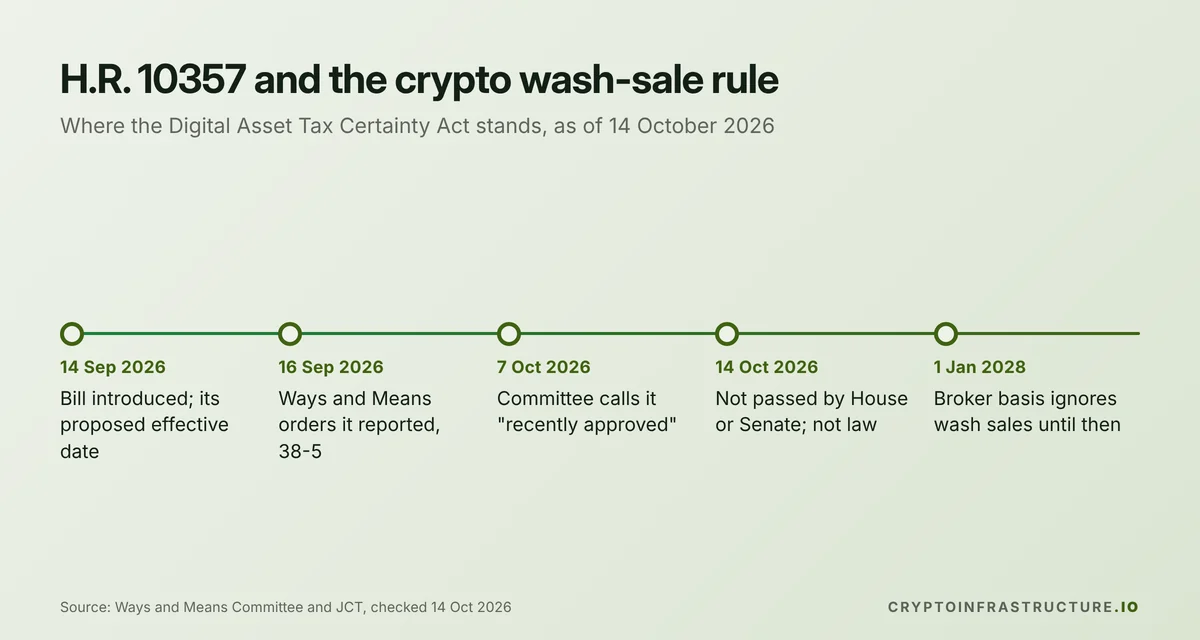
H.R. 10357, the Digital Asset Tax Certainty Act, was introduced on 14 September 2026. At its 16 September 2026 markup, the House Ways and Means Committee adopted Chairman Jason Smith’s substitute amendment by voice vote and ordered the bill reported to the House by a roll call vote of 38 yeas to 5 nays. A committee statement on 7 October 2026 describes it as “recently approved by the Ways and Means Committee”; as of 14 October 2026 it had not passed the full House or the Senate and is not law.
What the wash-sale part would do, according to the JCT description of the bill (checked 14 October 2026):
| Provision | As described by the JCT |
|---|---|
| Scope | Extends the wash-sale rule “to certain digital assets and certain related derivatives” |
| Which assets | “Traded digital assets”: fungible, with quotations readily available on an exchange, and not a tokenized digital asset. Wrapped assets follow their reference asset |
| Stablecoins | A qualified U.S. dollar stablecoin is excluded for dollar-based taxpayers |
| Substantially identical | Tokenized and wrapped assets can be treated as substantially identical to the stock, security or traded digital asset they are economically equivalent to |
| Staking and mining | Units acquired in connection with validating transactions are excluded, as are regular-series acquisitions included in ordinary income |
| Broker reporting | For dispositions before 1 January 2028, a broker’s reported basis ignores section 1091 for these assets |
| Effective date | Dispositions after the date of introduction. The JCT’s description of the chairman’s substitute replaces that wording with “September 14, 2026” |
The effective date is the part to take seriously. If the bill becomes law in its committee form, a crypto loss sale made after 14 September 2026 and paired with a purchase of the same asset within 30 days would be a wash sale, even though it was legal to do without consequence when you did it. Bills often change before passage, effective dates included, and Congress may not act on this one at all. But you cannot assume a December sale-and-rebuy is outside the rule until the outcome is known. The broker transition also means your 1099-DA would not flag a wash sale for you through 2027: tracking it would be your job.
For the wider picture of US crypto legislation this autumn, see the October 2026 regulation roundup.
The economic substance doctrine still applies
Even without a wash-sale rule, the IRS can deny a tax benefit from a transaction that lacks economic substance. The test is written into the Code at IRC section 7701(o). Where the doctrine is relevant, a transaction has economic substance only if:
- it “changes in a meaningful way (apart from Federal income tax effects) the taxpayer’s economic position”, and
- “the taxpayer has a substantial purpose (apart from Federal income tax effects) for entering into such transaction.”
For individuals, section 7701(o)(5)(B) applies the test only to transactions “entered into in connection with a trade or business or an activity engaged in for the production of income.” Holding crypto as an investment can fall within the phrase “activity engaged in for the production of income”, so you should not assume the doctrine is irrelevant to you.
Whether a sell-and-immediately-rebuy trade passes this test has not been settled by any IRS guidance or court decision found for this article. A sale and repurchase seconds apart, at the same price, on the same platform, changes your position very little. One that leaves you out of the market for a period, or moves you into a different asset, changes it more. That is a risk judgement, not a rule, and it is the kind of question to put to a tax professional before you rely on a large harvested loss.
Worked example: what harvesting saves (and what it defers)
All figures are hypothetical. Assumptions: you are a US single filer in the 24% ordinary bracket and 15% long-term bracket, the year is 2026, fees are ignored, no state tax, and the wash-sale bill is not law.
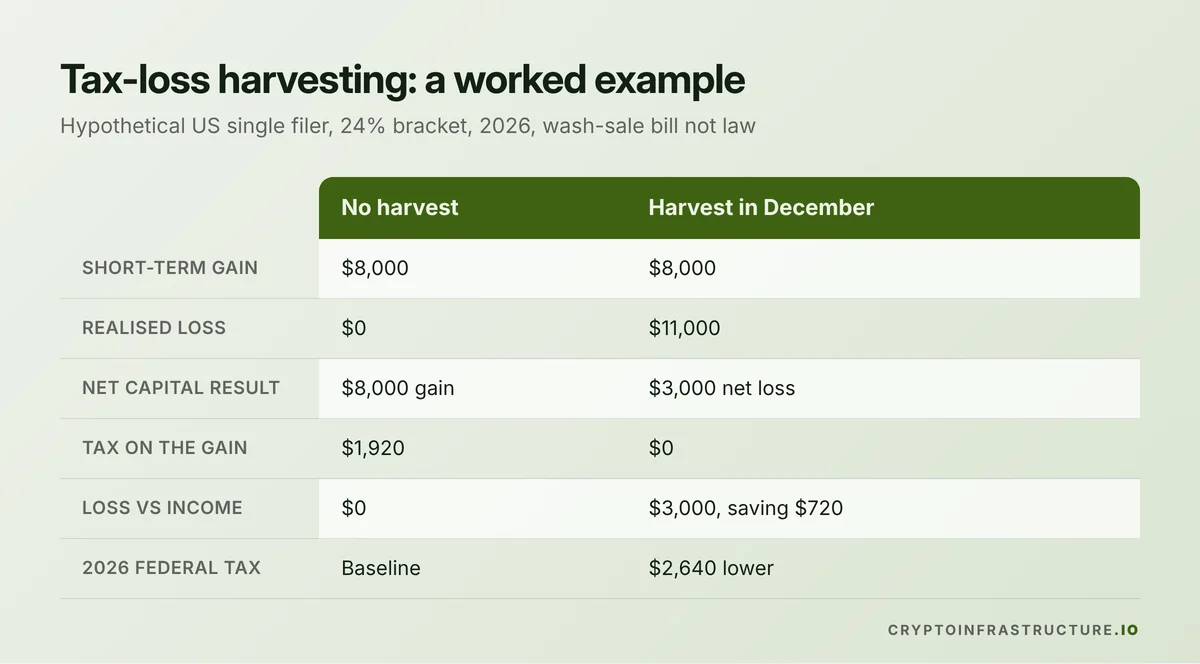
- Earlier in 2026 you sold Token X for an $8,000 short-term gain.
- You hold Token Y, bought in March 2026 for $20,000, now worth $9,000: an $11,000 unrealised short-term loss.
| Item | No harvest | Harvest: sell Token Y in December |
|---|---|---|
| Short-term gain (Token X) | $8,000 | $8,000 |
| Realised loss (Token Y) | $0 | $11,000 |
| Net capital result | $8,000 gain | $3,000 net loss |
| Tax on the gain at 24% | $1,920 | $0 |
| Loss used against ordinary income | $0 | $3,000 (the annual limit), saving $720 at 24% |
| Carryforward to 2027 | $0 | $0 |
| Federal tax difference for 2026 | $2,640 lower |
Now the part most examples skip. If you buy Token Y back at $9,000, your new cost basis is $9,000, not $20,000. If you later sell it for $20,000, you have an $11,000 gain. Held more than a year at 15%, that is $1,650 of tax. Harvesting moved tax from 2026 to a later year and, in this example, from a 24% rate to a 15% rate. It did not make the $11,000 disappear.
The same trade if H.R. 10357 passes as approved
Keep everything the same, but you rebuy Token Y within 30 days and the bill becomes law with the 14 September 2026 effective date. Under the section 1091 mechanics, the $11,000 loss would be disallowed for 2026 and added to the basis of the repurchased tokens. Your 2026 tax would be the $1,920 from the no-harvest column, and the loss would only count when you sell the replacement tokens without triggering another wash sale. Waiting more than 30 days to rebuy, or not rebuying, avoids that outcome under the bill as described; it also means a period in which you do not hold the asset.
How much does tax-loss harvesting save?
There is no fixed figure. The saving depends on the gains you have to offset, whether they are short- or long-term, your bracket, and whether you rebuy. Offsetting short-term gains is worth more per dollar than offsetting long-term gains. Beyond your gains, the benefit is capped at $3,000 of ordinary income a year, with the rest carried forward. And because a rebuy resets your basis lower, part of what you save now usually comes back as tax later.
If you make $100,000 in crypto, how much tax do you pay?
It depends on your profit, not the amount you cash out, and on how long you held. A $100,000 sale of coins that cost $90,000 is a $10,000 gain. If that gain is short-term it is taxed at your ordinary income rates; if long-term, at 0%, 15% or 20%. For 2025, Topic 409 sets the 0% long-term band at taxable income up to $48,350 for single filers and the 15% band up to $533,400, with 20% above that. Harvested losses reduce the gain before any of those rates apply.
When harvesting does not help, and common mistakes
- No gains and small income. If you have no gains to offset, the most you can use in a year is $3,000 against income. The rest waits in carryforward.
- Long-term gains in the 0% band. Offsetting a gain that would have been taxed at 0% saves nothing now and lowers your basis for later.
- Fees and spreads. Selling and rebuying costs trading fees, spread and possibly network fees on each leg. On small losses these can exceed the tax saved.
- Wrong lot sold. If you hold the same coin bought at different prices, the loss depends on which units you sell. Make sure your exchange or records identify the high-cost lot; a default lot method may sell a cheaper lot instead.
- Trusting the 1099-DA basis. Coins transferred in from another wallet can show missing or $0 basis, which turns a real loss into a reported gain unless you correct it on Form 8949.
- Assuming “no wash-sale rule” is permanent. See H.R. 10357 above. Keep dated records of every loss sale and repurchase so you can apply the rule if it arrives retroactively.
Outside the US: the UK and India
The wash-sale question looks different elsewhere. For a five-country overview, see How Is Crypto Taxed? The 2026 Guide.
| Country (checked 14 October 2026) | Can you harvest a crypto loss? | Repurchase rule |
|---|---|---|
| United Kingdom | Yes, losses offset capital gains | The 30-day “bed and breakfasting” rule: tokens of the same type bought within 30 days after a disposal are matched to that disposal instead of the pool (HMRC Cryptoassets Manual CRYPTO22200, TCGA 1992 section 106A). A same-day rule applies first |
| India | No | Not relevant: a loss on a virtual digital asset cannot be set off against other income or carried forward, and income from a transfer is taxed at 30% with only the cost of acquisition deductible |
In the UK, the effect of the 30-day rule is that selling and buying back within 30 days usually gives you little or no loss, because the disposal is matched against the new, similar-priced purchase. The UK crypto tax guide covers rates, the annual exempt amount and pooling. In India, the Income Tax Department’s VDA page confirms the flat 30% rate and that only the cost of acquisition is deductible; the India crypto tax guide covers the no-set-off rule and how to report a loss in Schedule VDA.
What this means for you
As of 14 October 2026, US federal law lets you realise a crypto loss and buy the same asset back without a wash-sale disallowance, and the loss offsets your gains plus up to $3,000 of other income a year. Two things limit that. H.R. 10357 has cleared committee with a wash-sale extension that, as approved, would apply to dispositions after 14 September 2026; it is not law, but a rebuy within 30 days carries the risk that it becomes one in that form. And the economic substance doctrine can apply whether or not the bill passes. Keep records of every loss sale and repurchase with dates and lot details, check the 1099-DA basis against your own, and treat the saving as deferral as well as reduction. Because the outcome depends on your gains, bracket, holding periods and the bill’s progress, it is worth having a tax professional review a large harvest before year-end.
For what brokers report and how to file, read the Coinbase taxes guide. For other countries, see How Is Crypto Taxed?, Crypto Tax in the UK and Crypto Tax in India, and the site’s methodology explains how sources are checked.