WAGMI stands for “we’re all gonna make it”, a crypto slang phrase people post to signal shared optimism that a community, a project or the market will come out ahead. Its opposite, NGMI (“not gonna make it”), mocks a person or decision expected to fail. DYOR means “do your own research”. HODL is a 2013 misspelling of “hold” that became a long-term holding slogan. FUD stands for “fear, uncertainty and doubt”. Google Trends data shows worldwide searches for “wagmi” were close to zero until spring 2021, rose sharply from September 2021 and peaked in January 2022. All five terms are harmless as jokes. Each can also be used to push you to buy, to keep holding or to ignore criticism, which is why this page lists the pressure use next to every meaning.
If you have scrolled crypto X, Discord or Telegram, you have seen replies that are nothing but “WAGMI”, “NGMI” or “DYOR”. The pages that rank for this question mostly come from exchanges and wallet makers. Most stop at the expansion of the acronym. This guide gives you the meaning, the earliest dated source available, an example sentence and the way each phrase gets used to pressure people, for five terms plus a few close relatives. It is a short slang explainer, not a full glossary. Nothing here is investment advice.
What does WAGMI mean?
WAGMI means “we’re all gonna make it”: a crypto slang phrase used to express shared optimism that a community, project or group of holders will succeed together. You will also see it written lowercase (“wagmi”) or as “we are all going to make it”.
Example: “Rough week for the market, but the devs shipped the upgrade on time. WAGMI.”
Where WAGMI came from
Ledger Academy’s glossary (updated 18 July 2023) traces the phrase to motivational videos by the late Russian-Australian bodybuilder Aziz “Zyzz” Shavershian. It says the phrase was popularised in 2021 by the r/wallstreetbets subreddit before spreading into crypto. Coinpaper’s explainer (updated 10 June 2024) gives the same story. Neither shows an early dated use of the acronym itself, so treat the Zyzz link as the commonly told origin rather than a documented one.
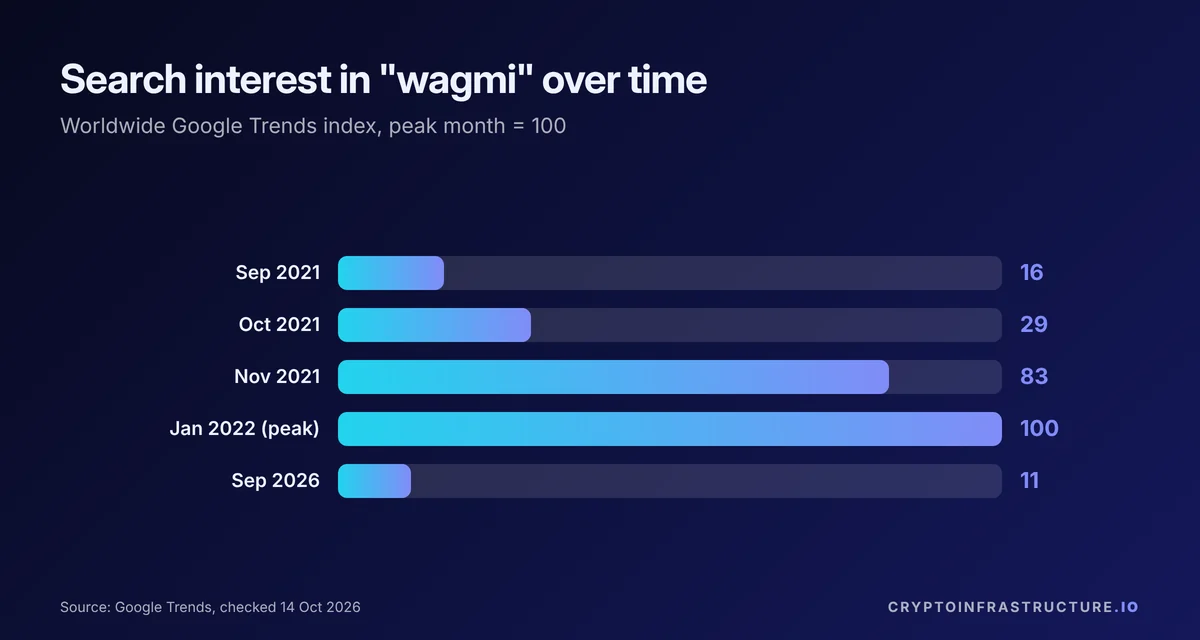
The 2021 timing is easier to verify. Worldwide Google Trends data for “wagmi” shows interest at or near zero from 2016 through February 2021, a first rise in spring 2021, then a steep climb: 16 in September 2021, 29 in October, 83 in November and a peak of 100 in January 2022. By September 2026 it stood at 11. One caveat: the search term also covers the Wagmi developer library and tokens that use the name, so the curve measures the word, not only the slang.
WAGMI is also a developer library
If you landed here from code, Wagmi is an open-source library of React Hooks for building Ethereum apps (accounts, wallets, contracts, transactions, signing). It borrows the slang name but has nothing to do with the phrase’s meaning.
How WAGMI is used to pressure people
Kraken’s own explainer (29 November 2024) notes that WAGMI “can also be used disingenuously”: someone who already holds a token posts it to pull others in, which helps push the price up for them. Ledger’s glossary adds the reverse use: people post WAGMI sarcastically to mock influencers who promote crypto for their own benefit or make unrealistic price calls. The test is simple. When “we” in “we’re all gonna make it” means “please buy what I hold”, it is a sales line. The site’s guide to KOLs and paid crypto promotion explains how creators are paid in discounted tokens to post exactly this kind of message. The memecoin guide shows how paid KOL posts feed new token launches.
What does NGMI mean?
NGMI means “not gonna make it” (sometimes “never gonna make it”). CoinMarketCap’s slang glossary describes it as a label for a person or company using the wrong tactics to succeed. It is the mirror image of WAGMI and usually appears as a one-word reply.
Example: “Sold the whole bag the day before the upgrade? NGMI.”
Origin: none of the sources cited here gives a dated first use. Coinpaper says only that NGMI appeared “shortly after” WAGMI took off in 2021.
Pressure use: NGMI is shame as a sales tool. Telling someone who sold, asked a sceptical question or skipped a launch that they are “not gonna make it” pushes them back toward buying and holding. Kraken’s explainer points out that the idea of avoiding “NGMI” projects rests entirely on the collective opinion of others. It recommends your own due diligence instead.
What does DYOR stand for in crypto?
DYOR stands for “do your own research”: examine a project’s documents, team, token distribution and audits yourself rather than relying on what someone posted.
Example: “Interesting tokenomics thread, but the unlock schedule isn’t public yet. DYOR.”
Origin: none of the sources cited here gives a dated first use; Binance Academy’s glossary and CoinMarketCap’s slang list make no origin claim.
Pressure use: DYOR is good advice turned into a disclaimer. Binance Academy notes that people often add it to social posts to signal that the post is personal opinion and not financial advice, and that responsibility for any decision still rests with you. In practice, a shill post ending in “DYOR” lets the poster promote a token and disown the result in the same breath. Real research means checking what the post does not tell you: who holds the supply, when insiders can sell and whether the poster holds it too. The guide to market cap vs FDV covers one of the first numbers to look at.
What does HODL mean?
HODL means to keep holding a crypto asset instead of selling, especially through price drops. Dictionary.com defines it as avoiding selling cryptocurrency, other digital assets or stocks, “especially over a long period of time”. It records it as first used in 2013 as a misspelling of “hold”.
Example: “Down 40% this month and I’m still not selling. HODL.”
The 2013 Bitcointalk post
The source is a thread on the Bitcointalk forum’s Speculation board titled “I AM HODLING”, posted by the user GameKyuubi on 18 December 2013 at 10:03 (forum time). The post opens by admitting the title is misspelled. Bitstamp’s explainer (29 July 2024) adds the context: Bitcoin had climbed from about $130 in April 2013 to around $950 by the time of the post. The typo became a meme, then a strategy name.
Does HODL stand for “hold on for dear life”?
Not originally. “Hold on for dear life” is a backronym, a phrase fitted to the letters after the word already existed. Bitstamp says plainly that this is not how the term started, even though CoinMarketCap’s glossary and many exchange pages now give it as the meaning.
How is HODL pronounced?
Dictionary.com lists three accepted pronunciations: “hod-l”, “hohd-l” or letter by letter, “H-O-D-L”.
How HODL is used to pressure people
HODL turns a personal choice into a loyalty test. In a falling market, “just HODL” can keep you in a position you would otherwise have reviewed, while the people saying it may be selling. Holding is a legitimate strategy for some people and assets; it is not a reason to stop reviewing what you hold.
What does FUD mean in crypto?
FUD stands for “fear, uncertainty and doubt”. Merriam-Webster lists it as an abbreviation with that meaning. In crypto, CoinMarketCap’s glossary uses it for negative news, such as regulation or criticism, and the price falls that may follow.
Example: “The exchange paused withdrawals and people are calling it FUD. It isn’t FUD if the withdrawals are actually paused.”
Origin: FUD is far older than crypto. The phrase “fear, uncertainty and doubt” appears in print from the 1920s. The tech-industry sense is usually credited to computer architect Gene Amdahl in 1975, describing IBM sales staff planting doubt in customers’ minds about rival products. In the 1990s it became associated with Microsoft’s marketing.
Pressure use: in crypto, “FUD” is often used to dismiss any bad news about a token someone holds. Calling a hack report, an enforcement action or a sceptical question “FUD” avoids answering it. When you see the word, ask whether the underlying claim is true; a sourced report is not FUD just because it is negative.
Close relatives: FOMO, GM, LFG, rekt and ape
These show up in the same threads. Definitions follow CoinMarketCap’s slang glossary, which says the origin of GM is unknown and gives no origins for the others.
| Term | Meaning | Example | Pressure use |
|---|---|---|---|
| FOMO | Fear of missing out on a price rise | “Everyone’s posting gains, the FOMO is real.” | Countdowns, “last chance” posts and screenshots of gains are built to trigger it |
| GM | “Good morning”, posted to spread positivity; variants include GN (good night) | “GM to everyone still building.” | Mostly harmless; “GM” raids on a project account can fake community size |
| LFG | “Let’s f***ing go”, an expression of excitement, for example after a price rise | “Listing confirmed. LFG!” | Hype replies that signal momentum and invite late buyers |
| Rekt | Misspelling of “wrecked”: someone who lost money, often through risky trades or leverage | “Got liquidated on a 50x long. Rekt.” | Used to mock losers, which pushes others to take bigger risks to avoid the label |
| Ape (ape in) | Buying into a project without due diligence, often driven by FOMO | “Didn’t read the docs, just aped in.” | Presented as bold; in practice it means skipping every check DYOR stands for |
One more word ties the list together. CoinMarketCap defines a shill as someone paid to promote a cryptocurrency who has a financial interest in its success. Most of the pressure uses above are what shilling sounds like in practice.
Why crypto slang works as pressure
Each term on this page compresses an argument into one word. The compression is the point. “WAGMI” asks you to trust the group, “NGMI” threatens exclusion if you don’t, “FUD” waves away bad news, “HODL” discourages selling, “DYOR” shifts responsibility to you and “ape” makes skipping research sound brave. Used together in a token’s comment section, they can make a coordinated promotion feel like a spontaneous community.
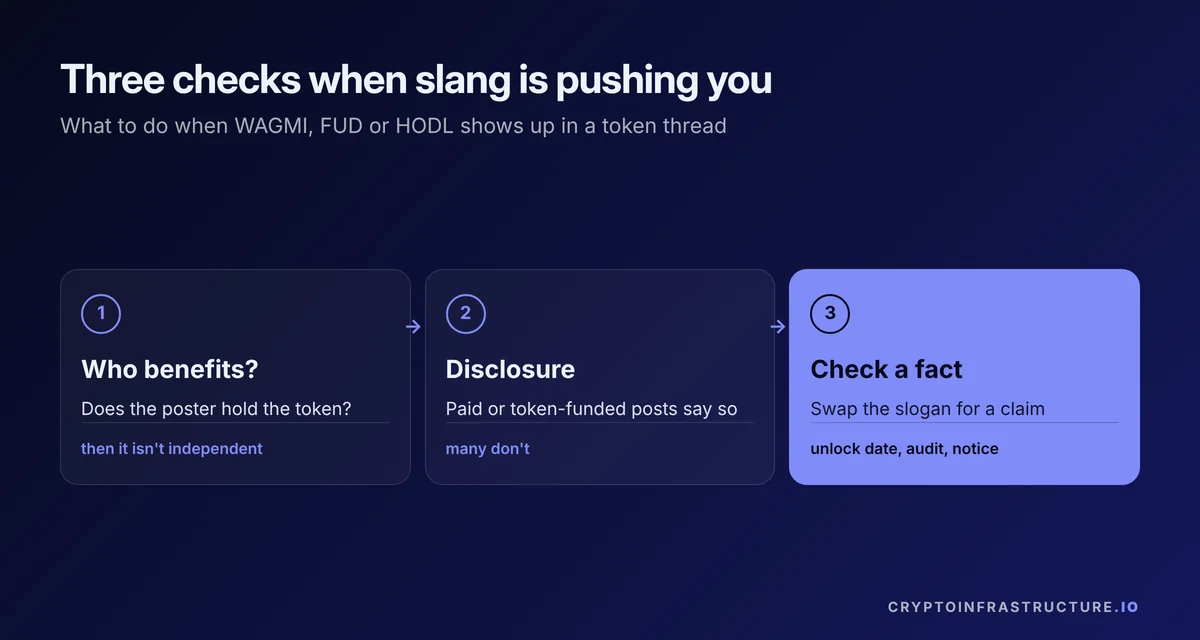
This matters most around new token launches. The site’s guide to how memecoins launch, pump and rug shows how insiders who bought first need later buyers and how paid posts and coordinated replies supply them. Large holders can move thin markets too; see what a crypto whale is. Three habits help:
- Ask who benefits. If the person posting WAGMI or calling something FUD holds the token, their optimism is not independent.
- Look for disclosure. A paid or token-funded post should say so. Many don’t; the KOL guide covers the US, UK and EU disclosure rules.
- Replace the slogan with a fact. Instead of “HODL” or “FUD”, test the specific claim: the unlock date, the audit, the regulator’s notice, the wallet that holds the supply.
What this means for you
WAGMI, NGMI, DYOR, HODL and FUD are everyday crypto vocabulary. Knowing them helps you read the conversation. They are also the vocabulary of promotion. Treat a one-word reply as a mood, not information. When a phrase is being used to make you buy, keep holding or ignore a warning, slow down and look at the facts behind it. The guides to KOLs, memecoins and seed phrase security cover the situations where this slang most often appears.
This guide is general information, not financial advice. Cryptoassets are volatile and uninsured; nothing here is a recommendation to buy or hold any asset. See the site’s disclaimer.