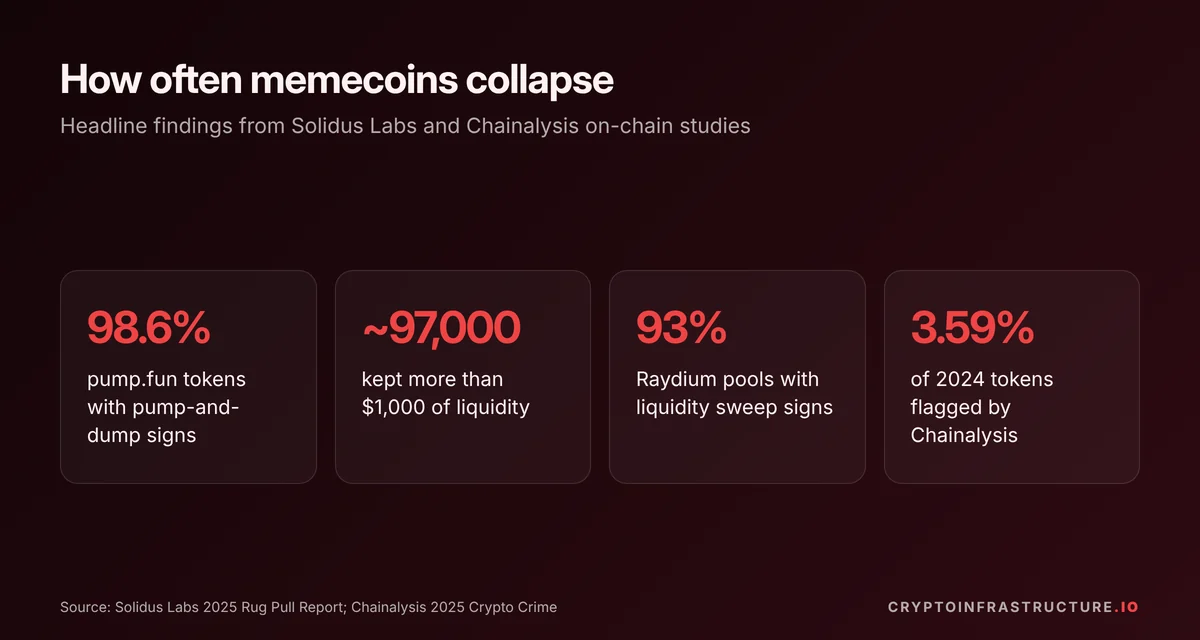
A memecoin is a crypto token built around an internet joke, character or trend, with no cash flows, product or rights attached. Its price depends only on attention and on someone else buying later. Dogecoin started the category in 2013; today most memecoins are tokens on Solana or Ethereum, and launchpads let anyone create one in seconds. The on-chain research is blunt. Solidus Labs found that 98.6% of more than 7 million tokens launched on pump.fun between January 2024 and March 2025 showed pump-and-dump signs, and only about 97,000 kept more than $1,000 of liquidity.
Chainalysis flagged 3.59% of all 2,063,519 tokens launched in 2024 under a much stricter test. In the US, SEC staff said on 27 February 2025 that typical memecoins are not securities, which also means buyers get no securities-law protection. This page explains how memecoins launch, how pumps are engineered, the main rug-pull types with dated cases, and a red-flag checklist. Nothing here is investment advice.
Memecoins are the part of crypto most people meet first and understand least. The pages that rank for this question mostly come from exchanges and wallet makers, stop at “it’s a joke coin with high volatility”, and were written before launchpads turned token creation into a one-click product.
That leaves out what actually decides whether you lose money: how the token was launched, who held the supply before you arrived, and whether the liquidity can be pulled. This guide covers those mechanics, the research on how often new tokens collapse, the legal status as of 14 October 2026, and the checks to run before you touch one. There are no affiliate links on this page and no coin is presented as an opportunity.
What is a memecoin?
A memecoin is a crypto asset inspired by an internet meme, character, current event or trend, sold to an online community that buys it for entertainment, social or speculative reasons rather than for any use. That is close to the definition the SEC’s Division of Corporation Finance used in its 27 February 2025 staff statement, which adds that memecoins “typically have limited or no use or functionality” and are “akin to collectibles”. Their price is driven by demand and speculation alone.
Google’s AI Overview for this search (checked 14 October 2026, US) says much the same: memecoins come from viral jokes and pop culture and rely on hype rather than fundamentals. What it leaves out is how they are created and why most new ones go to zero. The rest of this page covers that.
Are crypto and memecoins the same?
A memecoin is one kind of crypto asset, not a separate thing. The difference is in what backs the price. A network token like ETH pays for transactions on its chain, and a stablecoin is meant to be redeemable for a dollar. A memecoin has no such anchor. Technically, Dogecoin runs on its own proof-of-work blockchain, but most memecoins since then are tokens issued on an existing chain: ERC-20 tokens on Ethereum or SPL tokens on Solana, as Bitstamp’s explainer notes.
A short history: from Dogecoin (2013) to launchpads
- 2013, Dogecoin. Created by Billy Markus and Jackson Palmer around the Shiba Inu “doge” meme. The Dogecoin project’s own site says it “was first meant to be a joke”. Its supply is not capped: the site lists a block reward of 10,000 DOGE per block, checked 14 October 2026.
- 2020 to 2021, dog tokens on Ethereum. Shiba Inu and copycats turned the joke into a genre of ERC-20 tokens traded on decentralised exchanges.
- 2021, the first wave of rug pulls. Chainalysis reported (16 December 2021) that rug pulls took in more than $2.8 billion that year, 37% of all crypto scam revenue, up from 1% in 2020.
- 2024 onward, launchpads. Platforms on Solana such as pump.fun let anyone deploy a token with a built-in trading curve in one transaction. Solidus Labs counted more than 7 million pump.fun tokens with at least five trades between January 2024 and March 2025.
The scale change matters. One top-ranking exchange article from 2023 says “more than 300 meme coins” exist. Solidus Labs’ count works out to roughly 15,000 new pump.fun tokens a day across its 15-month study period.
How memecoins launch
There are two main launch routes. Both end with the token trading in a liquidity pool, and the details of that pool decide most of your risk.
Route 1: a bonding-curve launchpad
What is a bonding curve? It is a pricing formula built into the token’s launch contract: every purchase raises the price for the next buyer, and every sale lowers it. Solidus Labs describes it as a mechanism where “token prices increase exponentially with each additional purchase”, which means the earliest buyers get the lowest prices and later buyers pay for that.
On pump.fun, according to its fee documentation (last updated 8 October 2026, checked 14 October 2026):
- Anyone can create a coin, and trading starts on the bonding curve immediately.
- Trades on the curve pay a total fee of 1.25% (0.30% to the coin’s creator, 0.95% to the protocol).
- When a coin completes its curve it “graduates” to a pool on PumpSwap, the platform’s own exchange, with a 0.015 SOL graduation fee.
- Market cap there is calculated as price times 1 billion tokens, the fixed supply of each coin.
The curve itself is just maths. The risk comes from who buys first. Because the price is lowest in the first seconds, whoever controls the first purchases, often the creator, can collect most of the cheap supply before you see the token. Whether pump.fun as a platform is trustworthy is a separate question covered elsewhere on this site; this section only describes how it works.
Route 2: a direct liquidity pool
The older route skips the curve. The creator mints the full supply, then pairs part of it with SOL, ETH or a stablecoin in a decentralised exchange pool (Raydium or PumpSwap on Solana, Uniswap on Ethereum). Traders buy from the pool, and the price moves with the ratio of tokens to paired assets in it. For how pools work in general, see the guide to DeFi.
Whoever adds liquidity receives LP (liquidity provider) tokens, a claim on the pool’s assets. Whoever holds them can withdraw the pool. That is the whole mechanism behind the classic rug pull.
LP burns and locks: what they protect and what they don’t
- LP burned: the LP tokens are sent to an address nobody controls, so the pool can never be withdrawn by the creator.
- LP locked: the LP tokens sit in a time-lock contract. The pool is safe from withdrawal only until the lock expires, and only if the lock contract itself is sound.
Token-scanning tools check exactly this. Solidus Labs lists “ensuring liquidity tokens are burned or securely locked” as one of Token Sniffer’s core automated checks. But a burned LP stops only one type of rug. It does nothing about insiders who hold a large share of the supply and sell it into the pool, which is how most memecoin losses happen.
How memecoin pumps happen
A memecoin’s price rises only when new buyers arrive faster than holders sell. The tools for engineering that are well known.
Sniper bots and bundled wallets
A sniper bot is software that buys a new token in the first block or seconds after it appears, at the bottom of the bonding curve. A bundled launch is the creator’s own version of this: the creator funds a set of fresh wallets and has them buy in the same block the token is created.
Solidus Labs’ 2025 report cites research by Pine Analytics on “deployer-funded, same-block sniping localized to Pump.fun” as one way creators profit at the expense of later buyers. Spreading supply across many wallets also makes holder lists look healthy, so a token can appear widely held when one person controls most of it. Academic researchers studying 6.4 million Solana memecoins (arXiv, 20 August 2026) record bundle size and bundled buys for each token for this reason.
Paid promotion and KOL rounds
Once insiders hold cheap supply, they need buyers. That is the role of paid posts from crypto influencers, Telegram “call” channels and coordinated raids on X. In a KOL round, creators receive tokens at a discount with a short unlock in return for promotion, so the person telling you about a token may be able to sell it to you on launch day. The site’s guide to KOLs and KOL rounds covers how these deals work and the US, UK and EU disclosure rules.
Wash trading and fake volume
Volume rankings on trackers and screeners attract attention, and volume is cheap to fake when a few wallets trade with each other. Chainalysis devotes the market-manipulation chapter of its 2025 Crypto Crime Report to suspected wash trading alongside pump-and-dump patterns. High volume on a new token is not evidence of real demand.
How often do memecoins rug? What the on-chain research says
Three studies give very different headline numbers. They are not contradicting each other; they measure different things.
| Study | Sample | Test used | Result |
|---|---|---|---|
| Solidus Labs, 2025 Rug Pull Report (May 2025) | 7 million+ pump.fun tokens with at least five trades, January 2024 to March 2025 | Token treated as worthless once its liquidity falls below $1,000 | 98.6% showed pump-and-dump signs; only about 97,000 kept liquidity above $1,000 |
| Solidus Labs, same report | 388,000 Raydium V4 pools | “Liquidity sweep”: the deployer seeds all liquidity, waits for buys, then removes at least 90% | About 93% (roughly 361,000 pools) showed this sign. Median take about $2,832; largest detected $1.9 million |
| Chainalysis, 2025 Crypto Crime Report (29 January 2025, revised 13 February 2025) | 2,063,519 tokens launched across chains in 2024 | An address that added liquidity later removed at least 65% of it, worth $1,000+, and the pool then went inactive for 30 days after 100+ transactions | 74,037 tokens (3.59%) flagged; about 94% of flagged pools were drained by the address that created them |
| Li et al., arXiv (20 August 2026) | About 6.4 million Solana memecoins (pump.fun and Raydium), 30 November 2024 to 30 June 2025 | Machine-learning model for early rug detection | A “vast majority” showed rug-pull characteristics within one hour of launch |
Sources: Solidus Labs, The 2025 Rug Pull Report; Chainalysis, Crypto Market Manipulation 2025; Li, Kuznetsov, Yanovich et al., “Catching the Rug”, arXiv:2608.20271. All checked 14 October 2026.
How to read this: the Solidus figure counts every token that ended up with almost no liquidity, which includes coins that simply died with nobody to buy them. The Chainalysis figure counts only tokens where someone visibly pulled liquidity after a burst of trading, across all chains and all token types. Either way, the base rate for a new memecoin is collapse. A third data point points the same way: CoinGecko data reported by BeInCrypto (23 May 2025) found that about 53% of the roughly 7 million tokens listed on GeckoTerminal since 2021 had become inactive.
Rug-pull types, with dated examples
A rug pull is any scheme where the people behind a token take buyers’ money and leave the token worthless. These are the main forms.
| Type | How it works | Dated example (sourced) |
|---|---|---|
| Liquidity pull (hard rug) | The creator withdraws the paired SOL, ETH or stablecoin from the pool. The token instantly has no buyer. | Chainalysis’ 2021 scam report (16 December 2021) describes the DeFi pattern: developers “drain the funds from the liquidity pool, sending the token’s value to zero, and disappear”. It cites AnubisDAO among 2021 cases where value fell to zero after liquidity was drained. |
| Liquidity sweep | A variant Solidus Labs measured on Raydium: the deployer supplies all the liquidity, waits for traders, then removes at least 90%. | About 93% of 388,000 Raydium V4 pools (Solidus Labs, May 2025). |
| Insider dump (soft rug) | Insiders who bought cheap or received supply sell into the hype. The pool stays, but the price collapses. LP burns do not prevent this. | LIBRA, February 2025: a Solana token promoted by Argentina’s President Javier Milei in a now-deleted X post reached a peak valuation of about $4.5 billion before collapsing. Nansen found that 86% of the 15,431 wallets that traded it lost a combined $251 million, while 2,101 profitable wallets made about $180 million (Decrypt, 20 February 2025; Bloomberg, 19 February 2025). |
| Honeypot | The token contract lets you buy but blocks or heavily taxes selling, so the price only goes up on charts until the creator exits. | Squid Game token (SQUID), BNB Smart Chain: buyers “could buy the tokens but couldn’t sell them”. It hit an all-time high of $2,856, then on 1 November 2021 its website and social accounts disappeared while an address swapped SQUID for BNB worth over $2 million (Decrypt, 1 November 2021). |
| Exit scam (centralised) | Not a memecoin pattern, but the same family: an operator stops withdrawals and disappears. | Thodex, a Turkish exchange, 2021: its CEO disappeared after withdrawals were halted, with user losses of over $2 billion, nearly 90% of rug-pull value that year (Chainalysis, 16 December 2021). |
What is a honeypot in crypto?
A honeypot is a token whose code lets you buy but blocks or penalises selling, so buyers are trapped. The chart looks perfect because nobody can sell, as SQUID’s buyers found in 2021. The only reliable test is whether ordinary wallets have actually sold, which you can see in the token’s transaction history on a block explorer, or a contract scanner that simulates a sale.
What happens after a rug pull?
The token stays in your wallet, but there is no longer a market for it: with the liquidity gone or the price collapsed, there is nothing to sell into. In the US, as the next section explains, memecoin buyers do not get securities-law protection, so any recovery depends on fraud enforcement by other agencies.
Is it legal to create a memecoin? Regulatory status as of 14 October 2026
| Jurisdiction | Rule | What it means |
|---|---|---|
| United States: SEC | Division of Corporation Finance staff statement on meme coins, 27 February 2025 | Staff view: transactions in typical memecoins “do not involve the offer and sale of securities”, because a memecoin conveys no rights to income or business assets and buyers are not relying on others’ managerial efforts. Consequence: “neither meme coin purchasers nor holders are protected by the federal securities laws.” The view excludes tokens that are securities dressed up as memecoins, is not a Commission rule, and says fraud may still be pursued “by other federal or state agencies”. |
| European Union: MiCA | Regulation (EU) 2023/1114 | MiCA has no memecoin exemption. An offer of crypto-assets to the public generally needs a published white paper, with exemptions for offers to fewer than 150 persons per member state or with total consideration up to €1,000,000 over 12 months (recital 27). Marketing rules also apply; see the KOL guide for MiCA Article 7. |
Sources: SEC staff statement on meme coins, 27 February 2025, still published on sec.gov when checked; Regulation (EU) 2023/1114 on EUR-Lex. Checked 14 October 2026. This is a summary, not legal advice.
So creating a memecoin is not automatically illegal in either jurisdiction. What is illegal everywhere covered here is fraud: lying about who holds supply, hiding paid promotion, or building a contract designed to stop buyers selling. For the wider US picture, including the stalled CLARITY Act, see the October 2026 regulation roundup.
Are meme coins gambling?
No regulator cited here classifies them as gambling. US SEC staff compared them to collectibles. Economically, though, the research above shows the outcome distribution of a lottery with insiders holding the cheapest tickets: a tiny number of winners, a large majority of losers, and the people who launched the token best placed to profit. LIBRA’s on-chain numbers (86% of traders lost money) point the same way.
Red-flag checklist before you touch a memecoin
None of these checks make a memecoin safe. They only rule out the most obvious traps.
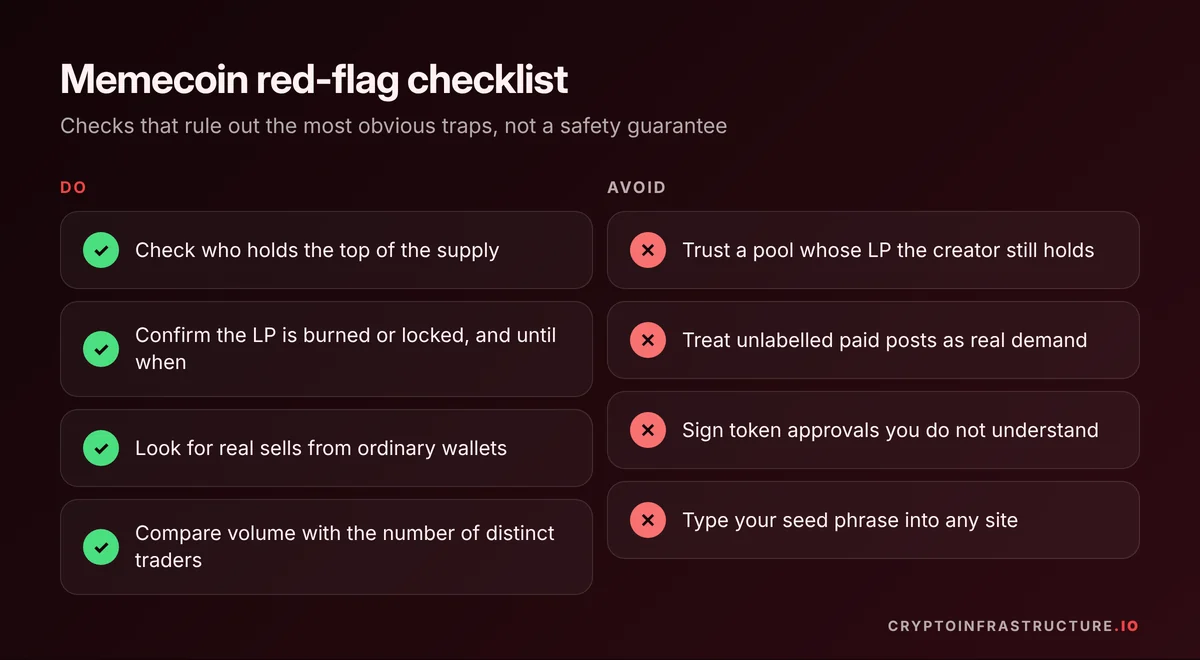
- Who holds the supply? Check the top holders on a block explorer or holder-analysis tool. Many fresh wallets funded from the same source and buying in the first block point to a bundled launch. Solidus Labs treats “concentrated holdings” as an immediate warning.
- Can the liquidity be pulled? Is the LP burned, locked (until when?) or held by the creator? A creator-held LP is a liquidity pull waiting to happen.
- Can anyone sell? Look for real sells from ordinary wallets in the transaction history. Buys-only activity is the honeypot signature.
- How was it launched? On a bonding curve, check how much the creator and the first wallets bought. In a direct pool, check how much of the supply went into the pool versus to wallets.
- Who is promoting it, and are they paid? Identical posts at the same hour, no “ad” or “I hold this” label, or a KOL round in the investor list. See how KOL rounds work.
- Is the volume real? A few wallets trading back and forth can top a volume chart. Compare volume with the number of distinct traders.
- Is market cap meaningful? On a thin pool, a market cap figure is price times supply, not money anyone could take out. The guide to market cap vs FDV explains why.
- Is the contract or name copied? Tokens named after celebrities, politicians or TV shows (SQUID, LIBRA) borrow trust they have not earned. A real endorsement does not make the supply fair.
- Is your wallet exposed? Never sign approvals you do not understand on a token site, and never type your seed phrase into any site.
What this means for you
As of 14 October 2026, a memecoin is best understood as a token with no claim on anything, launched by people who can see the supply before you can. The research gives you the base rate: on pump.fun, about 98.6% of tokens studied ended with almost no liquidity, and even the strictest cross-chain test flags tens of thousands of deliberate liquidity pulls a year. In the US you have no securities-law protection when a memecoin fails, and in the EU the rules cover offers and marketing, not your losses.
If you still choose to trade them, treat every amount as money you have already spent, run the checklist above on every token, and assume any paid post is an advertisement. If you are building or marketing a token, the honest route is visible: disclose holdings and paid promotion, burn or lock liquidity, and avoid launch mechanics that give insiders the first block. For the wallet side, see the evidence on Phantom, the Solana wallet reviewed on this site.


