Nobody owns Dogecoin. It has no company, CEO or shareholders: the network runs on open-source software that independent nodes and miners choose to run. The Dogecoin Foundation is a not-for-profit that funds development and defends the Dogecoin trademark; it does not own the coins or the chain. The creators, Billy Markus and Jackson Palmer, left the project in 2014.
What can be owned is DOGE, the coin. On BitInfoCharts’ rich list (13 October 2026), the largest address is a Robinhood cold wallet with about 27.16 billion DOGE (17.37% of supply), and the ten largest addresses hold about 44% between them, most of it in exchange wallets that hold coins for customers. Elon Musk has said he owns some DOGE but has never disclosed an amount.
“Who owns Dogecoin?” mixes two questions. One is about control: who can change the rules or shut the network down. The other is about the coins: who holds the most DOGE, and should you worry about it. The pages that rank for this question tend to answer one half, with rich lists that are months old, that do not name their data source, or whose percentages do not add up.
This guide separates the two. It covers who created Dogecoin, who maintains the code today, what the Dogecoin Foundation and its commercial partner House of Doge actually do, and who holds the most DOGE, from a named explorer, issuer pages and SEC filings. All figures were checked on 14 October 2026 unless another date is given. There is no price talk here: amounts are in DOGE.
Who owns Dogecoin? The short answer
No person, company or foundation owns Dogecoin. The project’s own explainer on dogecoin.com says no individual or corporate entity owns the Dogecoin blockchain, and that the network is open-source, permissionless and peer-to-peer, “controlled” by the nodes that run it (Dogecoin, “Who owns and controls the Dogecoin Network?”). Anyone can run a node, and miners secure the chain in exchange for block rewards.
What people can own is DOGE, the coin. Holding DOGE, even billions of it, gives you no vote on the software, no equity and no claim on any company. That is the main difference from owning shares in a business, and it is the same split explained in who owns Ethereum.
Who created Dogecoin?
Dogecoin was created in 2013 by software engineers Billy Markus and Jackson Palmer, as a joke built on the Shiba Inu “doge” meme. Dogecoin’s own site credits Palmer and “Shibetoshi Nakamoto”, Markus’s online name, and its developers page says Markus was the main developer of Dogecoin Core for its first releases. The code started as a fork of Litecoin and Lucky Coin, which were themselves forks of Bitcoin Core.
The same page says both creators left the project in 2014, and a group of developers took over as maintainers of the code repository. Neither creator holds any special power over the network today.
Do the creators still own Dogecoin?
- Billy Markus has said publicly that he sold his DOGE in 2015, years before the 2021 rally. CNBC reported on 14 July 2021 that both co-creators had sold their coins before the price surge and did not profit from it. He later returned in an advisory role when the Dogecoin Foundation was revived in 2021 (see below).
- Jackson Palmer left crypto altogether. In a July 2021 statement reported by CNBC, he said he would not return to the space and described crypto as “controlled by a powerful cartel of wealthy figures”. Nothing in the sources checked says he holds DOGE.
So the creators are not hidden owners waiting to cash out: both stepped away from the project in 2014, and both are reported to have sold their original coins long before 2021.
Who controls Dogecoin today?
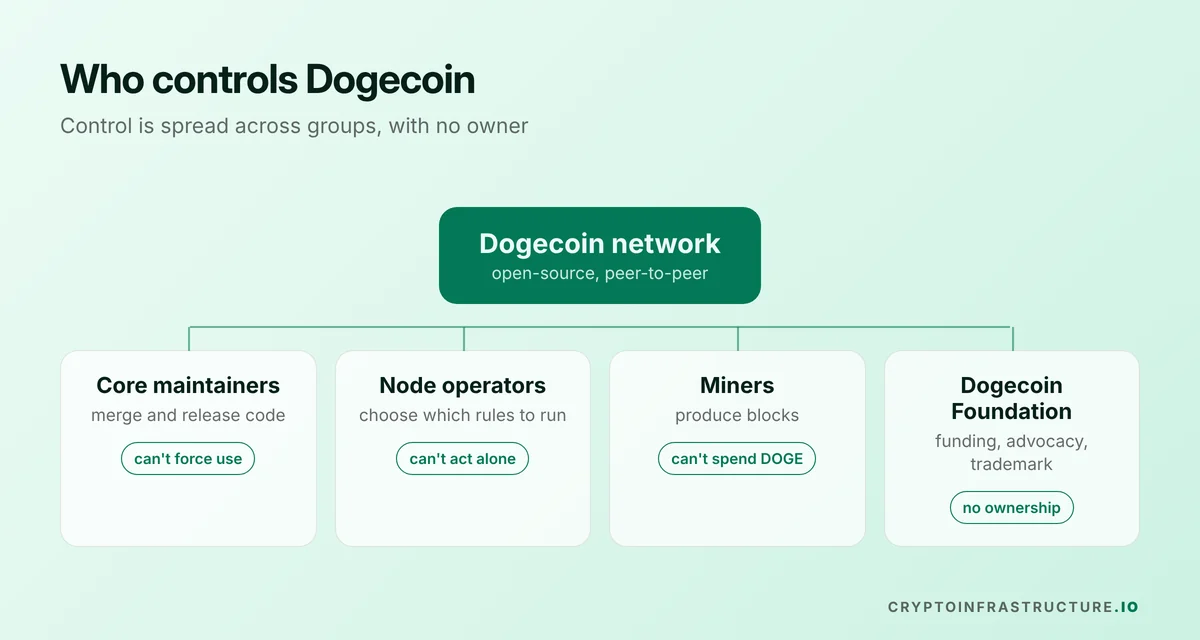
Control is spread across groups that cannot force each other’s hand.
| Group | What they control | What they cannot do |
|---|---|---|
| Dogecoin Core maintainers and contributors | What code is merged into the reference software and released | Make anyone install it |
| Node operators | Which software they run, so which rules the network enforces | Change the rules alone; a group running incompatible rules splits off |
| Miners | Producing blocks and ordering transactions | Create coins beyond the block reward or spend other people’s DOGE |
| Dogecoin Foundation | Funding, advocacy, the Dogecoin trademark, its own software projects | Own the chain or the coins, or override node operators |
| DOGE holders and exchanges | Which chain they treat as “Dogecoin” after any split; social pressure | Vote on-chain; there is no coin vote |
Who maintains the Dogecoin code?
Dogecoin Core, the reference software, lives in a public GitHub repository, and anyone can propose changes. According to the Dogecoin Core releases page and the GitHub API (checked 14 October 2026):
| Release | Published | Published by (GitHub) |
|---|---|---|
| Dogecoin Core 1.14.9 (marked latest) | 1 December 2024 | patricklodder |
| Dogecoin Core 1.14.8 | 7 August 2024 | patricklodder |
| Dogecoin Core 1.14.7 | 28 February 2024 | patricklodder |
| Dogecoin Core 1.14.6 | 20 July 2022 | patricklodder |
No newer release had shipped as of 14 October 2026, but work continues: the most recent commits on the main branch, dated 23 July to 10 September 2026, were written by the contributor “chromatic” and merged by “michilumin”. The repository’s release process requires at least three independent, matching builds signed by different developers before release files are signed, so one maintainer cannot quietly ship binaries on their own.
Dogecoin’s developers page does not publish a formal list of current maintainers, and the Foundation’s about page names no board. When the Foundation was revived in August 2021, Fortune (18 August 2021) reported that core developers Michi Lumin and Ross Nicoll joined it, with Max Keller as technical adviser.
What the Dogecoin Foundation does
The Dogecoin Foundation describes itself as a not-for-profit that supports Dogecoin “through development and advocacy”, defends the Dogecoin trademark “to prevent abuse and fraud”, and keeps a roadmap it calls the Trailmap. It says it was established by members of the Dogecoin team in 2014 and “re invigorated” in 2021 by members of the original core team plus newer members and advisors. It operates through Much Wow Ltd and MadeUpNumbers Ltd in England and Wales, Much Wow Inc. in the US, and Dogecoin Foundation Australia (foundation pages checked 14 October 2026).
The Trailmap, dated 10 December 2021, lists the Foundation’s own projects: libdogecoin, GigaWallet, the dogecoin.com rebuild with Dogepedia, and the Dogecoin Standard. These are tools built around Dogecoin, not control over it.
At the 2021 relaunch, Fortune reported that Vitalik Buterin was named to the board, Billy Markus became community and memes adviser, and Jared Birchall, head of Elon Musk’s family office, became legal and financial adviser representing Musk. The Foundation’s current about page lists no names, so treat that line-up as the August 2021 position, not today’s.
House of Doge: the Foundation’s corporate arm
The commercial side is a separate, listed company. House of Doge Inc., formerly Brag House Holdings, completed a merger on 30 June 2026 and began trading on Nasdaq as HODO on 1 July 2026. Its 8-K/A filed 14 September 2026 says:
- It holds an exclusive, worldwide trademark licence from the Dogecoin Foundation for the DOGECOIN mark, dated 31 January 2025 and amended in May and June 2025, and calls itself the “official corporate arm of the Dogecoin Foundation”.
- The licence carries a 5% royalty on net sales, with a minimum of $200,000 a month for the first five years.
- A House of Doge director, Timothy Stebbing, sits on the Foundation’s board as Director of Product.
- The filing gives no figure for any DOGE the company holds.
A trademark licence is about the brand, not the blockchain. House of Doge cannot change Dogecoin’s rules or move anyone’s coins.
Who owns the most Dogecoin?
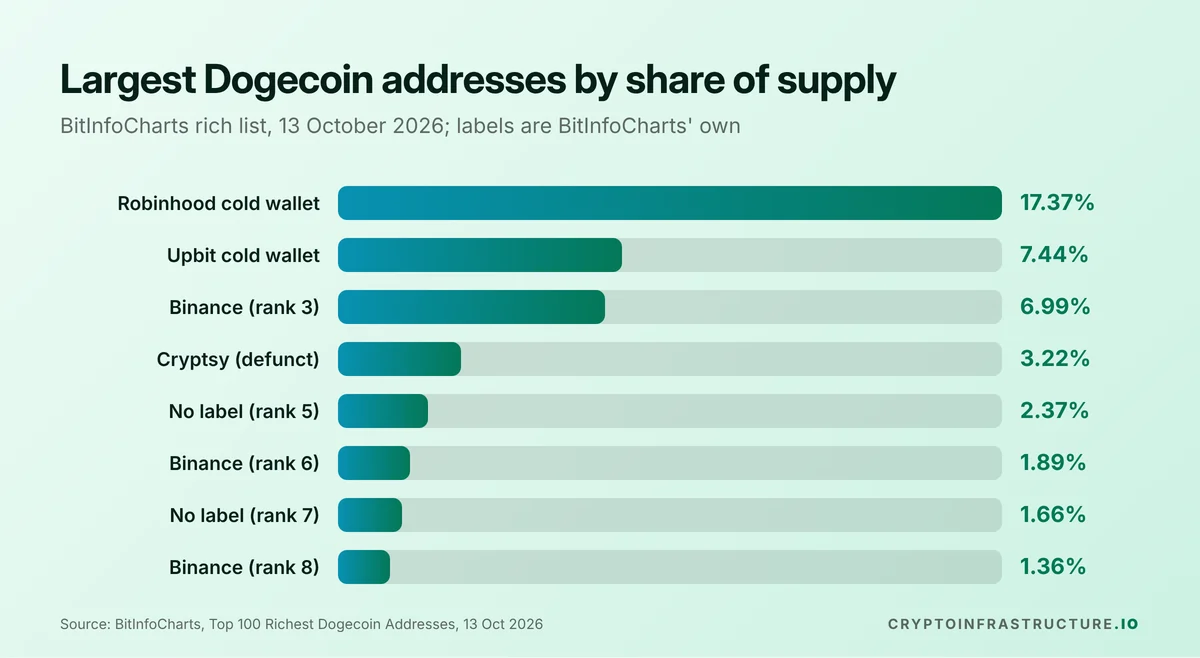
The answer depends on whether you count addresses or owners. The BitInfoCharts Dogecoin rich list (page timestamp 13 October 2026, 21:51 UTC) shows these addresses at the top. Labels are BitInfoCharts’ own.
| # | Address (start) | Label on BitInfoCharts | DOGE | Share of supply |
|---|---|---|---|---|
| 1 | DEgDVFa2… | Robinhood cold wallet | 27,164,003,624 | 17.37% |
| 2 | D8ZEVbgf… | Upbit cold wallet | 11,627,686,774 | 7.44% |
| 3 | DE5opaXj… | Binance | 10,934,742,143 | 6.99% |
| 4 | DDTtqnuZ… | Cryptsy (defunct exchange; no outflows since January 2014) | 5,031,001,969 | 3.22% |
| 5 | AC8azEye… | No label | 3,705,746,049 | 2.37% |
| 6 | DU8gPC5m… | Binance | 2,960,684,314 | 1.89% |
| 7 | DCdaxPdM… | No label | 2,590,165,347 | 1.66% |
| 8 | DGmzv39r… | Binance | 2,121,500,238 | 1.36% |
| 9 | DDogepar… | Dogeparty (XDP) burn address | 1,854,588,275 | 1.19% |
| 10 | DQhgaRJp… | Bithumb cold wallet | 1,500,741,498 | 0.96% |
Source: BitInfoCharts, Top 100 Richest Dogecoin Addresses, timestamp 13 October 2026 21:51 UTC (checked 14 October 2026). Further down, a Kraken-labelled address holds 1,000,000,039 DOGE (rank 13) and a Bybit-labelled address 956,634,443 DOGE (rank 14). The share figures imply a total supply of about 156.4 billion DOGE.
Who owns the majority of Dogecoin?
No single holder comes close to a majority. Adding up the table, the ten largest addresses hold about 44.5% of supply, and the top 100 about 66%. But most of that is not one person’s money:
- About 36% of all DOGE sits in the exchange-labelled addresses in the top 10 (Robinhood, Upbit, three Binance addresses and Bithumb). Those balances are mostly customer coins held in custody, so the real owners are the platforms’ users.
- The Cryptsy address has had no outflows since January 2014, and the Dogeparty address is a burn address, so about 4.4% of supply in the top 10 is in practice stuck.
- Only two of the top 10 addresses are unlabelled. An unlabelled address is not necessarily one person: it could be an exchange, a custodian or a fund that the explorer has not identified.
Lower down, the spread is wide: BitInfoCharts’ distribution table counts about 8.5 million addresses with a balance on 13 October 2026, though one person can hold many addresses and one exchange address can serve millions of people.
The “one whale holds 30%” story
A long-running claim says a single private whale, often said to be Elon Musk, holds close to 30% of all DOGE. The Dogecoin Foundation addressed this in an FAQ dated 20 April 2022: community tracking of deposits and withdrawals showed the “whale” was a platform wallet holding coins for hundreds of thousands of retail customers, later split across several addresses in October and November 2021. Today BitInfoCharts labels the largest address as a Robinhood cold wallet. If you see that address described as a person, the article is out of date or wrong.
ETFs and treasury companies
US-listed DOGE funds exist, but they hold far less than the big exchange wallets. From issuer pages checked 14 October 2026:
| Fund | Listed | DOGE held | As of |
|---|---|---|---|
| REX-Osprey DOGE ETF (DOJE), Cboe BZX | Inception 18 Sep 2025 | 81,270,030 DOGE directly, plus 1,711,700 shares of the 21Shares Dogecoin ETP | 12 Oct 2026 |
| Grayscale Dogecoin Trust ETF (GDOG), NYSE Arca | Listed 24 Nov 2025 | 11,136,681 DOGE (latest figure shown on the fund page) | 21 Nov 2025 |
| Bitwise Dogecoin ETF (BWOW), NYSE Arca | Inception 25 Nov 2025 | 8,192,894 DOGE. Bitwise plans to close and liquidate the fund on 22 Oct 2026 | 11 Oct 2026 |
| 21shares Dogecoin ETF (TDOG), Nasdaq | Inception 22 Jan 2026 | No DOGE quantity published on the fund page | n/a |
The company once billed as the “Official Dogecoin Treasury” no longer holds it. CleanCore Solutions adopted a Dogecoin treasury strategy on 5 September 2025, managed by a House of Doge subsidiary and 21Shares. Its 10-K filed 28 September 2026 says the company announced on 8 June 2026 that it would move away from the strategy, that “substantially all Dogecoin assets were sold” on 20 July 2026, and that it renamed itself Zone Frontier Inc. on 31 August 2026. Pages that still list it as a big DOGE holder are out of date.
Does Elon Musk own Dogecoin?
Elon Musk does not own Dogecoin the network; nobody does. He has said he owns some DOGE as a holder, without ever giving an amount. What he has said on the record:
- July 2021: at “The B Word” conference he said he owns bitcoin, ether and dogecoin.
- 24 October 2021: he repeated on X (then Twitter) that he holds only bitcoin, ether and dogecoin, “That’s it”, as reported by CNBC the next day.
- 20 July 2022: on Tesla’s earnings call he said of the company, “We have not sold any of our Dogecoin; we still have it”, as reported by TechCrunch. Tesla gave no DOGE amount.
No address on the rich list is labelled as Musk’s or Tesla’s, and no filing checked for this guide gives a DOGE figure for either. Any specific number you see for Musk’s DOGE is a guess. His influence is real but informal: his posts move attention, and his family office head was named an adviser to the Foundation in 2021. He has no role in merging code or running the network.
Common mistakes on “who owns Dogecoin” pages
Among the ranking pages reviewed for this guide (checked 14 October 2026):
- Percentages that do not add up. One exchange’s 2026 rich list gives shares that do not match its own supply figure and names no data source. A broker’s November 2025 list says the top 10 hold “just over 60%” while its own table adds to about 43%.
- Stale rankings. Lists from late 2025 put Binance second; on 13 October 2026 BitInfoCharts shows an Upbit cold wallet second.
- Exchange wallets read as whales. Robinhood’s and Binance’s custody wallets are customers’ coins, not one owner’s fortune.
- No word on the control side. Several pages say “decentralised” and stop, without naming who maintains the code, when it was last released, or what the Foundation and House of Doge can and cannot do.
- Missing 2026 changes. None of the pages reviewed mention that the “Official Dogecoin Treasury” sold its DOGE in July 2026 or that the Bitwise DOGE ETF is being closed.
What this means for you
If your worry is that someone can switch Dogecoin off or rewrite it: no single owner exists. Changes need maintainers to ship code and node operators and miners to run it. The concentration that matters in practice is custodial: about a third of all DOGE sits in a handful of exchange wallets, which means the exchanges’ security and solvency matter more to most holders than any individual whale. If you keep DOGE on an exchange, you are one of the people “inside” those wallets. These numbers move every week, so check the dated sources above rather than any list, including this one, that is more than a few weeks old.
For the bigger picture on joke tokens, read what a memecoin is and how they launch, pump and rug. To compare how control works on a smart-contract chain, see who owns Ethereum. Since Robinhood holds the largest DOGE address, who owns Robinhood is a useful follow-up, and institutional crypto custody explains how large balances are held for others. Browse more in Guides, and see the methodology for how this site sources and dates its figures.


