Bitget is a real, large exchange, but “legit” is not the same as “safe”. On 24 September 2026 attackers took crypto from its hot and warm wallets; Bitget’s revised figure of 25 September puts the loss at about $387.5 million. Bitget says user balances were untouched. It says it paid the loss from its own Protection Fund, refilled that fund to more than $300 million on 30 September and reopened all withdrawals by 2 October 2026. Its latest proof of reserves (snapshot 29 September 2026) shows 131% across 19 assets but names no auditor. No Bitget entity is listed in ESMA’s interim MiCA register. Its terms of use say it does not serve the United States, Canada, Japan, Singapore, Hong Kong, Germany, Austria, France and others. Its terms also say your crypto is not segregated on-chain from Bitget’s own assets. Bitget’s own terms exclude US residents.
If you are asking “is Bitget safe?”, the timing matters. Most of the pages ranking for that question were written before 24 September 2026, when Bitget lost about $388 million in a hack. Some still say it has never been hacked, quote a protection fund size with no date or call it “regulated” without saying where. This review checks Bitget against the same six points this site uses for every exchange: licences by region, proof of reserves, custody terms, insurance, incident and enforcement history plus the risk that stays with you. It also answers whether Bitget is legal in the US, using Bitget’s own terms rather than guesswork.
Is Bitget safe and legit? The short answer
Bitget is a real operating exchange with named licences and registrations in several countries, a published proof of reserves and a public record of how it handled a major hack. No exchange can be called safe outright. The evidence for Bitget is a fast, funded response to the September 2026 hack, monthly reserve reports and a protection fund it has refilled. The evidence against is the hack itself, a proof of reserves no auditor signs, no MiCA authorisation in the EU, a 2025 Philippine regulator advisory, a 2025 futures rollback and terms that keep your crypto pooled with Bitget’s own. Whether that is acceptable depends on how much you hold there and for how long.
The six checks, as in the Bybit and MEXC reviews:
- Licences by region, with the source for each
- Proof of reserves: method, snapshot date and who checked it
- Custody, from Bitget’s own terms
- Insurance and the Protection Fund, and what they really cover
- Incidents and enforcement, dated and sourced
- The risk that remains for you
They follow the site’s methodology: track record, transparency, security practices and jurisdiction coverage.
Is Bitget safe after the September 2026 hack?
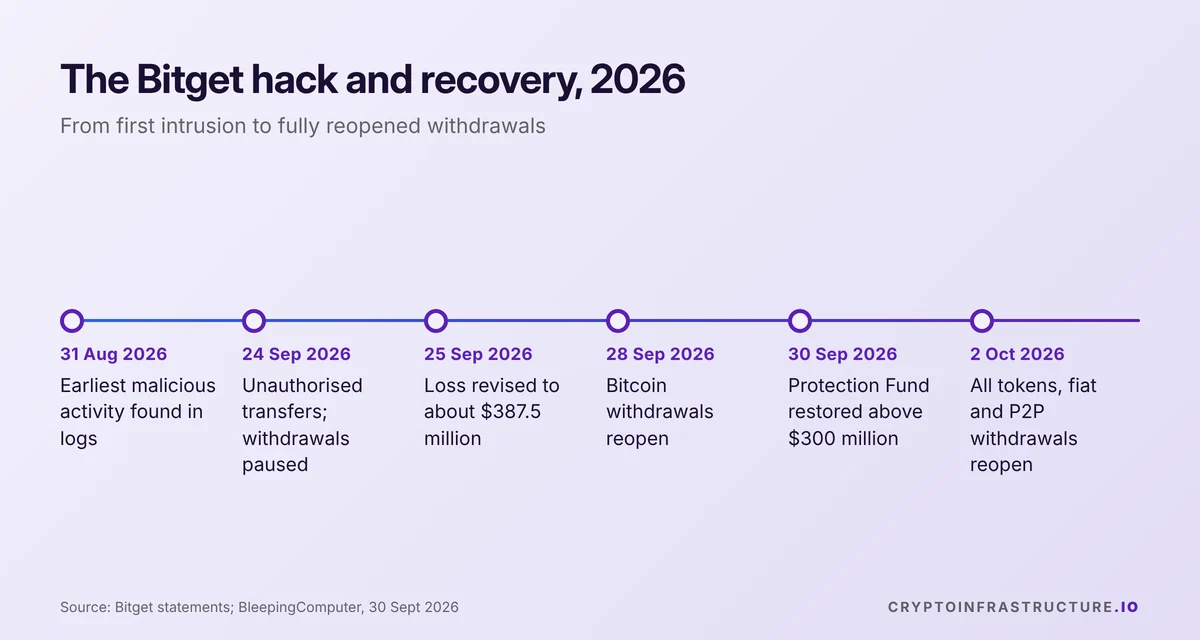
On 24 September 2026, Bitget’s systems detected unauthorised transfers out of part of its hot and warm wallet infrastructure. It suspended withdrawals. Bitget says its cold wallets were not affected.
How much was stolen
Bitget first put the loss at about $351.6 million on 24 September, then revised it to about $387.5 million on 25 September. It said the increase came from Zcash and TRON assets left out of the first count, not from new transfers. BleepingComputer, reporting on 30 September 2026, lists the affected networks as Ethereum, XRP Ledger, Arbitrum, Avalanche, Optimism, BSC and Base. Bitget’s chief executive Gracy Chen said XRP was the largest single-chain loss.
How the hack happened
This was not a stolen private key. According to BleepingComputer’s account of the forensic findings:
- Attackers used a zero-day flaw in two third-party security appliances, planted web shells and moved to Bitget’s wallet job server.
- SlowMist found the earliest malicious activity in the available logs on 31 August 2026, more than three weeks before the theft.
- Chen said the attackers breached a backend system and spoofed transaction data, which triggered Bitget’s own authorisation process to move the funds.
- The transfers ran for close to three hours.
Bitget hired Mandiant and SlowMist to investigate. Chen attributed the attack to North Korean hackers, citing IP behaviour and on-chain patterns. That attribution is Bitget’s; no government statement confirming it has been found.
The lesson goes beyond Bitget. An exchange can keep its keys locked away and still lose funds if an attacker can feed false instructions into the system that signs withdrawals. Ask any exchange how it protects that layer, not only where its keys are kept.
Did Bitget users lose money? Can you withdraw from Bitget?
No report of customers losing balances has been found, and Bitget says the loss was not passed on. What follows is Bitget’s own account:
- Trading and deposits continued during the pause. Bitget says account balances “remained accurate and unaffected”.
- Withdrawals reopened in phases at 08:00 UTC: bitcoin on 28 September, ether on 29 September, USDT on 30 September, then all other tokens, fiat and P2P on 2 October 2026.
- Bitget launched a recovery bounty paying 5% of any funds frozen or recovered.
Bitget says withdrawals have been fully open since 2 October 2026. Minimum withdrawal amounts and fees are set per coin and per network, so check the withdrawal screen for the exact network you plan to use.
A covered loss is not a recovered one. CNBC reported on 2 October 2026 that Bitget’s chief executive was “not expecting to recover a lot” of the stolen funds. The cost sat with Bitget’s own reserves.
The Bitget Protection Fund: what it is and what it covers
Bitget paid for the hack from its User Protection Fund, a pool of company-owned assets it keeps for platform-wide losses.
| Date | Protection Fund status | Source |
|---|---|---|
| 25 September 2026 | Bitget said the fund held 5,500 BTC (about $464 million at that day’s price) and would cover the loss | Bitget statement, as reported by RegTech.com |
| 28 September 2026 | Bitget committed to refilling the fund to at least $300 million within one week | Bitget |
| 30 September 2026 | Bitget said the fund was restored to more than $300 million | Bitget, Protection Fund update |
Bitget says the fund’s wallet addresses are published on its Protection Fund page. That page did not display a live value or addresses at the time of review, so verify them yourself before relying on the figure.
Three limits matter. First, the fund is held in bitcoin, so its dollar value moves with the bitcoin price. Second, Bitget’s Protection Fund page says claims are reviewed case by case and losses caused by your own actions or trading are excluded. Third, the fund is not mentioned anywhere in Bitget’s terms of use, so it is a company policy, not a contractual promise to you.
Is Bitget insured?
Not in the way a bank deposit is. Bitget’s terms of use mention no deposit insurance or protection scheme. They also exclude liability for losses from “extreme market volatility” and from cancelled or amended transactions (clause 16.2). The Protection Fund is the only backstop and, as above, it is discretionary.
Is Bitget legal? Licences and registrations by region
Bitget’s global platform is run under terms with BTG Technology Holdings Limited, governed by Hong Kong law with arbitration in Hong Kong (clauses 18.1 and 18.3). The terms do not state where that company is incorporated. Its licences and registrations sit in different places and cover different things:
| Region | Status | Source |
|---|---|---|
| European Union (MiCA) | No Bitget or BTG entity is listed in ESMA’s interim MiCA register of crypto-asset service providers. ESMA updates the register regularly, so check the current version. Bitget’s terms list Austria, Germany and France as prohibited countries. | ESMA interim MiCA register; Bitget terms |
| France | Bitget ended services for French users: open positions were closed from 31 March 2026 and remaining assets moved to a licensed provider from 8 April 2026, after “discussions with the Autorité des Marchés Financiers” | Bitget notice, 13 March 2026 |
| Lithuania and Poland | Bitget announced national virtual asset registrations in April 2023 (Lithuania) and May 2023 (Poland). These were pre-MiCA national registrations; whether they still let Bitget serve EU users after MiCA has not been confirmed on a national register. | Bitget press releases, April and May 2023 |
| Italy and Bulgaria | Bitget said in February 2025 that it held approvals in Italy and had registered in Bulgaria. Not confirmed on the OAM or Bulgarian registers. | Bitget announcement, February 2025 |
| El Salvador | Bitcoin Service Provider licence from the Central Reserve Bank (announced 16 December 2024) plus a Digital Asset Service Provider licence from the National Commission of Digital Assets (announced 4 April 2025) | Bitget announcements; the CNAD register was not searched |
| Argentina | Added to the CNV’s Virtual Asset Service Provider registry (reported 12 June 2026) | crypto.news, 12 June 2026 |
| Australia | Reported to be registered with AUSTRAC as a digital currency exchange | Secondary report only; AUSTRAC register not searched |
| United Kingdom | The UK is not on Bitget’s prohibited list. Bitget returned to UK users in November 2024, reportedly through an arrangement with an FCA-authorised firm. No FCA registration for a Bitget entity has been confirmed. | Bitget terms; Cointelegraph, December 2024 |
| Philippines | The Philippines SEC named Bitget among 10 platforms operating without registration in August 2025 (see the enforcement table below) | CoinGeek, 7 August 2025 |
What a licence does not mean
A licence or registration lets one regulator supervise one company in one country. Several of Bitget’s are anti-money-laundering registrations, which check who the customers are, not whether the exchange can pay them back. None of them follows you if your account is held under the global terms with BTG Technology Holdings. For how MiCA changed the picture for offshore exchanges, see the offshore exchange comparison.
Is Bitget legal in the US?
Not under Bitget’s own terms. Its terms of use list the United States and its territories (including Puerto Rico, Guam and the US Virgin Islands) as prohibited countries. Clause 8.6 says you must not get around access restrictions, “including by use of any virtual private network”. If you open or use an account from the US anyway, you are in breach of the terms. Clause 5.10 and clause 8.2 let Bitget void or reverse transactions and act on the account.
Two things confuse this question. Bitget lets eligible users outside the US trade price exposure to US stocks with USDT; that is a product about US shares, not permission for US residents. A CFTC advisory in August 2025 also restated how foreign trading venues can register to serve US customers; nothing in Bitget’s terms reflects such a registration. If you are in the US, the best crypto exchanges in the US lists platforms that are licensed to serve you.
Which countries can’t use Bitget?
Bitget’s terms list these prohibited countries and regions: the United States, Canada, Japan, Singapore, Hong Kong, Malaysia, Thailand, Kazakhstan, Austria, Germany, France, Iran, North Korea, Cuba, Iraq, Libya, Yemen, Afghanistan, Sudan, South Sudan, Somalia, Lebanon, Haiti, the Central African Republic, the Democratic Republic of the Congo, Guinea-Bissau plus Crimea, Donetsk and Luhansk. Bitget can add to the list at any time, so check the current terms for your country before you deposit. Read them in full on Bitget’s Terms of Use page.
Who owns Bitget, and which country is it from?
Bitget was founded in 2018 and its chief executive is Gracy Chen. Your contract under the global terms is with BTG Technology Holdings Limited, under Hong Kong law. Bitget’s 2023 press releases were datelined Victoria, Seychelles. No country owns it. What matters for you is which company holds your account and which regulator, if any, can hear a complaint about it.
Does Bitget have proof of reserves?
Yes. Bitget publishes a monthly proof of reserves. This is what its latest report shows:
| Item | What Bitget publishes |
|---|---|
| Latest snapshot | 29 September 2026, 09:00 UTC (five days after the hack), published 30 September 2026 |
| Total reserve ratio | 131% across the covered assets; Bitget says all 19 were above 100% |
| Assets covered | 19: BTC, USDT, ETH, LTC, LINK, XRP, USDC, DOGE, BNB, SOL, ADA, NEAR, XAUT, TAO, SUI, ONDO, HYPE, PI and USDGO (up from four assets before September 2026) |
| Method | Merkle tree of user balances, with an open-source checker (MerkleValidator) on GitHub; reserves compared with Bitget’s published cold, warm and hot wallet addresses |
| Who checked it | No auditor or accounting firm named |
| Bitget’s own caveat | The report “should not be considered equivalent to a full financial audit” and is a single point in time |
Source: Bitget, Proof of Reserves expansion. The live proof-of-reserves page showed no data at the time of review.
A reserve ratio only compares coins held with what users are owed in those coins. It says nothing about Bitget’s other debts. With no auditor, you are relying on Bitget’s data and your own check of your Merkle inclusion.
Custody: what Bitget’s terms say
This comes from the terms of use of 15 September 2026, not from an independent check:
- No on-chain segregation: clause 19.12 says your digital assets “will not be segregated on-chain” in separate wallets from other users’ assets or from Bitget’s own business assets. Bitget tracks your balance on an internal ledger.
- Not a trustee: the same clause says Bitget “is not a trustee of” any digital assets held to your credit. It may use assets of the same type and amount when acting on your instructions.
- Your credentials, your risk: clause 5.13 makes you responsible for keeping your account credentials secure.
This is the weakest part of the picture. Pooled assets and an express “not a trustee” clause give you less protection on paper than terms that promise segregation, as the Bybit review shows for comparison. If you want to hold the keys yourself, you need a self-custody wallet and a properly stored seed phrase.
Bitget’s incident and enforcement history
| Date | What happened | Outcome for users | Source |
|---|---|---|---|
| 20 April 2025 | Abnormal trading in the VOXELUSDT perpetual futures market between 08:00 and 08:30 UTC. Bitget said certain accounts may have manipulated the market. It suspended them and announced it would roll back the irregular trades. | Irregular trades were to be rolled back; Bitget said it would compensate users who lost money and that other accounts were unaffected | Bitget statement, 20 April 2025, via Cryptopotato and TradingView |
| August 2025 | The Philippines SEC named Bitget, OKX, Bybit, MEXC, KuCoin, Phemex, CoinEx, BitMart, Poloniex and Kraken as unregistered under its new crypto-asset service provider rules, warning of possible cease and desist orders and site blocking | Philippine users warned not to trade on the named platforms | CoinGeek, 7 August 2025 |
| March and April 2026 | Bitget ended services in France after discussions with the AMF | Positions closed from 31 March; remaining assets moved to a licensed provider from 8 April; balances of 10 USDC or less could be forfeited | Bitget notice, 13 March 2026 |
| 24 to 25 September 2026 | About $387.5 million stolen from hot and warm wallets via a zero-day in third-party security products | Bitget says balances unaffected; withdrawals paused and fully restored on 2 October 2026; loss paid from the Protection Fund | Bitget; BleepingComputer, 30 September 2026 |
The VOXEL rollback deserves a second look. Bitget’s terms (clauses 5.10 and 6.5) let it void, reverse or reprice trades it considers erroneous, abusive or “abnormal”. That power was used in 2025. If you trade futures on Bitget, assume a trade you think is settled can still be undone. The leverage and perpetual futures guide explains why these markets are where this happens.
Some ranking pages are out of date here. One hardware wallet vendor’s review, last modified November 2025, says Bitget has not been involved in any major incidents and quotes a $350 million fund with no date. Another review page names no regulator or licence at all. Its sign-up buttons point to a third-party domain rather than Bitget.
Is Bitget a scam? How to tell a real Bitget from a fake
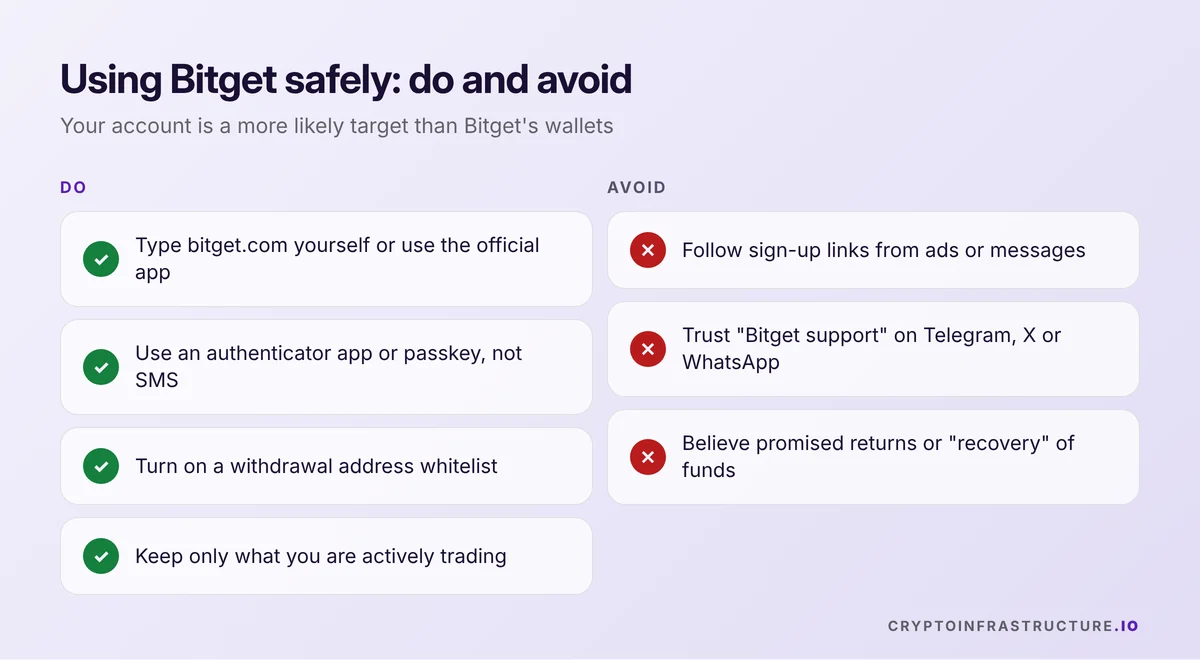
Bitget itself operates as a real exchange: it has a long track record, processes withdrawals and publishes reserves. The scams are the ones that borrow its name. Your account is a more likely target than Bitget’s wallets:
- Type bitget.com yourself or use the official app. Don’t follow ads, search results you didn’t check or links in messages. Some “review” pages route sign-ups through other domains.
- Use an authenticator app or passkey, not SMS. Set an anti-phishing code if offered.
- Turn on a withdrawal address whitelist, so funds can only leave to addresses you approved earlier.
- Treat “Bitget support” on Telegram, X or WhatsApp as suspect, especially anyone asking you to move funds, share a code or “verify” a wallet.
- Ignore anyone promising returns from copy trading, bots or “recovery” of hacked funds. A guaranteed profit is the clearest sign of a scam.
- Keep only what you are actively trading on the exchange.
Is Bitget better than Binance or Bybit?
A one-word answer won’t help you. Compare the same evidence for each:
- Bitget vs Bybit: both were hit by large hacks attributed to North Korea and both say customers did not bear the loss. Bybit’s Austrian company, Bybit EU GmbH, appears in ESMA’s MiCA register (authorised 28 May 2025); no Bitget entity does. Full details are in the Bybit review.
- Bitget vs Binance: see the Binance review for its licences, enforcement history and reserves.
- Against other offshore exchanges: the offshore exchange comparison puts OKX, KuCoin, Bybit, MEXC and Binance side by side. The MEXC review applies the same checks to MEXC.
What this means for you
Bitget is a working exchange with registrations in El Salvador, Argentina and, by its own account, several other countries. It publishes a monthly proof of reserves showing 131% across 19 assets. It used and refilled its Protection Fund after losing about $387.5 million in September 2026. Against that: no MiCA authorisation, a proof of reserves no auditor signs, a 2025 Philippine regulator advisory, a history of reversing trades and terms that keep your crypto pooled with Bitget’s own and promise no deposit protection. Its own terms exclude residents of the US, Canada, Japan, Singapore, Hong Kong, Germany, Austria and France. The risk that stays with you is counterparty risk: you are trusting Bitget’s solvency, security and goodwill with whatever you leave on it. Keep that risk in mind when deciding how much to hold there. Check which Bitget company and which terms apply where you live.
For the same evidence check on other platforms, see the Exchanges section.
This review is general information, not financial or legal advice. Cryptoassets are volatile and uninsured; nothing here is a recommendation to use any platform or hold any asset. See the site’s disclaimer.