Checked 14 October 2026. What is a CBDC? A CBDC (central bank digital currency) is a digital form of a country’s own money that is a direct liability of its central bank, the same way banknotes are. A stablecoin is a privately issued token that promises to be redeemable for a fixed amount of money and is backed by the issuer’s reserves.
A bank deposit is a claim on a commercial bank, protected in the US by deposit insurance up to $250,000. As of May 2026 the Atlantic Council counts 146 countries and currency unions exploring a CBDC, but only three have launched one: the Bahamas, Jamaica and Nigeria. The US has gone the other way: a January 2025 executive order bars federal agencies from creating a CBDC, and a statutory ban has passed the House but not the Senate.
“CBDC” gets used for everything from China’s digital yuan to a supposed government crypto coin, and most of the explainers ranking for it were written between 2021 and 2023, before the US banned work on one and before Europe set a date for the digital euro. If you are trying to work out what a CBDC actually is, how it differs from the stablecoins you can already hold, and where each country stands right now, this guide covers the definition, how a CBDC works, a three-way comparison with stablecoins and bank deposits, and a dated status table for the US, EU, UK, China and India.
Checked 14 October 2026 against the Atlantic Council CBDC Tracker, the BIS 2024 CBDC survey (BIS Paper 159), ECB and Bank of England digital currency pages, the 23 January 2025 US executive order, the GENIUS Act (Public Law 119-27), FDIC deposit insurance guidance and RBI annual report data as reported by the press. Where a figure comes from press coverage rather than the central bank itself, the text says so. This is an education guide, not investment or legal advice.
What is a CBDC in simple words?
A central bank digital currency is digital money issued by a country’s central bank, in that country’s own currency, that you hold as a direct claim on the central bank. The US executive order of 23 January 2025 uses a tight legal version of the same idea: “a form of digital money or monetary value, denominated in the national unit of account” that “is a direct liability of the central bank.”
The phrase that matters is direct liability of the central bank. Today the only central bank money most people ever touch is cash. The money in your bank account is not central bank money: it is a debt your commercial bank owes you. A retail CBDC would give you a digital version of cash, with the central bank itself standing behind every unit.
Is a CBDC a cryptocurrency? Which crypto is backed by the government?
No, and no crypto is. A CBDC is national currency in digital form, issued and controlled by a central bank, with the same value as the notes in your wallet: one digital euro would always equal one euro. Bitcoin and other cryptocurrencies have no issuer and no government backing. A CBDC also does not need a blockchain: some designs use one, others use a conventional central ledger, which is a point several ranking explainers get wrong when they say CBDCs are “built on blockchain.”
Stablecoins sit in between. They usually run on public blockchains like crypto, and they track a national currency like a CBDC, but they are issued by private companies. In the US, the GENIUS Act states that a payment stablecoin may not be “backed by the full faith and credit of the United States” or covered by federal deposit insurance. So the honest answer to “which crypto is government-backed” is: none of them. Government backing is what makes something a CBDC rather than a crypto asset.
What is “digital cash”?
“Digital cash” is the informal name for a retail CBDC, because it is meant to do the job cash does (a public, risk-free form of money anyone can use) in electronic form. The digital euro is the clearest example of the design goal: the ECB says it would be legal tender, free for basic use, would pay no interest, and “would complement cash, not replace it.” Its planned offline mode is the closest thing to physical cash: when you pay offline, the ECB says, “only the payer and the payee would know the personal transaction details.”
How does a CBDC work?
The retail designs published so far, including the digital euro and India’s e-rupee, use a two-tier model. The central bank issues the currency; banks and licensed payment firms give you the wallet, check your identity and handle customer service. In practice:
- You open a wallet through a bank or approved provider, which runs the usual know-your-customer checks. In India, the RBI has also allowed certain non-banks to offer e-rupee wallets.
- You load it by moving money from your bank account. The bank deposit becomes a central bank liability instead of a bank liability.
- You pay another person or a merchant, by app or QR code, and in some designs offline by tapping two devices together.
- Limits apply. Because a run from bank deposits into a CBDC could drain bank funding, most designs cap how much you can hold. The ECB and the Bank of England both plan holding limits, and neither had set a final number on the pages checked.
Retail vs wholesale CBDCs
There are two types. A retail CBDC is for the public and businesses, like the e-CNY or the planned digital euro. A wholesale CBDC is only for banks and financial institutions, to settle large payments between them. The BIS’s 2024 survey of 93 central banks, published 22 August 2025, found 91% were exploring one or both types, and that wholesale work is generally at more advanced stages than retail work. It also found that more than one in three jurisdictions had sped up CBDC work because of stablecoins and other crypto assets.
CBDC vs stablecoin vs bank deposit: how they differ
This is the comparison most of the pages reviewed for this guide leave out. All three can show up as “$100” or “€100” on your phone, but who owes you the money, and what happens if something breaks, is very different.
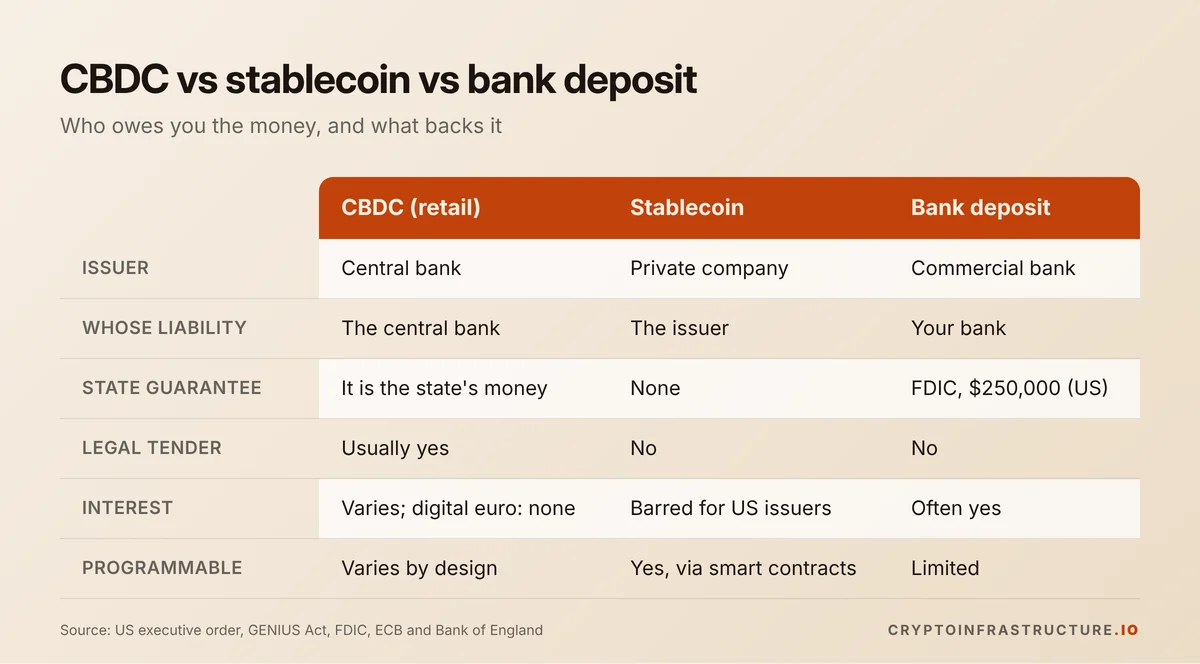
| Feature | CBDC (retail) | Stablecoin | Bank deposit |
|---|---|---|---|
| Issuer | Central bank | Private company (in the US, a “permitted payment stablecoin issuer” under the GENIUS Act) | Commercial bank |
| Whose liability is it? | Direct liability of the central bank | Liability of the issuer, which must redeem for a fixed amount and back tokens at least 1:1 with reserves (US rules) | Liability of your bank |
| Government guarantee | It is the state’s own money | None: US law bars full-faith-and-credit backing and federal deposit insurance | US: FDIC insurance of at least $250,000 per depositor, per ownership category, per insured bank |
| Legal tender | Usually yes (the digital euro would be) | No | No; a deposit is a claim to be paid in legal tender |
| Interest | Varies: the digital euro would pay none; China’s banks pay interest on e-CNY wallet balances from January 2026 (reported) | US issuers may not pay holders any interest or yield (GENIUS Act) | Often yes, set by the bank |
| Privacy | Set by law and design: ECB says it could not link transactions to individuals; Bank of England says it would not see how you spend | Transactions on public blockchains are visible to anyone; issuers must be able to freeze and block transactions (US) | Your bank sees everything; standard financial privacy law applies |
| Programmability | Varies: the ECB says the digital euro “would never be programmable money”; India’s e-rupee pilot added programmable features in FY2024-25 | Yes, through smart contracts on the blockchain it runs on | Limited to what the bank’s systems offer |
| Who can hold it | Residents through approved wallets, usually with holding limits | Anyone with a compatible wallet, subject to platform KYC and local rules | Account holders after KYC |
Sources: US executive order of 23 January 2025; GENIUS Act sections 2(22), 4(a) and 4(e); FDIC deposit insurance guidance; ECB digital euro FAQ; Bank of England digital pound page; RBI annual report data reported 29 May 2025; e-CNY interest reported by Electronic Payments International on 29 December 2025. Checked 14 October 2026.
A worked example: the same 100 units three ways
Suppose you hold 100 units of currency in each form, and something goes wrong.
- In a CBDC wallet: if the bank that runs your wallet fails, the 100 units are still a claim on the central bank, because the wallet provider only services the account. Your risk is mainly operational (losing access, outages) and the rules the state sets on use.
- As a stablecoin: your 100 tokens are only as good as the issuer’s reserves, its redemption terms and your ability to reach it. If you hold through an exchange, you also carry the exchange’s risk. A stablecoin can trade below its peg on the market even while the issuer is solvent. The stablecoin explainer covers how depegs happen.
- In a bank account: in the US, the 100 is insured by the FDIC within the coverage limit if the bank fails. Above that limit, you are an unsecured creditor of the bank.
Why central banks care about stablecoins
Stablecoins are one reason CBDC work has sped up. A widely used private dollar or euro token outside the banking system shifts payments, data and possibly monetary control away from central banks and banks. That concern runs through the BIS survey finding above, and it is why the EU is pushing a public digital euro while the US has chosen the opposite route: banning a federal CBDC and regulating private stablecoins through the GENIUS Act instead. For the issuer rules in each market, see stablecoin regulation explained, and for the two largest dollar coins, USDT vs USDC.
How many countries have a CBDC?
According to the Atlantic Council CBDC Tracker (last updated May 2026), 146 countries and currency unions, representing over 98% of global GDP, are exploring a CBDC, and 77 are in an advanced phase (development, pilot or launch). Only three have fully launched one: the Bahamas, Jamaica and Nigeria. The tracker counts 41 pilot projects, including China’s e-CNY and India’s e-rupee.
Older pages in the search results quote “more than 60 central banks” (a 2021 figure) or “130 countries” (a May 2025 figure), and one vendor page still says no state has launched a CBDC. Use the dated count above, and expect it to move.
CBDC status by country (14 October 2026)
| Jurisdiction | Project | Status | Key date |
|---|---|---|---|
| United States | None (digital dollar) | Federal agencies barred from establishing, issuing or promoting a CBDC by executive order; Anti-CBDC Surveillance State Act passed the House, awaiting the Senate | Executive order 23 January 2025; House passed H.R. 1919 on 17 July 2025 (219-210) |
| Euro area | Digital euro | ECB moved to the next project phase; EU regulation still in negotiation between Parliament and Council | Pilot could start mid-2027; ready for potential first issuance during 2029 if the law is adopted in 2026 |
| United Kingdom | Digital pound | Design phase; no decision to issue | Bank of England said a decision on next steps would come in 2026 (page updated 23 October 2025) |
| China | e-CNY (digital yuan) | Large-scale pilot; banks pay interest on wallet balances from January 2026 (reported) | 3.48 billion transactions worth 16.7 trillion yuan by end-November 2025 (PBoC deputy governor, as reported) |
| India | e-rupee (e₹) | Retail and wholesale pilots since 2022 | ₹1,016 crore in circulation and 6 million retail users at end-March 2025 (RBI annual report, as reported) |
| Bahamas, Jamaica, Nigeria | Retail CBDCs (the Bahamas’ is the Sand Dollar) | Launched | Atlantic Council tracker, May 2026 |
Checked 14 October 2026. China and India figures come from press reports of official statements; the latest India figure confirmed for this guide is from March 2025. Recheck the EU and UK rows before relying on them, because both are expected to change before the end of 2026.
The US: which country has banned CBDCs?
The United States is the main economy to rule one out. The executive order of 23 January 2025, “Strengthening American Leadership in Digital Financial Technology”, says that “except to the extent required by law, agencies are hereby prohibited from undertaking any action to establish, issue, or promote CBDCs within the jurisdiction of the United States or abroad.”
An executive order is not a statute, and a later administration could reverse it. The Anti-CBDC Surveillance State Act (H.R. 1919), which would bar the Federal Reserve from issuing a CBDC directly or indirectly to individuals, passed the House 219-210 on 17 July 2025. On 29 April 2026 House Majority Whip Tom Emmer’s office said the language had also been attached to the Foreign Intelligence Accountability Act and that the bill “awaits consideration in the Senate”. No Senate passage had been confirmed as of that date, which is the latest status checked for this guide. A Senate companion was introduced by Sen. Ted Cruz.
What happens if the US switches to digital currency?
It is not switching. Under current policy no US agency may create a digital dollar, so the dollars you hold in a bank, a payment app or a dollar stablecoin stay private-sector money. What has changed is stablecoin law: the GENIUS Act, signed on 18 July 2025, requires US payment stablecoins to be fully reserved and lets issuers freeze transactions, and from three years after enactment US platforms may only offer stablecoins from permitted issuers. For the separate crypto market-structure bill, see the CLARITY Act explainer.
The digital euro
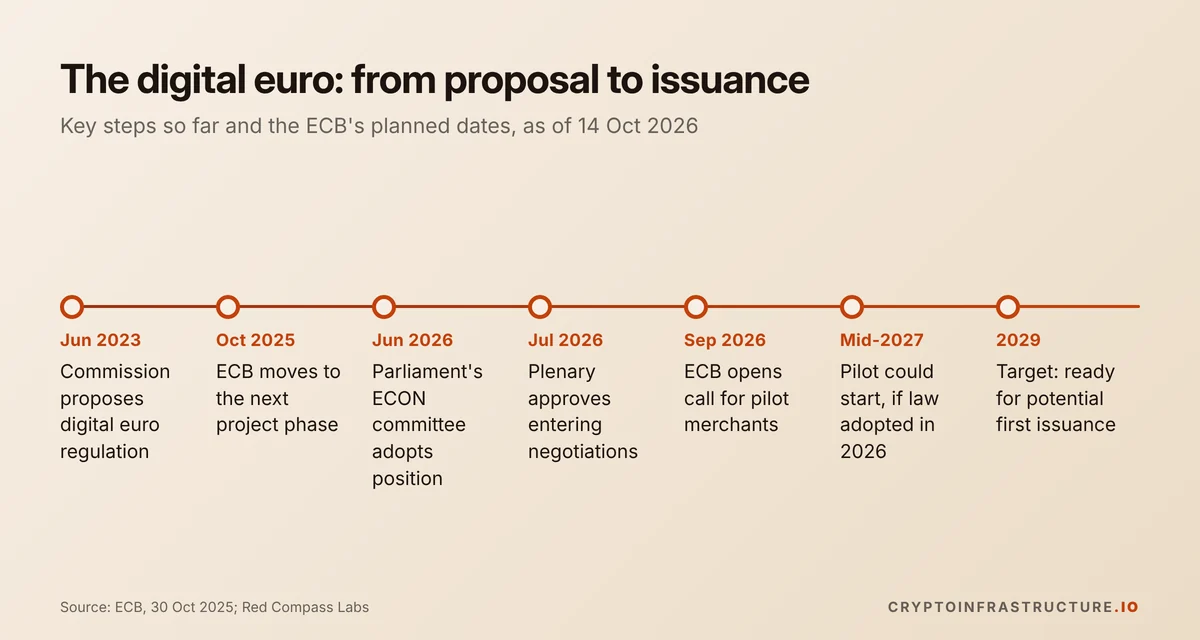
On 30 October 2025 the ECB’s Governing Council decided to move to the next phase of the project. If EU lawmakers adopt the digital euro regulation in 2026, a pilot and first transactions “could take place as of mid-2027” and the Eurosystem aims to be ready for a potential first issuance during 2029. The final decision on whether and when to issue will only be taken once the legislation has been adopted.
The Commission proposed the regulation on 28 June 2023; the Council has agreed its negotiating position, and according to Red Compass Labs the European Parliament’s ECON committee adopted its position on 23 June 2026 and the plenary approved entering negotiations on 9 July 2026. The regulation was not yet adopted as of 14 October 2026. Meanwhile the ECB published draft version 0.91 of the scheme rulebook in July 2026 and opened a call for merchants to join the pilot in September 2026.
The digital pound
The Bank of England is in a design phase and says it has not decided whether to introduce a digital pound; the earliest issuance would be “the second half of this decade”. It says it and the government “would not be able to see how you spent your digital pounds”, that a holding limit would be set high enough for day-to-day spending, and that Parliament would vote before any launch. Its consultation drew more than 50,000 responses.
China’s e-CNY and India’s e-rupee
China runs a large-scale retail pilot. According to an article by People’s Bank of China deputy governor Lu Lei, as reported in December 2025, the e-CNY had handled 3.48 billion transactions worth 16.7 trillion yuan by the end of November 2025, and banks running e-CNY wallets would start paying interest on balances in January 2026. That change makes e-CNY balances behave more like a deposit than like cash.
India’s e-rupee started with a wholesale pilot in November 2022, followed by a retail pilot. The RBI’s annual report, as reported on 29 May 2025, put e-rupee in circulation at ₹1,016 crore at end-March 2025, up from ₹234 crore a year earlier, with the retail pilot covering 17 banks and 6 million users. Offline and programmable features were added during FY2024-25, used for things like targeted benefit payments to farmers, and the RBI said it was exploring cross-border pilots. If you hold crypto in India as well, the rules for that are covered in crypto tax in India.
Benefits and risks of CBDCs
Central banks and critics broadly agree on the list; they disagree on the weights.
- Claimed benefits: a public, risk-free digital means of payment as cash use falls; cheaper and faster payments, including across borders; a fallback if private payment systems fail; and keeping central bank money relevant as payments move to tokens and stablecoins.
- Privacy and control: the main objection raised by critics, including US lawmakers backing the House ban. A CBDC’s privacy depends entirely on its legal and technical design. The ECB and Bank of England both say they would not see individual spending, and the ECB rules out programmable money, but those are design choices other central banks need not copy.
- Bank funding: if people move deposits into a CBDC, banks lose cheap funding, especially in a crisis. This is why holding limits and no-interest designs are common.
- Adoption: despite 146 jurisdictions exploring, only three have fully launched, per the Atlantic Council, so real-world evidence on take-up is still thin.
- Operational and cyber risk: a national payment system run through one core ledger is a high-value target and must work offline and at scale.
What this means for you
- If you are in the US: no CBDC is coming under current policy. The digital dollars you will meet are bank deposits and regulated stablecoins, which carry issuer and platform risk that a CBDC would not.
- If you are in the euro area: watch the trilogue outcome on the digital euro regulation in late 2026; the earliest pilot is mid-2027 and potential issuance is 2029.
- If you are in the UK: no decision has been made; any digital pound needs a parliamentary vote first.
- If you build payments or fintech products: plan for CBDCs as a regional, slow-moving channel and stablecoins as the faster-moving one, and track the licensing rules for each in stablecoin regulation explained.
- Everyone: treat any “CBDC coin” or “government crypto” sold on an exchange as a red flag. None of the CBDCs covered here is sold as a tradable crypto token.
For this month’s regulatory changes across regions, see the October 2026 regulation roundup, and the methodology explains how this site sources and dates its facts.


