The largest crypto exchange hack on record is Bybit: about $1.5 billion in ether stolen on 21 February 2025, attributed by the FBI to North Korea. The most recent major one is Bitget, which lost about $387.5 million on 24 to 25 September 2026. This list covers every centralised exchange incident of $100 million or more at the time of the theft, plus smaller ones that changed how exchanges work and every exchange hack of $50 million or more in 2025 and 2026. The pattern across 12 years is consistent: almost every big loss came from hot wallets, stolen keys or the software and people around the signing process, not from a broken blockchain. Users were made whole in most recent cases, but only because the exchange or its owner could pay. At Mt. Gox, creditors are still being repaid 12 years later and at WazirX about 15% of balances stayed locked in recovery tokens.
Every time an exchange is hacked, the same questions come back: has this happened before, did people get their money back and what should you do with coins you keep on an exchange? Most lists that rank for “crypto exchange hacks” stop at Bybit in early 2025, mix exchanges with DeFi bridges and Ponzi schemes, or give one dollar figure with no date or source. This reference sets out every major exchange hack in one dated table, with the amount at the time (in coins where known), the attack vector, who was blamed and by whom and what happened to users. Then it goes through each incident and the lesson it left. It will be updated after each new incident.
What counts as a “major” exchange hack here
A list of “every” hack needs a line. This one uses three rules:
- Centralised exchanges only. A centralised exchange holds your coins and keys for you. DeFi protocols, cross-chain bridges, wallets and Ponzi schemes are left out, even when they are larger (for example the Ronin bridge in 2022 or the Drift exploit in April 2026).
- $100 million or more at the time of the theft, using the exchange’s own figure or an official one where available, or historically significant: a smaller incident that changed how exchanges hold funds, how users are repaid or how regulators respond (Bitfinex 2016, Binance 2019, Crypto.com 2022, the Coinbase data breach of 2025).
- For 2025 and 2026, every exchange hack of $50 million or more, so the recent record is complete.
Dollar figures are the value at the time of the theft. Where sources disagree, the table gives the official or company figure first and notes the other.
Every major crypto exchange hack: the dated table
| Date | Exchange | Amount at the time | Attack vector | Attribution | What happened to users |
|---|---|---|---|---|---|
| Late 2011 to February 2014 (collapse 24 to 28 February 2014) | Mt. Gox (Japan) | About 850,000 BTC reported lost (about 750,000 customer, 100,000 company), about $473 million; about 200,000 BTC later found | Gradual theft from the hot wallet over years, per WizSec’s 2015 analysis | No conviction for the theft. Former CEO convicted in 2019 of data falsification only. | Bankrupt, then civil rehabilitation. Repayments in BTC and BCH began July 2024; the latest deadline set by the trustee was 31 October 2026. |
| August 2016 | Bitfinex | 119,754 BTC, about $72 million | More than 2,000 unauthorised transactions from multisignature wallets secured with BitGo | US DOJ: Ilya Lichtenstein (pleaded guilty 2023, 5 years) and Heather Morgan (18 months) | 36% cut to all balances, repaid via BFX tokens by April 2017. More than 94,000 BTC seized by the DOJ in 2022. |
| January 2018 | Coincheck (Japan) | About 523 million NEM (XEM), about $530 million | NEM held in a hot wallet without multisignature, as reported | Not formally attributed; Japanese prosecutors charged people who traded the stolen coins | About 260,000 users repaid in yen from Coincheck’s own capital. Bought by Monex Group in April 2018. |
| Early 2018 | BitGrail (Italy) | About $170 million in Nano, as reported | Not publicly established; founder and Nano Foundation blamed each other | None found | Lawsuits; no full repayment has been reported |
| 7 May 2019 | Binance | 7,000 BTC (about 2% of its BTC, from one hot wallet) | Stolen user API keys and 2FA codes via phishing and malware, used to pass withdrawal checks | Not named | Covered in full by Binance’s SAFU fund; withdrawals paused for about a week |
| Late September 2020 | KuCoin | About $281 million first reported in BTC, ERC-20 and other tokens; KuCoin’s later breakdown adds up to $285 million | Hot wallet private keys exposed | Accused: North Korea’s Lazarus Group | KuCoin says 78% recovered with partners, 6% with law enforcement, 16% ($45.55 million) paid from its insurance fund |
| 4 December 2021 | BitMart | About $196 million (CEO said $150 million), from two hot wallets on Ethereum and BSC | Hot wallets drained; access method not published | Not named | Reimbursement has not been confirmed |
| January 2022 | Crypto.com | About $33.7 million | Unauthorised withdrawals from customer accounts | Not named | Crypto.com said no customer lost funds |
| 11 to 12 November 2022 | FTX | About $473 million to $477 million drained the night it filed for bankruptcy | SIM swap, per a January 2024 DOJ indictment (victim reported as FTX) | Three people indicted (US) | Separate from the fraud. Estate repayments after the March 2026 distribution: US customers 100%, Dotcom customers 96%. |
| 10 November 2023 | Poloniex | About $126 million on Ethereum, TRON and Bitcoin | Hot wallets drained | Unconfirmed | Owner Justin Sun said it would “fully reimburse” affected funds |
| Late May 2024 | DMM Bitcoin (Japan) | 4,502.9 BTC, $308 million (about ¥48.2 billion) | Fake LinkedIn recruiter compromised an employee of wallet provider Ginco; attackers then altered a real DMM transaction | FBI, DC3 and Japan’s NPA: North Korea’s TraderTraitor (23 December 2024) | DMM said it would guarantee all customer BTC. Accounts and assets moved to SBI VC Trade on 8 March 2025. |
| 18 July 2024 | WazirX (India) | About $230 million, later put at $234.9 million | Multisignature wallet run under a custody arrangement with Liminal | Blockchain analysts: Lazarus Group | Platform frozen; loss shared across users under a Singapore scheme sanctioned 13 October 2025. About 85% paid out after relaunch on 24 October 2025; the rest held in non-withdrawable recovery tokens. |
| 23 January 2025 | Phemex | About $73.5 million across almost 30 chains | Hot wallets drained; early analysis pointed to an access control breach | Unconfirmed | Withdrawals paused; compensation plan promised |
| 21 February 2025 | Bybit | 401,347 ETH plus stETH, cmETH and mETH: about $1.44 billion by the values in Bybit’s breakdown, $1.46 billion in Bybit’s headline figure, about $1.5 billion per the FBI | Malicious code in the Safe{Wallet} interface used by Bybit’s cold wallet signers swapped the transaction they approved | FBI PSA, 26 February 2025: North Korea (“TraderTraitor”) | Withdrawals kept running; ETH gap closed within 72 hours with bridge loans, deposits and purchases |
| 15 May 2025 (disclosed) | Coinbase (data, not funds) | Customer data of under 1% of monthly transacting users; $20 million ransom demanded and refused | Bribed overseas customer support agents copied data from support tools | Not named; insiders referred to law enforcement | No funds or keys taken. Coinbase said it would reimburse retail customers tricked into sending funds. |
| 18 June 2025 | Nobitex (Iran) | About $90 million claimed by the attackers; SlowMist’s first estimate $81.7 million | Hot wallets drained and coins sent to unspendable “burn” addresses | Claimed by Predatory Sparrow (Gonjeshke Darande) | Nobitex said user funds were safe and cold wallets unaffected |
| 14 August 2025 | BtcTurk (Turkey) | About $51.7 million across seven chains | Leaked hot wallet private keys (its second hot wallet loss after about $55 million in June 2024) | Not named | Crypto deposits and withdrawals suspended; BtcTurk said customer funds were secure |
| 24 to 25 September 2026 | Bitget | About $387.5 million (first reported as $351.6 million) | Zero-day flaw in two third-party security appliances, then lateral movement to the wallet job server | Bitget’s CEO blamed North Korea (company claim; no government statement found) | Bitget says balances were unaffected; paid from its Protection Fund; all withdrawals restored 2 October 2026 |
Sources: exchange statements and trustee notices, US DOJ and FBI releases, Japan’s National Police Agency, the Rekt leaderboard (amounts and dates for BitMart, Crypto.com, Poloniex, Phemex and BtcTurk), SlowMist, TRM Labs, BleepingComputer and press reports named in each section below. BitGrail is listed from secondary reports only; no primary post-mortem was found.
Close to the line, but not in the table
- Under $50 million in 2025: CoinDCX (India, 18 July 2025, about $44.3 million), BigONE (15 July 2025, about $27 million) and WOO X (24 July 2025, about $14 million), per the Rekt leaderboard.
- Not an exchange: on 6 September 2026, attackers took about 4,000 BTC (about $319 million) from the Liquid Network, a Bitcoin sidechain built by Blockstream and run by a federation of exchanges and other firms. TRM Labs reports about 85% was returned the next day. It hit exchanges that use Liquid, but it was a flaw in the network’s software, not an exchange breach.
- DeFi, not centralised: DL News reports that Drift, a Solana-based exchange protocol, lost about $285 million in April 2026 after North Korean hackers social-engineered two employees. It sits outside this list because users did not hand custody to a company.
What is the biggest crypto exchange hack ever?
Bybit, on 21 February 2025. The FBI put the theft at about $1.5 billion and named North Korea in a public service announcement on 26 February 2025. The asset values in Bybit’s own breakdown add up to about $1.44 billion (Bybit’s headline figure is $1.46 billion); the Rekt leaderboard gives $1.436 billion. Chainalysis, in its report of 18 December 2025, said Bybit alone was about 44% of the more than $3.4 billion stolen across crypto from January to early December 2025.
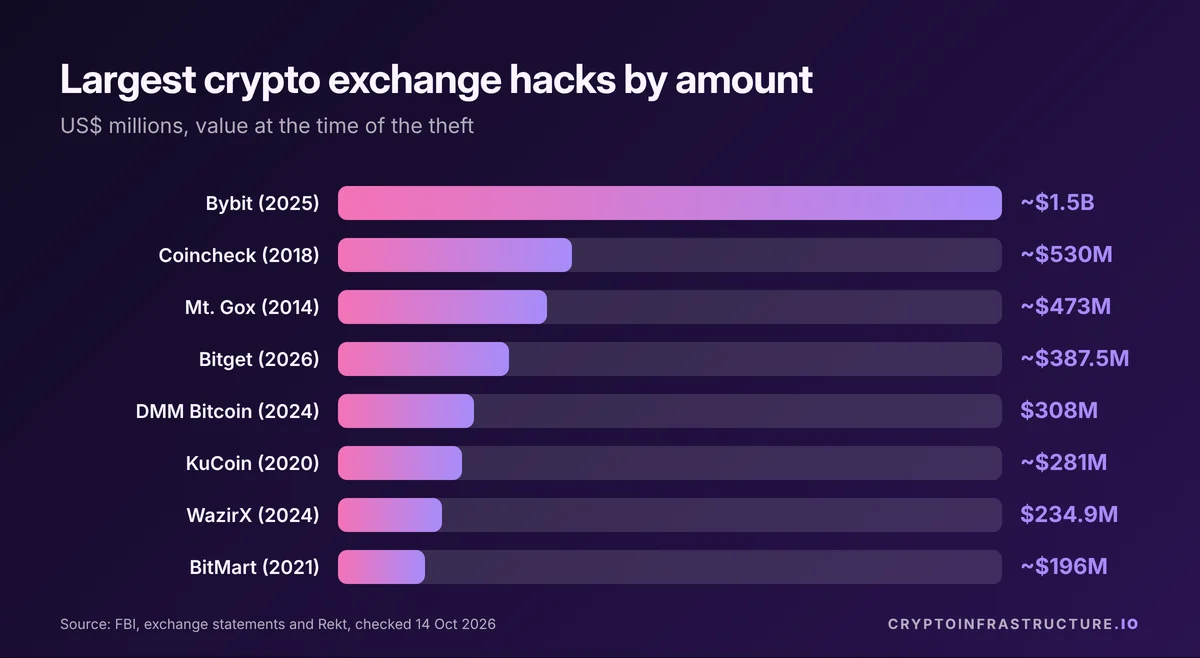
Two bigger figures sometimes appear in these lists. The Rekt leaderboard’s top entry, about $14.8 billion dated 20 December 2020 and the roughly $3.5 billion DL News says was taken from LuBian wallets in December 2020, a breach that went unnoticed for almost five years, are not exchange thefts. Mt. Gox lost more bitcoin (about 850,000 BTC) but was worth far less in dollars at the time.
Each hack and what it taught
Mt. Gox, 2011 to 2014: the exchange that taught “not your keys”
Mt. Gox, in Tokyo, was once the largest bitcoin exchange. It suspended trading on 24 February 2014 and filed for civil rehabilitation on 28 February. It said it had lost almost 750,000 customer bitcoin and about 100,000 of its own, worth about $473 million near the filing. On 20 March 2014 it found about 200,000 BTC in an old wallet. A 2015 analysis by the security firm WizSec concluded most of the coins had been stolen from the hot wallet gradually from late 2011. Former CEO Mark Karpelès was convicted in 2019 only of falsifying data, with a suspended sentence.
The repayment story is still running. The rehabilitation trustee’s notices show repayments in bitcoin and bitcoin cash starting in July 2024, with the latest repayment notice on 27 March 2025. On 27 October 2025 the trustee moved the deadline for base, early lump-sum and intermediate repayments to 31 October 2026. That deadline has now passed, so check the trustee’s site for the latest notice.
Lesson: an exchange can be insolvent for years before anyone notices, because nobody outside can see its wallets. That is the origin of proof of reserves and why a single dated snapshot is still not an audit.
Bitfinex, 2016: multisig is not enough and stolen bitcoin can be traced
In August 2016, more than 2,000 unauthorised transactions took 119,754 BTC (about $72 million then) from Bitfinex, even though its wallets used multisignature security with BitGo. Bitfinex cut every customer’s balance by 36%, including accounts that were not hacked and issued BFX tokens for the loss. Users who kept the tokens were repaid in full by April 2017.
Six years later, the US Justice Department announced on 8 February 2022 the arrest of Ilya Lichtenstein and Heather Morgan and the seizure of more than 94,000 BTC, then worth over $3.6 billion. Lichtenstein pleaded guilty in 2023 and was sentenced to five years in November 2024; Morgan received 18 months.
Lesson: two things. A “socialised loss” can hit you even if your own account was never touched. And bitcoin moves on a public ledger, so can the FBI trace crypto? Yes, sometimes years later, but tracing is not the same as getting your coins back on time.
Coincheck, 2018: the hot wallet problem at scale
In January 2018, about 523 million NEM tokens, worth about $530 million, were taken from Coincheck in Japan. Reports say it kept most of its NEM in a hot wallet (one connected to the internet) without multisignature protection. Coincheck repaid about 260,000 affected users in yen from its own capital. Japan’s Financial Services Agency ordered it to improve its security and Monex Group bought it in April 2018 for 3.6 billion yen.
Lesson: users were saved by an exchange that could pay and a buyer that stepped in, not by any rule. Japan is also where DMM Bitcoin, below, was hit six years later.
BitGrail, 2018: when nobody takes responsibility
About $170 million in Nano was reported missing from the Italian exchange BitGrail in early 2018. No technical post-mortem was published and the founder and the Nano Foundation blamed each other while users went to court. This entry rests on secondary reports only.
Lesson: how an exchange behaves after a loss matters as much as the loss. Silence and blame are red flags.
Binance, 2019: the first big “we’ll cover it” fund
On 7 May 2019, Binance lost 7,000 BTC from its bitcoin hot wallet, which held about 2% of its bitcoin. Its notice that day said attackers had collected “a large number of user API keys, 2FA codes, and potentially other info” through phishing, viruses and other methods and used them in a single withdrawal that passed its checks. Binance paid the loss from its Secure Asset Fund for Users (SAFU) and paused deposits and withdrawals for about a week.
Lesson: the exchange was hit through its users’ accounts. Your API keys and 2FA are part of the exchange’s security. SAFU-style funds also became the industry’s answer to hacks, but they are company reserves, not insurance you can claim on.
KuCoin, 2020: most of the money came back, but not by itself
In late September 2020, private keys for KuCoin‘s hot wallets were exposed and about $281 million in bitcoin, ERC-20 and other tokens was first reported taken. The Lazarus Group was accused. According to CEO Johnny Lyu’s February 2021 account, KuCoin recovered $222 million (78%) with other exchanges and token projects, $17.45 million (6%) with law enforcement and paid $45.55 million (16%) from its insurance fund. Those three figures add up to $285 million. The last one is why the Rekt leaderboard lists KuCoin at about $45 million while most lists say $281 million.
Lesson: recovery depended on token issuers freezing or reissuing stolen tokens. That works for some tokens, not for bitcoin or ether, so do not assume the same outcome next time.
BitMart, 2021: two hot wallets, two chains
On 4 December 2021, about $196 million was drained from two BitMart hot wallets, about $100 million on Ethereum and $96 million on BNB Smart Chain, according to Rekt. BitMart’s CEO put the loss at $150 million. How the attacker got access was not published and reimbursement has not been confirmed.
Lesson: exchanges that support many chains run many hot wallets. Each one is a separate target.
Crypto.com, 2022: account security is exchange security
In January 2022, attackers made unauthorised withdrawals from Crypto.com customer accounts, worth about $33.7 million according to Rekt. Crypto.com paused withdrawals and later said no customer lost funds. The Crypto.com review covers the incident in more detail.
Lesson: the cash amount was small next to the others, but it showed how account-level attacks can hit many customers at once.
FTX, 2022: a theft on top of a fraud
FTX is two separate stories and many lists blur them.
- The fraud. FTX and more than 100 affiliates filed for bankruptcy on 11 November 2022 after customer money was used by its sister firm Alameda Research. Founder Sam Bankman-Fried was convicted on all seven counts on 2 November 2023, sentenced to 25 years on 28 March 2024 and ordered to forfeit $11.02 billion. The Second Circuit upheld the conviction on 12 June 2026 and he petitioned the US Supreme Court in September 2026.
- The theft. Late on 11 November 2022, the night of the bankruptcy filing, about $473 million to $477 million was drained in what FTX US called “unauthorised transactions”. In January 2024 the Justice Department indicted three people for stealing “over $400 million” through a SIM swap; sources told Bloomberg the victim was FTX.
For customers, the estate has repaid more than many expected. After a fourth distribution of about $2.2 billion on 31 March 2026, AMBCrypto reported cumulative recoveries of 100% for US customer claims and 96% for Dotcom customer claims, with claims valued at the dollar prices of November 2022, not at today’s prices.
Lesson: the biggest loss at FTX was not a hack. An exchange that misuses customer deposits can fail without any outsider breaking in, which is why segregation of customer assets matters as much as wallet security.
Poloniex, 2023: owner-backed refunds
On 10 November 2023, about $126 million was drained from Poloniex hot wallets on Ethereum, TRON and Bitcoin. Owner Justin Sun said Poloniex would “fully reimburse” the affected funds and offered a 5% bounty. Attribution was not confirmed.
Lesson: a refund promise is only as good as the person or company behind it. Check who owns the exchange and whether they have the money.
DMM Bitcoin, 2024: attacked through a supplier
In late May 2024, 4,502.9 BTC worth $308 million was taken from DMM Bitcoin in Japan. The FBI, DC3 and Japan’s National Police Agency said on 23 December 2024 that North Korean “TraderTraitor” actors posed as a LinkedIn recruiter and sent an employee of Ginco, a Japanese wallet software company, a “pre-employment test” that was really malicious code. They later used that access to change a legitimate transaction request from a DMM employee. DMM said it would guarantee all customer bitcoin deposits. It then wound down: its customer accounts and assets moved to SBI VC Trade on 8 March 2025, according to SBI’s announcement as reported by PANews.
Lesson: your exchange’s security is also its suppliers’ security. And even a fully repaid hack can end an exchange.
WazirX, 2024: the users paid
On 18 July 2024, India’s WazirX lost about $230 million (later put at $234.9 million) from a multisignature wallet held under a custody arrangement with Liminal. Blockchain analysts attributed it to the Lazarus Group. The loss was close to half the exchange’s reported reserves. WazirX froze the platform, reset balances to their 18 July state and proposed spreading the loss across all users. Singapore’s High Court sanctioned the creditor-approved scheme on 13 October 2025. WazirX relaunched on 24 October 2025, paid out about 85% of rebalanced balances and on 9 January 2026 finished allocating non-tradable, non-withdrawable recovery tokens for the rest.
Lesson: when an exchange cannot cover a hack, you may share the loss even if your account was never touched and you wait more than a year to find out how much. Multisig with a third-party custodian did not prevent it.
Phemex, January 2025: dozens of hot wallets at once
On 23 January 2025, attackers drained Phemex hot wallets across almost 30 chains, about $73.5 million in total per Rekt. Early analysis by Hacken pointed to an access control breach. Phemex paused withdrawals and said a compensation plan would follow. Attribution has not been confirmed.
Lesson: attackers who get into an exchange’s internal systems can empty many hot wallets at once. Rekt noted the cold wallets may have stayed safe, which is the point of keeping most funds offline.
Bybit, February 2025: the largest exchange hack on record
On 21 February 2025, attackers took 401,347 ETH, 90,375 stETH, 15,000 cmETH and 8,000 mETH from one Bybit Ethereum cold wallet. The asset values in Bybit’s own timeline add up to about $1.44 billion and Bybit’s headline figure is $1.46 billion. Bybit says forensic firms Sygnia and Verichains found malicious JavaScript on the Safe{Wallet} platform used to approve the transaction and no vulnerability in Bybit’s own systems. The signers approved what looked like a normal transfer; the code swapped it for one that handed over control of the wallet.
Bybit did not halt withdrawals. It says it processed 99.994% of more than 350,000 withdrawal requests within 10 hours and received $1.23 billion in ETH through bridge loans, deposits and over-the-counter purchases by 24 February, closing the gap within 72 hours. The full story, including what Bybit’s proof of reserves shows now, is in the Bybit review.
Lesson: a cold wallet is only as safe as the screen its signers trust. “Blind signing”, approving a transaction you cannot independently read, defeated a multisig cold wallet. The account abstraction guide explains how smart wallets approve transactions.
Coinbase, May 2025: a data breach, not a hack of funds
Coinbase disclosed on 15 May 2025 that criminals had bribed a small group of overseas customer support agents to copy customer data. It affected less than 1% of monthly transacting users. The data included names, addresses, phone numbers, emails, the last four digits of Social Security numbers, masked bank account numbers, government ID images and account balances. Coinbase says no passwords, 2FA codes, private keys or funds were accessed. The attackers demanded $20 million; Coinbase refused and offered a $20 million reward instead and said it would reimburse retail customers who were tricked into sending funds to the attackers.
Did Coinbase get hacked? Not in the sense of a wallet theft. Its systems were not broken into, but its people were bribed and the stolen data was meant to make “Coinbase support” scams more convincing. See the Coinbase review for its wider record.
Lesson: the main risk from a data leak is the phone call or email that follows. Treat any unexpected “support” contact as a scam until proven otherwise.
Nobitex, June 2025: destruction, not profit
On 18 June 2025, the hacker group Predatory Sparrow (Gonjeshke Darande) claimed an attack on Iran’s largest exchange, Nobitex and sent about $90 million in crypto to “burn” addresses no one can spend from, according to SlowMist’s analysis of 20 June 2025 (its first loss estimate was $81.7 million; Nobitex put it near $100 million). The group accused Nobitex of helping Iran evade sanctions. Nobitex said user funds were safe and the breach was limited to hot wallets.
Lesson: exchanges can be targets in geopolitical conflicts, where the aim is damage, not theft.
BtcTurk, August 2025: hit twice
On 14 August 2025, about $51.7 million was drained from BtcTurk hot wallets across seven chains after private keys leaked, according to Rekt. It was the Turkish exchange’s second such loss: about $55 million had been taken from ten hot wallets in June 2024. BtcTurk suspended crypto deposits and withdrawals and said customer funds and cold wallets were secure.
Lesson: an exchange that has been hacked once has not necessarily fixed the cause. Check what changed after the first incident.
Bitget, September 2026: the latest major exchange hack
Which crypto platform got hacked most recently? The latest major exchange hack is Bitget. Bitget paused withdrawals and first put the loss at about $351.6 million, as reported on 25 September 2026; it later revised the figure to about $387.5 million. According to the Bitget review and BleepingComputer’s account of the forensic findings (30 September 2026), attackers used a zero-day flaw in two third-party security appliances, planted a web shell and moved to Bitget’s production wallet job server. SlowMist found the earliest malicious activity in the logs on 31 August 2026, more than three weeks before the theft. Bitget’s CEO, Gracy Chen, blamed North Korean hackers; that attribution is the company’s own.
Bitget says user balances “remained accurate and unaffected”. It covered the loss from its Protection Fund, said it restored that fund to more than $300 million on 30 September and finished reopening withdrawals on 2 October 2026. CNBC reported on 2 October that the CEO was “not expecting to recover a lot” of the stolen funds.
Lesson: keys locked in cold storage do not help if an attacker can feed false instructions into the system that approves withdrawals. That layer is now the target.
How do crypto exchanges get hacked?
Reading the incidents together, five routes cover almost every case above:
- Hot wallet key theft. Keys for internet-connected wallets are stolen or leaked (Mt. Gox, Coincheck, KuCoin, BitMart, Poloniex, BtcTurk, Phemex).
- Tampered signing. Signers approve a transaction that is not what they see, through compromised wallet software or a supplier (Bybit, DMM Bitcoin, WazirX).
- Internal systems. Attackers get into the backend that triggers withdrawals, often through a third-party product (Bitget).
- Customer accounts. Stolen API keys, 2FA codes and SIM swaps (Binance 2019, Crypto.com, the FTX theft).
- People. Fake recruiters, bribed staff and social engineering (DMM’s supplier, Coinbase’s support agents, Drift).
None of these broke Bitcoin or Ethereum. What fails is the company’s operations around the coins.
Can crypto exchanges be hacked and who is behind it?
Yes and the largest attacks are increasingly state-backed. Chainalysis reported on 18 December 2025 that North Korean hackers stole at least $2.02 billion in 2025, about 59% of all crypto theft that year. The FBI or Japanese police formally attributed Bybit and DMM Bitcoin to North Korea; KuCoin, WazirX and Bitget were blamed on North Korea by others, with no government statement found. The pace has not slowed: DL News reported 29 hacks and exploits in April 2026 alone, the highest monthly count on record per DefiLlama data, with $635 million lost.
Has Binance been hacked?
Once at the exchange level: 7,000 BTC on 7 May 2019, covered by SAFU, as above. A separate October 2022 exploit hit the BNB Chain bridge, not Binance exchange accounts. The Binance review sets out both.
Do users get their money back after an exchange hack?
Usually in recent years, but never because of a guarantee. Sorting the table by outcome:
| Outcome | Examples | Who paid |
|---|---|---|
| Covered in full, no break in service | Bybit 2025, Bitget 2026 | The exchange’s balance sheet, protection fund and lenders |
| Covered in full after a pause | Binance 2019, KuCoin 2020, Coincheck 2018, DMM 2024 | Company funds, partners’ freezes, a parent company |
| Loss shared across all users, repaid later | Bitfinex 2016, WazirX 2024 | Every customer, hacked or not, until recovery tokens were redeemed |
| Bankruptcy, repaid years later | Mt. Gox 2014, FTX 2022 | Court-run estates, at dollar values from the collapse date |
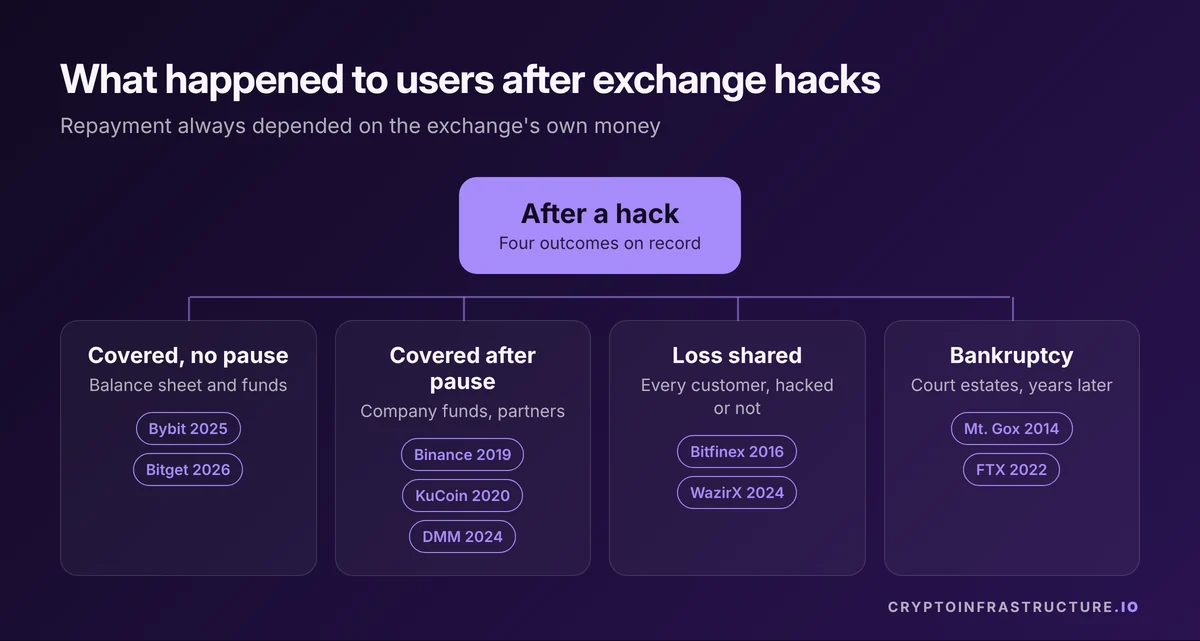
Two patterns stand out. Repayment depended on the exchange’s own money every time; no government scheme covered crypto balances. And bankruptcy repayments are valued at the date of collapse, so you can be “repaid in full” in dollars and still have far less than the coins you held.
“I lost money in a hack. How can I recover it?”
If your exchange was hacked, follow only the exchange’s official announcements and claims process. If your own account was drained, report it to the exchange at once and to the police; in the US, the FBI takes reports through IC3. Be very wary of anyone offering to “recover” stolen crypto for a fee. Both the Mt. Gox trustee and Coinbase’s breach disclosure warned of impersonation and fake recovery services target exactly the people in this article.
What this means for you
Twelve years of exchange hacks point to the same few facts. The coin’s blockchain was never the weak point; the exchange’s operations were. Hot wallets, signing software, suppliers, staff and your own login are where the money leaves. Whether you get it back depends on whether the exchange or its owner can pay and on rules that change by country. So, before you leave crypto on any exchange:
- Keep only what you are actively trading there. Move the rest to a wallet you control and store its seed phrase properly.
- Check the exchange’s own history in the table above and in its review in the Exchanges section: was it hacked, how did it respond and what changed afterwards?
- Look at the latest proof of reserves and its date and who checked it, if anyone.
- Read what the terms say about segregation and loss sharing. That decides whether you look like Bybit’s customers in 2025 or WazirX’s in 2024.
- Lock down your account: authenticator app or passkey rather than SMS, withdrawal address whitelist, minimal API key permissions and no trust in unexpected “support” contacts.
This reference will be updated after each new major exchange hack. For how institutions hold large balances differently, see the institutional custody guide.