A crypto ETF (exchange-traded fund) is a fund whose shares trade on a stock exchange and give you exposure to the price of one or more cryptocurrencies without holding the coins yourself. A spot crypto ETF owns the actual coins, kept by a custodian such as Coinbase Custody Trust Company. A futures crypto ETF owns futures contracts instead, and pays a roll cost when later-dated contracts are more expensive. In the US, spot bitcoin ETPs were approved on 10 January 2024, spot ether ETPs on 23 May 2024, in-kind creations and redemptions on 29 July 2025, and generic listing standards on 17 September 2025. Some funds now stake the coins they hold. Outside the US, similar products trade in Canada and Hong Kong, while the UK and Europe mostly use exchange-traded notes.
You can now buy bitcoin, ether or solana exposure in the same brokerage account you use for index funds. But “crypto ETF” covers very different products: some hold coins in a vault, some hold futures contracts that slowly leak value, some stake their coins, and some outside the US are not funds at all but debt notes. Most explainers stop at “it tracks the price”. This guide shows how each type actually holds its exposure, what a futures roll costs with a worked example, how shares are created and redeemed, who holds the coins, how US approvals unfolded, and what the main funds charge, with every figure dated.
What is a crypto ETF?
ETF stands for exchange-traded fund: a pooled fund whose shares are listed on a stock exchange and trade all day like a share of a company. In crypto, the term means a fund that tracks the price of a cryptocurrency, or a basket of them, and sells shares to you through an ordinary brokerage or retirement account. In simple terms, you buy a share of a fund that owns the exposure, instead of buying the coin on a crypto exchange and storing it in your own wallet.
Two points that most summaries skip:
- Many US “crypto ETFs” are technically ETPs, not ’40 Act funds. The spot bitcoin and ether products are trusts listed as exchange-traded products (ETPs). Broker pages, such as E*TRADE’s crypto page (checked 14 October 2026), note that spot crypto ETPs are not registered under the Investment Company Act of 1940, so they do not carry the protections that apply to most mutual funds and ETFs. In everyday language people still call them ETFs, and this guide does too.
- You own fund shares, not coins. You cannot withdraw bitcoin from an ETF to your own wallet. The fund’s sponsor and custodian hold the coins, and the sponsor of the iShares Bitcoin Trust states that it “is not responsible for losses incurred due to loss, theft, destruction, or compromise of the trust’s bitcoin” (iShares investor education page dated 14 August 2026).
Spot vs futures crypto ETFs: what is the difference?
The difference is what the fund owns. A spot ETF owns the cryptocurrency itself. A futures ETF owns contracts that bet on the coin’s price at a future date, and never touches the coin.
| Spot crypto ETF | Futures crypto ETF | |
|---|---|---|
| What it holds | The coin itself (for example bitcoin), held by a custodian | Regulated futures contracts (for example CME bitcoin futures) plus cash or Treasury-type holdings as collateral |
| Example | iShares Bitcoin Trust (IBIT), Fidelity Wise Origin Bitcoin Fund (FBTC) | ProShares Bitcoin ETF (BITO), launched 18 October 2021 |
| Main tracking cost | Sponsor fee | Fund fee plus roll cost when futures trade above spot (contango) |
| Custody risk | Yes: coins sit with a custodian | No coin custody; exposure is to futures exchanges and counterparties |
| US regulator for the underlying | SEC regulates the ETP shares; spot crypto markets themselves are largely outside direct federal oversight | CFTC regulates the futures; SEC regulates the fund shares |
ProShares states that BITO “invests in futures and swaps and does not directly invest in bitcoin”. Its holdings on 13 October 2026 were roughly 80% CME bitcoin futures, about 15% Coinbase bitcoin futures and about 4.5% a swap on a CME bitcoin futures roll index, with the rest in a money market fund. The CFTC’s investor advisory on bitcoin futures ETFs explains that such a fund usually trades through a subsidiary commodity pool, that roll premiums and management fees reduce returns, and that returns “may not match” the spot market. If you want the mechanics of futures themselves, see the site’s guide to leverage and perpetual futures.
Contango and roll cost: a worked example (hypothetical numbers)
Futures contracts expire. To keep its exposure, a futures ETF sells the contract that is about to expire and buys the next one. This is called rolling. When the next contract trades at a higher price than the expiring one, the market is in contango, and every roll costs the fund a little. The CFTC describes this as paying a roll premium.
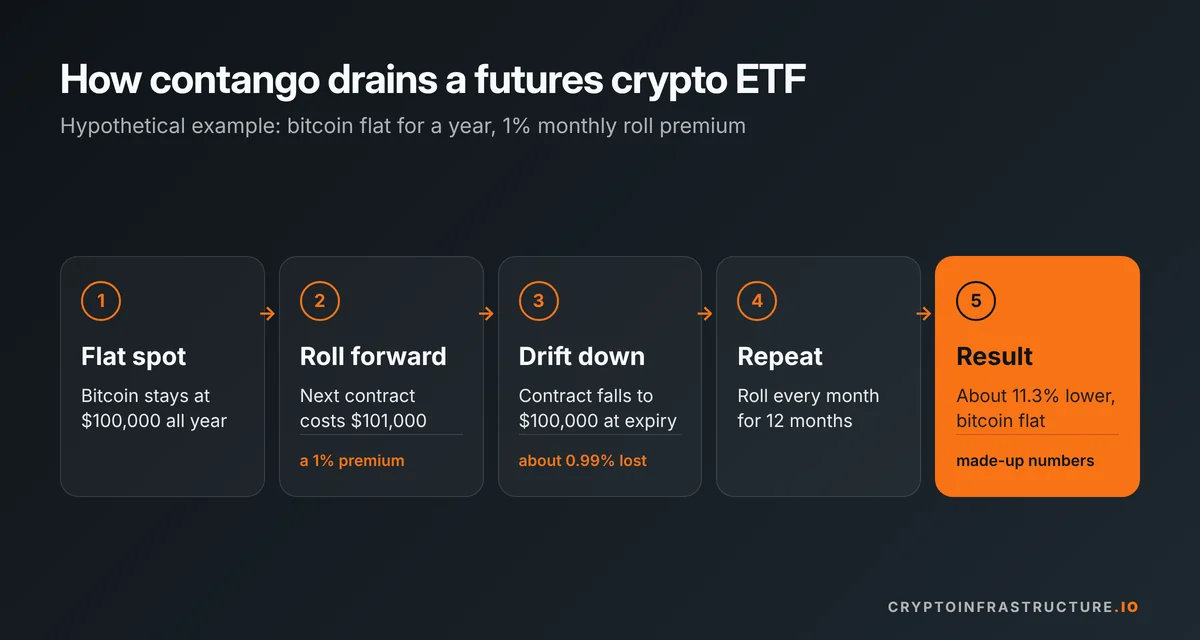
The numbers below are made up to show the effect. They are not real prices and not a forecast.
- Bitcoin’s spot price is $100,000 and stays exactly flat for a year.
- Each month the expiring contract settles at the spot price, $100,000, while the next month’s contract trades at $101,000, a 1% premium.
- The fund sells the expiring contract at $100,000 and buys the next one at $101,000. Over the month, that new contract drifts down to the flat spot price of $100,000 at expiry, a loss of $1,000 on $101,000, or about 0.99%.
- Repeat for 12 months: 0.9901 to the power of 12 is about 0.887. The fund’s futures exposure ends the year about 11.3% lower, even though bitcoin itself did not move.
A spot ETF in the same flat year would lose only its fee. Three caveats keep this honest: the premium in real markets changes every month and can be smaller or larger than 1%; when later contracts are cheaper (backwardation), rolling adds to returns instead; and a futures fund also earns interest on its cash collateral, which offsets part of the roll cost. ProShares’ own page says the costs of rolling futures “may have a negative impact on performance”.
How do crypto ETFs hold coins? Creation and redemption
An ETF does not buy or sell coins every time you trade a share on the exchange. Your trade is with another investor. New shares are only created, and old ones redeemed, in large blocks called baskets, and only by authorized participants (APs): registered broker-dealers with an agreement with the fund.
On the iShares Bitcoin Trust page, one basket equalled 22.64 BTC, or $1,868,585.88, as of 12 October 2026, and the trust had 1,422,080,000 shares outstanding on that date (iShares IBIT product page, checked 14 October 2026).
Cash vs in-kind creation
- Cash creation. The AP delivers dollars to the fund. The fund, or a trading partner on its behalf, then buys the bitcoin and moves it to the custodian. On redemption, the fund sells bitcoin and pays the AP in cash. This is how the US spot bitcoin and ether funds started in 2024.
- In-kind creation. The AP delivers the coins themselves to the fund in exchange for new shares, and receives coins back when it redeems shares. The fund never has to trade.
On 29 July 2025 the SEC approved exchange rule changes (Release No. 34-103571) letting the listed bitcoin and ether trusts create and redeem in kind, in addition to cash. The order covered funds on Nasdaq (iShares Bitcoin Trust, iShares Ethereum Trust), Cboe BZX (including the Fidelity, ARK 21Shares, 21Shares, VanEck, WisdomTree, Invesco Galaxy and Franklin funds) and NYSE Arca (the Bitwise bitcoin and ether funds).
Why it matters to you: the creation and redemption process is what keeps the share price close to the value of the coins the fund holds (its net asset value, or NAV). If shares trade above NAV, APs create new shares and sell them; if below, they buy shares and redeem them. In-kind creation lets APs do this with coins directly, which removes a cash trading step. It is also the reason ETF flows can move large amounts of coins between custodians, which the site’s guide to crypto whales touches on.
Who holds the coins? Custodians
A spot crypto ETF’s coins sit with a custodian, a regulated firm that stores the private keys, often in offline (cold) storage. The fund’s prospectus names the custodian, and that is the place to check, because product pages often do not.
| Fund | Custodian named by the issuer | Source, date checked |
|---|---|---|
| iShares Bitcoin Trust (IBIT) | Coinbase Custody Trust Company, LLC (not affiliated with BlackRock) | iShares investor education page, dated 14 Aug 2026; checked 14 Oct 2026 |
| Grayscale Bitcoin Trust (GBTC) | Coinbase Custody Trust Company, LLC | Grayscale GBTC page, checked 14 Oct 2026 |
| Fidelity Wise Origin Bitcoin Fund (FBTC) | Fidelity Digital Assets, National Association | Fidelity crypto funds page, checked 14 Oct 2026 |
| Fidelity Ethereum Fund (FETH) | Fidelity Digital Assets, National Association; Anchorage; BitGo | Fidelity crypto funds page, checked 14 Oct 2026 |
| Purpose Bitcoin ETF (Canada) | Not named on the product page; the fund says it holds bitcoin directly in cold storage | Purpose Investments page, checked 14 Oct 2026 |
Concentration is a real point to understand: several of the largest US funds use the same custodian, so an operational problem at one firm could affect many funds at once. How institutional custodians are structured, insured and regulated, including the SEC’s custody proposal of 1 October 2026, is covered in the site’s guide to institutional crypto custody.
US approvals timeline
| Date | What happened | Source |
|---|---|---|
| 18 Oct 2021 | ProShares Bitcoin Strategy ETF (now ProShares Bitcoin ETF, BITO) launches as a futures-based fund | ProShares BITO page (inception date) |
| 10 Jan 2024 | SEC approves the listing and trading of a number of spot bitcoin ETP shares. The chair’s statement says “we did not approve or endorse bitcoin” | SEC statement, 10 Jan 2024 |
| 11 Jan 2024 | Grayscale Bitcoin Trust begins trading on NYSE Arca as a spot ETP; its expense ratio before that date was 2.00% | Grayscale GBTC page |
| 23 May 2024 | SEC approves exchange rule changes for eight spot ether ETPs on NYSE Arca, Nasdaq and Cboe BZX (Release No. 34-100224) | SEC order 34-100224 |
| July 2024 | Spot ether ETFs begin trading after their registration statements take effect | Crypto.com guide, 2 Sep 2025 (iShares lists ETHA’s inception date as 24 Jun 2024) |
| 29 Jul 2025 | SEC approves in-kind creations and redemptions for listed bitcoin and ether trusts (Release No. 34-103571) | SEC order 34-103571 |
| 17 Sep 2025 | SEC approves generic listing standards for commodity-based trust shares on Nasdaq, Cboe BZX and NYSE Arca (Release No. 34-103995). Products that meet each exchange’s generic rule, such as NYSE Arca Rule 8.201-E (Generic), can list without a separate SEC rule-change approval for each fund | SEC order cited in Federal Register, 1 Oct 2025 |
| After Sep 2025 | Spot funds on other assets list in the US. Examples on issuer and broker pages checked 14 Oct 2026: Fidelity Solana Fund (FSOL) and a Morgan Stanley SOL product (MSOL) | Fidelity and E*TRADE pages |
If you are wondering what a spot ETF means for a coin like XRP or Solana: it means a fund holds that coin through a custodian and you can get price exposure through a brokerage account. It says nothing about the coin’s technology or its future price, and the SEC’s 2024 statement made clear that approving a product is not an endorsement of the asset.
Do crypto ETFs stake their coins?
Some now do. Proof-of-stake networks such as Ethereum and Solana pay rewards to holders who lock coins with validators. The early US ether ETFs did not stake, and some top-ranking explainers still say ETH ETFs “cannot offer staking rewards”. That is out of date for at least some funds.
- The Fidelity crypto funds page (checked 14 October 2026) says the Fidelity Ethereum Fund and the Fidelity Solana Fund expect to receive staking rewards, distributed four times a year after staking fees. It lists slashing penalties (losses when a validator misbehaves) and unstaking delays (“buffer periods”) as risks.
- BlackRock lists a separate iShares Staked Ethereum Trust ETF (ETHB) next to its iShares Ethereum Trust (ETHA). The ETHA page itself does not say ETHA stakes (checked 14 October 2026).
Staking changes what you hold: part of the fund’s coins may be locked and not immediately available for redemptions, and rewards are variable, not a fixed yield. Read the fund’s prospectus for how much it stakes, who the validators are and how rewards are taxed and paid.
Crypto ETFs outside the US
| Market | What exists | Dated fact |
|---|---|---|
| Canada | Spot bitcoin ETFs on the Toronto Stock Exchange | Purpose Bitcoin ETF lists 23 Feb 2021 as the inception of its hedged series and calls itself “the world’s first spot Bitcoin ETF” (issuer claim); management fee 1.00% (checked 14 Oct 2026) |
| Hong Kong | Spot virtual asset ETFs authorised by the SFC, listed on HKEX | HKEX announced the listing of “Asia’s first Spot Virtual Asset ETFs” on 30 Apr 2024 (Xinhua report, 30 Apr 2024). For the licensing side, see the site’s Hong Kong VATP guide |
| United Kingdom | Crypto exchange-traded notes (cETNs), not ETFs | The FCA lifted its retail ban on cETNs on 8 Oct 2025, for notes traded on a UK recognised investment exchange; its retail ban on crypto derivatives stayed in place (Solicitors Journal, 17 Oct 2025) |
| European Union | Exchange-traded products, mostly structured as notes | An ETN is a debt instrument issued by a company, usually backed by coins it holds, rather than a fund. You are exposed to the issuer’s structure as well as the coin |
For a UK or EU investor the label matters: a note’s legal claim and protections differ from a fund’s, so check the issuer, the collateral arrangement and the custodian in the prospectus.
Fees of some large crypto ETFs (dated)
These are listed fees and holdings from issuer pages, not a ranking or a recommendation. Fees can change and temporary waivers can expire, so check the current prospectus.
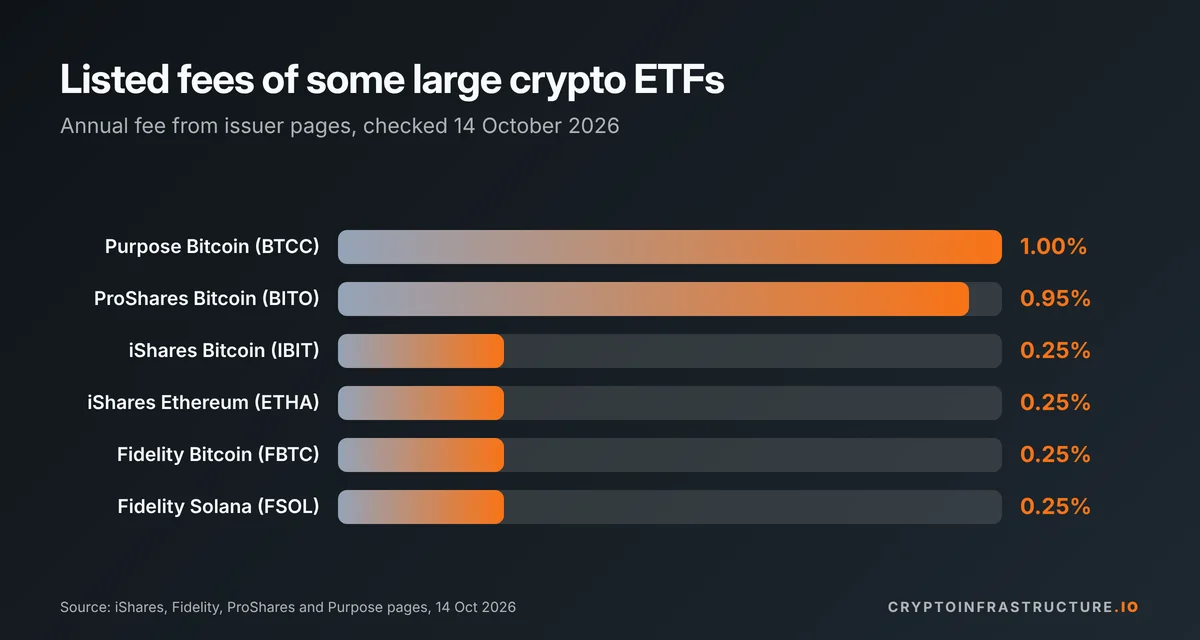
| Fund (ticker) | Type | Listed fee | Net assets (as of) | Checked |
|---|---|---|---|---|
| iShares Bitcoin Trust (IBIT) | Spot bitcoin | 0.25% sponsor fee | $66.43 billion (12 Oct 2026) | 14 Oct 2026 |
| iShares Ethereum Trust (ETHA) | Spot ether | 0.25% sponsor fee | $8.76 billion (12 Oct 2026) | 14 Oct 2026 |
| Fidelity Wise Origin Bitcoin Fund (FBTC) | Spot bitcoin | 0.25% (effective 1 Aug 2024) | Not listed on the page checked | 14 Oct 2026 |
| Fidelity Ethereum Fund (FETH) | Spot ether, staking | 0.25% (effective 1 Jan 2025) | Not listed on the page checked | 14 Oct 2026 |
| Fidelity Solana Fund (FSOL) | Spot SOL, staking | 0.25% | Not listed on the page checked | 14 Oct 2026 |
| ProShares Bitcoin ETF (BITO) | Bitcoin futures | 0.95% expense ratio | Not used here | 14 Oct 2026 |
| Purpose Bitcoin ETF (BTCC, Canada) | Spot bitcoin | 1.00% management fee (MER capped at 1.50%) | Not used here | 14 Oct 2026 |
Sources: iShares IBIT and ETHA product pages, Fidelity crypto funds page, ProShares BITO page, Purpose Investments product page, all checked 14 October 2026. A futures fund’s total cost also includes roll cost, which is not part of its expense ratio.
Crypto ETF vs owning the coin: what changes
People often ask why anyone would hold a bitcoin ETF instead of bitcoin. This is not a recommendation either way; the trade-offs are structural:
- Keys. With an ETF, a custodian holds the keys and you hold a brokerage position. With the coin, you or your exchange hold the keys. If you self-custody, losing your seed phrase means losing the coins; the site’s seed phrase guide covers that risk.
- Access and hours. ETF shares trade during stock market hours in brokerage and retirement accounts. Coins trade around the clock on crypto exchanges.
- Use. You cannot send ETF shares on-chain, pay with them, or use them in DeFi.
- Costs. An ETF charges an annual fee on your holding. Buying coins directly involves trading spreads and fees, and sometimes withdrawal fees.
- Protections. Spot crypto ETPs are not registered under the Investment Company Act of 1940, and brokers note that crypto is not covered by FDIC or SIPC protection the way a bank deposit or a failed broker’s securities might be.
Common mistakes when reading about crypto ETFs
- Treating spot and futures funds as the same. A futures fund can lag the coin for long stretches because of roll costs.
- Reading old explainers. Pages from 2020 to 2022 still rank and say most bitcoin ETFs use futures or that no spot fund exists in the US. Both statements were overtaken in January 2024.
- Assuming an ETF stakes, or does not stake. It depends on the fund. Check the prospectus.
- Assuming the custodian is insured for everything. The sponsor’s disclaimers about loss or theft are worth reading before you rely on the structure.
- Confusing ETNs with ETFs. Outside the US and Canada, many listed crypto products are notes, with issuer risk.
What this means for you
A crypto ETF is a way to hold price exposure through a regulated listed product rather than holding coins yourself. The key question is what the fund actually owns: coins in custody (spot), futures contracts with roll costs, or, outside the US, a note from an issuer. From there, check the custodian, how shares are created and redeemed, whether the fund stakes, and the current fee in the prospectus, with the date you checked it.
For who controls the networks behind these funds, read who owns Ethereum and who owns Dogecoin. For how this site sources and dates figures, see the methodology, and find more explainers in Guides.