Checked 14 October 2026. Tokenomics is the set of rules that decide how many units of a crypto token exist, who gets them, when they can be sold, how new ones are created or destroyed, and what holding one lets you do. The parts that move the most supply are allocation (team, investors, community, treasury), vesting (cliffs and release schedules), unlocks (the dates locked tokens become sellable) and emissions (ongoing issuance minus burns). Two published examples: Uniswap gave 60% of UNI to its community and 40% to team, investors and advisors on four-year vesting (September 2020); Arbitrum gave 44.47% of ARB to team and investors with a one-year cliff and three years of monthly unlocks (March 2023). If you design a token, the legal side now matters as much as the maths: in the US the SEC’s 17 March 2026 interpretation and its August 2026 proposal both look at supply, allocations and vesting, and in the EU MiCA requires a notified white paper before most public offers.
Most explanations of what is tokenomics stop at “token plus economics” and a list of buzzwords. That is not much use if you are trying to read a project’s allocation chart, work out why a price chart sagged on a particular Tuesday, or design a token for your own team. This guide explains supply types, allocation, vesting, unlocks, emissions and sinks, and governance with real, dated allocation tables from projects’ own documents, then gives token teams a design section covering the legal constraints in the US and EU and a checklist you can work through before launch.
Checked 14 October 2026 against Uniswap’s and the Arbitrum Foundation’s own token documents, ethereum.org, bitcoin.org and xrpl.org, the SEC’s March 2026 release and withdrawn 2019 framework, a law-firm summary of the SEC’s August 2026 proposal, and the MiCA regulation on EUR-Lex. All numbers labelled “hypothetical” are illustrations, not data. This is education, not investment or legal advice, and nothing here recommends any token.
What is tokenomics?
Tokenomics is the economic design of a crypto token: its supply, how it is distributed, how and when locked tokens are released, how new tokens are issued or removed, and what rights or uses the token carries. The rules live partly in smart contracts or protocol code (which can enforce them) and partly in documents and promises (which cannot).
The word also has a second, unrelated meaning. Google’s AI Overview for this search, seen on 14 October 2026, notes that cloud and AI teams use “tokenomics” for the cost of the text tokens a language model processes. This guide is about crypto tokens only.
Why tokenomics matters
Price is roughly supply meeting demand, and tokenomics controls the supply side on a published timetable. A token can have a small circulating supply today and a much larger one in two years, which is why the gap between market cap and fully diluted valuation is the first number to check; the market cap vs FDV guide walks through that maths. For a team, tokenomics also decides who controls governance, how long contributors stay motivated, and how regulators are likely to read the token.
Supply: the three numbers every token has
| Term | What it means | Where it changes |
|---|---|---|
| Circulating supply | Tokens that exist and can be traded now | Rises with unlocks and emissions, falls with burns |
| Total supply | Tokens that exist, including locked and unvested ones | Rises with minting, falls with burns |
| Max supply | The hard limit the code allows, if there is one | Only by changing the protocol |
Supply models fall into three broad types:
- Fixed cap. Bitcoin is the reference case. bitcoin.org states that “only 21 million bitcoins will ever be created”, with new issuance automatically halved over time until it stops. So the answer to “how much BTC is in supply” is: at most 21 million, ever. The bitcoin halving guide explains the schedule.
- No cap, with burns. Ether has no fixed maximum. Since the Merge, ethereum.org says execution-layer issuance is zero and validators receive roughly 1,700 ETH a day, about 0.52% a year, while the base fee every transaction pays has been burned since the London upgrade in August 2021. On days when the average gas price is around 16 gwei or higher, ethereum.org says burning offsets issuance and net supply growth is zero or negative (page updated 6 June 2026).
- Pre-minted with scheduled release. Most project tokens. The full supply is created at the token generation event (TGE, the moment the token contract mints its supply) and released over years through vesting. XRP is an older version of this model: xrpl.org says 100 billion XRP existed at creation and that Ripple placed 55 billion of it in escrow in 2017 so supply entering circulation “grows predictably”. That is the short answer to “what is the tokenomics of XRP”.
Allocation: who gets the tokens
Allocation is the split of total supply between groups. There is no regulator-set standard split, so the most honest way to learn the norms is from the tables projects publish themselves. Two well-documented examples:
| Group | Uniswap (UNI), 1 billion at genesis | Arbitrum (ARB), 10 billion initial supply |
|---|---|---|
| Community, users, DAO treasury | 60% (incl. 15% airdrop to past users and a 43% treasury) | 35.28% DAO treasury, 11.62% user airdrop, 1.13% DAO airdrop |
| Team and contributors | 21.266% | 26.94% (team, contributors and advisors) |
| Investors | 18.044% | 17.53% |
| Advisors | 0.69% | Included in team line |
| Foundation | None listed | 7.5% |
| Insider share (team + investors + advisors) | 40.0% | 44.47% |
| Insider vesting | Four years, identical schedule for all three groups | Four-year lockup: one-year cliff from TGE on 16 March 2023, then monthly unlocks for three years |
| Ongoing inflation | 2% a year after the first four years | Maximum 2% a year |
| Source and date | Uniswap blog, 16 September 2020 | Arbitrum Foundation docs, post AIPs 1.1 and 1.2 |
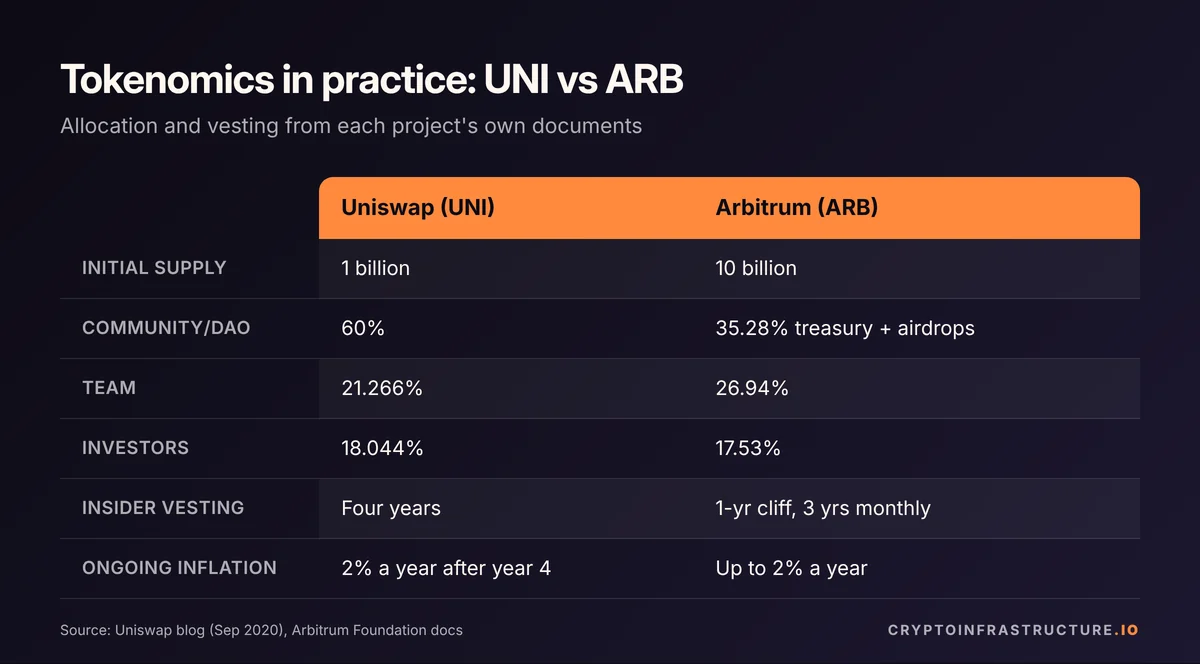
Both tables read from the projects’ own documents on 14 October 2026. Uniswap’s community breakdown as published (15% airdrop plus 43% treasury) adds up to 58% of the 60% community share; the post does not explain the other 2%, beyond describing liquidity mining of 5 million UNI per pool across four pools.
What to take from these, rather than copy: both projects put roughly 40 to 45% with insiders and the rest with community programmes, both locked insiders for four years, and both kept a small ongoing inflation option for the DAO. What the tables do not tell you is how much of the “community” share is actually controlled by a foundation or a small group of voters, which is the question worth asking of any allocation chart.
Smaller and newer launches often add lines these two lack, such as market-maker loans, exchange listing allocations and paid influencer rounds. The KOL guide explains how KOL rounds and influencer deals work, and the memecoin guide covers the opposite extreme: tokens with no vesting at all, where supply concentration is the main risk.
Vesting, cliffs and unlock schedules
Vesting is the schedule on which locked tokens become the holder’s to move or sell. Three building blocks describe almost every schedule:
- Cliff: a waiting period with no releases. When it ends, the amount that has accrued so far usually releases at once. Arbitrum’s insider cliff was one year from TGE.
- Linear (continuous or monthly) release: equal amounts every block, day or month after the cliff. Arbitrum used monthly unlocks for the remaining three years.
- TGE unlock: a percentage released the moment the token launches, common for public sale and airdrop buyers.
What is a token unlock?
A token unlock is the moment previously locked tokens become transferable. It does not create new tokens; it moves existing ones from locked to circulating. Whether an unlock matters depends on its size relative to what already circulates, not relative to total supply.
Worked example (hypothetical numbers)
The figures below are invented to show the maths. They are not taken from any real token.
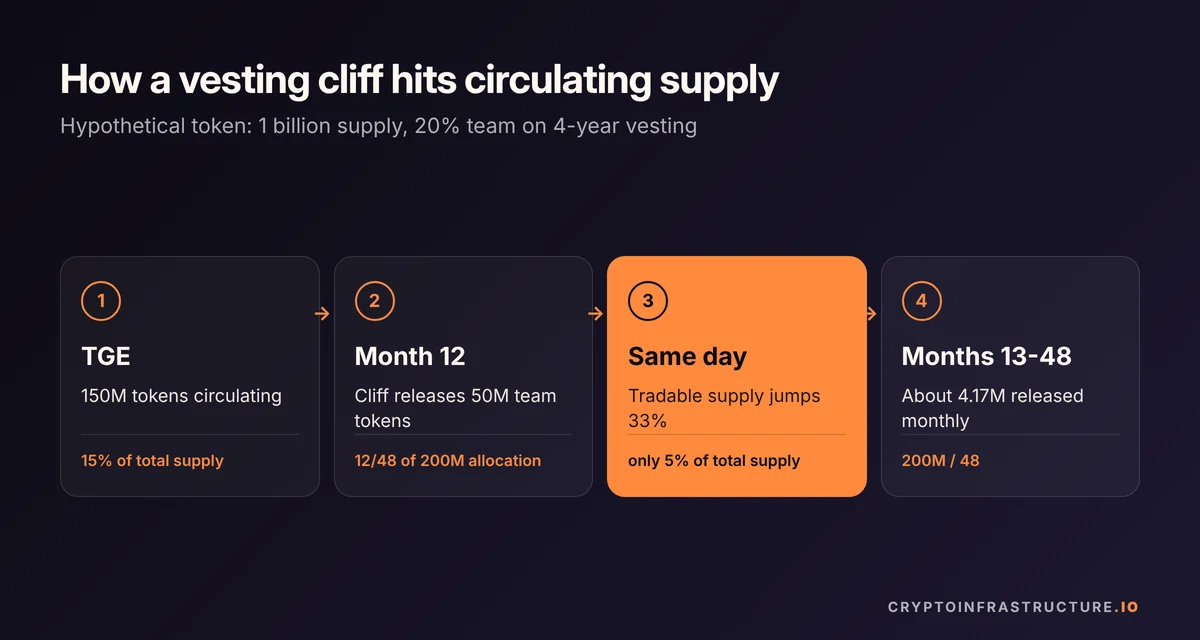
- Total supply: 1,000,000,000 tokens. Circulating at TGE: 150,000,000 (15%).
- Team allocation: 200,000,000 (20%), four-year vesting with a one-year cliff, accrued amount released at the cliff, then monthly.
- At month 12 the cliff releases 12/48 of the team allocation: 50,000,000 tokens. Against 150,000,000 circulating, that is a 33% increase in tradable supply on one day, even though it is only 5% of total supply.
- From month 13 to month 48, about 4,170,000 tokens release each month (200,000,000 / 48).
This is why the same “20% team, four-year vest” headline can mean very different things depending on how much floats at launch. A low float at TGE makes every later unlock larger in relative terms.
How unlocks are tracked
- Start with the project’s own allocation and vesting table in its docs or white paper, like the two linked above.
- Find the vesting contracts. On-chain vesting is enforced by contracts whose balances and release functions you can read on a block explorer. Off-chain promises (a spreadsheet or a legal agreement) cannot be checked this way, and you should treat them as weaker.
- Use an unlock tracker as a calendar, not as the source. Services such as Tokenomist describe tracking cliff and linear unlocks from on-chain and off-chain sources, and label some entries as projections from a vesting schedule. Its API notes say ongoing emissions such as mining and staking rewards are excluded from unlock schedules, so you need to add those yourself.
- Express each unlock as a percentage of circulating supply and note who receives it (team, investors, ecosystem fund), since recipients differ in how likely they are to sell.
Emissions and sinks
Emissions are new tokens created after launch: block rewards, staking rewards, liquidity mining and treasury inflation. Sinks remove tokens or lock them away: fee burns, buy-and-burn programmes, staking lockups and fees paid to the protocol. Net supply growth is emissions minus sinks.
- Bitcoin: emissions only, shrinking by halving, with no burn.
- Ether: about 0.52% a year in validator issuance against a fee burn that rises with network use (ethereum.org).
- UNI and ARB: optional inflation of up to 2% a year controlled by governance, per their documents.
Two points that ranking pages tend to skip. First, a burn only offsets supply if fees are paid in the token; a burn funded by the treasury buying tokens is a spending decision that can stop. Second, staking rewards paid in the same token are emissions, not income created from nowhere: holders who do not stake are diluted.
Utility and governance
Utility is what the token does: paying fees (ETH for gas), securing a network through staking, granting votes over a treasury or protocol parameters (UNI and ARB are governance tokens), or giving access to a service. Governance design questions include how many tokens are needed to make a proposal, how votes are counted, whether insiders’ unvested tokens can vote, and what the DAO can change on its own, such as switching on the inflation both UNI and ARB allow.
Utility also has a legal side. The more a token’s value depends on a team’s continuing work and promises, the more it looks like an investment in that team, which is the next section.
How to design tokenomics: a section for token teams
If you are on a token team, tokenomics is a product, legal and treasury decision at once. Work through it in this order.
1. Start from what the token must do
Write one sentence on why the network needs a token at all (fees, staking security, governance, access). If the only answer is fundraising, expect regulators to treat it as a fundraising instrument.
2. Set supply and emissions together
Decide fixed cap or ongoing issuance, then model circulating supply month by month for at least four years, with every allocation, cliff, unlock and emission on one chart. Publish the model, not only a pie chart.
3. Allocation and vesting
- Put team and investors on schedules at least as long as the work you are asking the market to rely on; Uniswap and Arbitrum both used four years.
- Use on-chain vesting contracts so anyone can verify releases.
- Keep the TGE float in view: a very low float makes every later unlock heavy, as the hypothetical example shows.
- Disclose every special allocation (market makers, exchange listings, KOL rounds) with its own vesting terms.
4. US legal design: the Howey framing in 2026
US law still asks the question from the Supreme Court’s Howey case: is there an investment of money in a common enterprise with an expectation of profits from the efforts of others? What has changed is how the SEC applies it to tokens.
- 17 March 2026: the SEC issued a Commission interpretation, joined by the CFTC, that sorts crypto assets into digital commodities, digital collectibles, digital tools, stablecoins and digital securities (SEC press release 2026-30). Chairman Paul Atkins said “investment contracts can come to an end”: a token that is not itself a security can still be sold under an investment contract, and stops being subject to it once the issuer’s promises are fulfilled or end.
- The 2019 framework is withdrawn. The SEC staff’s April 2019 “Framework for Investment Contract Analysis of Digital Assets” is marked withdrawn and superseded by the March 2026 interpretation. Its factors are still a useful design checklist of what looks like an investment: a team that controls supply and the market for the token, marketing that stresses price, raising more than the network needs, and selling broadly to investors rather than users.
- 18 August 2026 proposal: the SEC proposed “Regulation Crypto Assets”. According to Lowenstein Sandler’s 20 August 2026 summary, it includes a startup exemption of up to $5 million over four years, a fundraising exemption of up to $20 million (Tier 1) or $75 million (Tier 2, audited financials) in 12 months, required disclosures that include “supply mechanics”, “token allocations and vesting” and governance, and a Rule 400 safe harbour under which an issuer that completes or stops its promised managerial efforts files a Form TR. It is a proposal, not a final rule.
- Congress: the CLARITY Act, which would add a statutory “mature blockchain” test, is not law as of 14 October 2026. See the CLARITY Act guide for its status.
The design consequence: the same allocation and vesting tables you build for the market are becoming required disclosure in the US proposal, and promises about what the team will build are what tie the token to an investment contract. Keep promises specific and finite, and do not market the token on price.
5. EU legal design: MiCA white-paper duties
Regulation (EU) 2023/1114 (MiCA) sets the rules for offering tokens that are not stablecoins to the public in the EU. Its recitals summarise the duties:
- Offerors should be legal persons, and must notify a crypto-asset white paper to their national competent authority before any public offer in the EU.
- The white paper is a mandatory disclosure document covering the issuer, the project, the rights attached to the token, the underlying technology and the risks, plus climate-related information on the consensus mechanism. Authorities do not approve it in advance.
- The white-paper duty does not apply to offers to fewer than 150 persons per member state, offers with total consideration of no more than EUR 1,000,000 over 12 months, or offers only to qualified investors.
- Retail buyers get a right of withdrawal for 14 days after acquisition, and offerors and their management body face civil liability for the information in the white paper.
Stablecoins sit under separate MiCA rules; the stablecoin regulation guide covers them. In practice, your allocation table, vesting terms and emissions model belong in the white paper, so the legal team needs them early, not after launch.
6. Design checklist
- One-sentence reason the token must exist, not counting fundraising.
- Fixed cap or issuance policy written down, with who can change it.
- Allocation table that adds to 100%, with every special allocation named.
- Vesting terms per group: TGE unlock, cliff length, release frequency, total duration.
- Vesting enforced by on-chain contracts, with addresses published.
- Month-by-month circulating supply model for at least four years, including emissions.
- Largest single unlock as a percentage of circulating supply on that date.
- Sinks described honestly: protocol-enforced burns separated from discretionary buybacks.
- Governance: proposal thresholds, whether unvested tokens vote, what the DAO can change.
- US review against the March 2026 interpretation and, if you raise money, the August 2026 proposal’s exemptions and disclosures.
- EU review: whether an exemption applies, otherwise a MiCA white paper notified before the offer.
- Marketing review: no price claims, no yield promises, paid promotion disclosed.
Common tokenomics red flags
- Allocation table with no vesting terms, or insiders unlocking in months rather than years.
- Very low TGE float with large unlocks scheduled soon after.
- Vesting described only in a document, with no on-chain contract.
- Undisclosed allocations to market makers, exchanges or influencers.
- A “community” allocation controlled in practice by the team or foundation.
- Yield paid in the same token, presented as income.
- No white paper for an EU public offer that does not fit an exemption.
What this means for you
- Reading a token: find the project’s own allocation and vesting table, check that vesting is on-chain, and express upcoming unlocks as a share of circulating supply, not total supply.
- Designing a token: build the supply model, allocation and vesting before marketing, assume they will be public disclosures in both the US and EU, and keep team promises specific and finite.
- Everyone: recheck the US position before relying on it; the August 2026 SEC proposal is not final and the CLARITY Act is not law as of 14 October 2026.
For launch platforms and token-design advisers, see the Token Launchpads & Tokenomics section, and for how this site sources and dates its facts, the methodology.